
When you get insurance for a jewelry store, you’re probably thinking about outside threats—a fire, a storm, or a break-in. Your commercial property insurance is built to handle those exact scenarios. But what happens when the threat comes from within?
What if your high-tech security system suddenly shorts out, or the custom ventilation for your workshop seizes up on a hot summer day? That’s where equipment breakdown coverage comes in. Think of it as a specialized policy for the sudden and accidental internal failure of your most critical machinery.
It’s not for wear and tear; it’s for the unexpected, catastrophic meltdowns that can bring your business to a grinding halt.
The Foundation of Your Business Protection
Your standard property policy is your first line of defense against external events. It’s essential. But it has a built-in blind spot: it almost always excludes damage from things like mechanical failure, power surges, and electrical shorts.
This is a massive gap for any modern jeweler. Your jewelry business relies on a complex ecosystem of equipment—from HVAC and point-of-sale systems to specialized casting machines and ultrasonic cleaners. An internal failure in any one of these can be just as devastating as a fire.
Why Standard Policies Fall Short
A general insurance policy just isn't designed to cover the internal collapse of a machine. This distinction is critical for a jeweler, where the right equipment is the very heart of your operation.
The global market for this type of insurance, valued at USD 7.35 billion, is a testament to how crucial this protection is. It's projected to hit USD 12.59 billion by 2031, with businesses in North America making up over 40% of that demand. That growth is fueled by businesses just like yours that can't afford to be sidelined by equipment failure. You can dive deeper into these trends in this detailed industry report.
To make the difference perfectly clear, let's look at how these two policies stack up side-by-side.
Equipment Breakdown vs Commercial Property Insurance at a Glance
| Coverage Aspect | Commercial Property Insurance | Equipment Breakdown Coverage |
|---|---|---|
| Primary Focus | Protects against external perils like fire, theft, and wind. | Covers internal failures like power surges and mechanical breakdown. |
| Typical Covered Event | A fire damages your building and its contents. | A power surge fries your point-of-sale and security systems. |
| Key Exclusion | Excludes damage from internal mechanical or electrical failure. | Excludes damage from external events and normal wear and tear. |
| Analogy | A shield protecting your business from outside attacks. | A "warranty" for the internal mechanics of your equipment. |
This table shows why you can't rely on one policy to do the job of another. They are two distinct, yet complementary, pillars of a truly resilient insurance strategy.
This coverage is not just about fixing a broken machine; it’s about preserving your business's ability to operate and generate income. It protects your cash flow when a sudden failure threatens to shut you down.
Bridging the Coverage Gap
Without this specific protection, you’re left paying out-of-pocket for some incredibly expensive repairs or replacements. Imagine your casting machine suddenly failing or your secure vault’s climate control system going down. Those aren't small fixes.
This is why understanding what equipment breakdown coverage is becomes a foundational step in building a strong insurance plan. It works hand-in-hand with a core policy like Jewelers Block insurance, which protects your high-value inventory. Together, they ensure that both your precious stock, like a beautiful diamond ring, and the essential systems that protect it are fully covered.

What Types of Failures Are Actually Covered
To really get what equipment breakdown coverage is, you have to look past the dense policy wording and think about real-world meltdowns. This isn't insurance for the slow, predictable decay of machinery over time. It’s for the sudden, internal, and completely accidental failures that bring your jewelry business to a screeching halt.
Typically, it boils down to five main types of failure. Each one represents a serious threat to your day-to-day operations, capable of tanking your sales, damaging your reputation, and costing you a fortune. Let's walk through exactly what’s covered, using examples pulled straight from the jeweler's workshop.
Mechanical Breakdown
This one is the most straightforward. Think about all the moving parts inside your equipment—the gears, motors, bearings, and belts. When one of these critical components suddenly gives out, snaps, or seizes up, that’s a mechanical breakdown.
For a jeweler, this might look like the motor on your centrifugal casting machine burning out right in the middle of a custom job, ruining the mold and stopping production cold. Or it could be a key bearing in your polishing lathe freezing up, instantly taking one of your most essential finishing tools out of commission.
Electrical Failure
Modern jewelry businesses are powered by electricity, and this coverage steps in when something goes wrong inside your equipment. We're talking about power surges, short circuits, and electrical arcing that can fry sensitive electronics in a heartbeat.
Picture this: it's the middle of the holiday rush, and a sudden short circuit in your point-of-sale (POS) terminal bricks the entire system. Another classic example is a power surge that wipes out the delicate circuitry in your high-tech security cameras, leaving your vault and display cases dangerously exposed.
This coverage is designed for the unexpected pop, sizzle, or bang that signals an internal electrical catastrophe. It's the moment a machine that worked perfectly an hour ago suddenly goes dark.
The explosive growth in the equipment breakdown insurance market shows just how vital this protection is. Market data reveals that machinery breakdown accounts for 40% of claims, with electrical and mechanical at 35%, and resulting property damage at 25%. The electrical segment alone was valued at over USD 15 billion historically. This coverage fills a critical gap, covering not just the repair bills but also the lost income from downtime, which can easily stretch for weeks while you wait for custom parts. You can find more data on these market trends in this detailed industry analysis.
Pressure Systems Failure
Lots of jewelry workshops rely on equipment that uses pressure or vacuum systems, like steam cleaners for finishing or casting machines. This part of the policy is built for the sudden and violent rupture, implosion, or collapse of those pressurized vessels.
A perfect example is when a high-pressure steam cleaner used for getting that final sparkle on a piece suddenly ruptures. An event like that doesn't just destroy the machine; it creates a serious safety hazard for anyone in the workshop. The damage to the unit itself would be a covered loss.
Electronic Derangement
This failure is a bit more subtle but can be just as devastating. Electronic derangement is what happens when a piece of electronic or computerized equipment stops working correctly, but there’s no visible physical damage. The machine just… glitches out.
Think about your computerized engraver suddenly going haywire and failing to follow its programmed path, ruining a client's irreplaceable heirloom. Or what if your digital diamond grading microscope's software corrupts, making it impossible to accurately assess your stones? That's exactly what electronic derangement coverage is for.
Operator Error
This one might surprise you, but some policies will actually cover breakdowns caused by a simple mistake. As long as the employee’s action was sudden and accidental, the resulting damage could be covered. This is a huge benefit, because in a busy workshop, mistakes are bound to happen.
For instance, an employee might briefly set a laser welder to the wrong power level, causing an internal component to overload and fail. While not every policy includes this, it’s a great example of how this insurance can protect you from a wider range of real-world operational risks.
Common Policy Exclusions You Should Know
To really get what equipment breakdown coverage is, you have to know its limits. Just like any insurance policy, this one has specific exclusions built in to keep it focused. Knowing what isn't covered is just as important as knowing what is—it’s how you avoid nasty surprises and make sure your jewelry business has a complete safety net.
The biggest rule to remember is that this coverage is for sudden and accidental internal failures. It’s not for predictable problems that pop up over time. Think of it as a policy for the unexpected catastrophe, not the slow, inevitable decline of aging machinery. That single distinction is at the heart of most common exclusions.
Why Normal Wear and Tear Isn't Covered
Let's say the belts on your polishing machine have been slowly fraying for years, or the motor in your ventilation system just doesn't have the same power it did a decade ago. That’s normal wear and tear—the expected aging process for any machine that gets regular use.
Insurance sees these things as routine maintenance and operational costs, not sudden breakdowns. It’s designed to shield you from unforeseen risks, and the gradual aging of your equipment is a predictable expense. It's something you're expected to manage with good upkeep and a plan for eventual replacement.
An equipment breakdown policy is like an airbag for your machinery; it’s there for a sudden, unexpected impact, not to replace your tires when the tread wears thin.
This same logic applies to related issues like rust, corrosion, decay, or gradual cracking. These are all slow-moving problems that a solid maintenance schedule can usually catch and fix long before they become catastrophic.
External Perils and Other Insurance Policies
Another huge category of exclusions involves damage from the outside world. Your equipment breakdown policy is designed to handle problems that start inside your machines. When an external event causes damage, that’s a job for other policies in your portfolio, usually your commercial property or Jewelers Block insurance.
Here are a few clear-cut examples of what’s typically excluded for this reason:
- Fire and Flood: If a fire tears through your workshop and destroys your casting machine, your commercial property policy is the one that responds, not your equipment breakdown coverage.
- Theft and Vandalism: If a burglar breaks in and smashes your POS system, the claim falls under the theft or vandalism peril in your property policy.
- Windstorms and Natural Disasters: Damage from a hurricane, earthquake, or other act of God is a classic external event covered by your property insurance.
This separation of duties is completely intentional. It makes sure there are no overlaps or gaps, letting each policy do its specific job. Your property insurance protects your business from outside threats, while equipment breakdown coverage protects your machinery from itself.
The Importance of Maintenance and Proper Use
Finally, these policies won't cover damage that results from neglect or intentional misuse. If a piece of equipment fails because you deliberately ignored the manufacturer's required maintenance schedule for months on end, the insurer could rightfully deny the claim.
The same goes for intentionally damaging equipment or using it for something it was never designed to do. At First Class Insurance Jewelers Block Agency, we can help you see how a proactive maintenance plan doesn't just prevent breakdowns—it actually strengthens your entire insurance profile, making sure you're covered when you really need it. You can Get a Quote for Jewelers Block and we can walk you through how all these coverages fit together.
Real-World Claim Scenarios for Jewelers
Policy language and theory can only take you so far. To really get a handle on what equipment breakdown coverage is—and why it’s a critical piece of your jewelry store insurance—you have to see it in action.
Let's step away from the definitions and walk through a few real-world situations that could hit any jeweler, on any given day. These stories show just how quickly a single internal failure can cascade into a financial mess, and how the right coverage steps in to make things right.
Scenario 1: The Vault Lock Failure
It’s Tuesday morning, and you’re ready for a busy day. You punch the code into your high-security vault’s electronic lock… and nothing. You try again. The heavy door stays stubbornly sealed.
A frantic call to a technician confirms your worst fear: an overnight power surge completely fried the lock's internal motherboard. Your entire day's inventory, including pieces for scheduled client appointments, is locked away. The financial fallout starts right now.
- Emergency Repair Costs: You need an emergency locksmith and a vault specialist to manually override the lock and replace the fried electronics, all at premium, last-minute rates.
- Business Interruption: You can't sell what you can't access. High-value client appointments get canceled, which hurts both your reputation and your bottom line.
- Extra Expenses: You might even have to hire temporary security to watch the vault until the new system is installed and fully functional.
Without coverage, you’d be on the hook for thousands in repairs, not to mention all the lost income. With an equipment breakdown policy, you'd be covered for the cost of repairing or replacing the lock system and the lost business income from the shutdown.
Scenario 2: The Mid-Production Casting Disaster
Your workshop is buzzing, right in the middle of casting a complex custom order of platinum wedding rings. Suddenly, your centrifugal casting machine makes a sickening crunch and shudders to a stop. That unmistakable smell of burnt wiring hangs in the air. The main motor just seized and burned out.
This is more than a delay; it's a production catastrophe. The custom mold is ruined mid-spin, the platinum is now a useless lump, and the wedding is fast approaching.
A single mechanical failure can do more than just break a machine; it can break a promise to a client. This coverage protects your equipment, your materials, and your professional reputation when the unexpected happens.
Here’s how equipment breakdown coverage would jump in:
- Repair or Replacement: The policy would pay to fix the motor or, if it’s beyond repair, replace the entire casting machine with a comparable one.
- Spoilage: It could also cover the value of the platinum and other materials destroyed when the machine suddenly failed.
- Expediting Expenses: To hit that client's deadline, you need that new motor yesterday. The coverage can pay the extra fees for rush shipping on replacement parts, getting you back up and running much faster.
Scenario 3: The Showroom Climate Catastrophe
A brutal summer heatwave has the city sweltering. Right in the middle of the afternoon rush, your commercial HVAC system dies with a loud clank. The AC is gone, and the temperature in your showroom starts climbing—fast.
This creates two immediate, serious problems for your insurance for jewelry business. First, customers start heading for the door; the stuffy heat is killing the luxury experience. Second, some of your inventory—delicate pearls and opals—are sensitive to extreme temperature shifts, putting them at risk of damage. Much like fine watches, even small environmental changes can affect these precious items, which you can read more about in our guide to protecting high-value assets.

The financial damage is swift and comes from all sides.
- Lost Sales: A hot, uncomfortable showroom is a sales killer. It completely shatters the high-end atmosphere you’ve worked to build.
- Repair Costs: Fixing a commercial HVAC unit is never cheap. You could be looking at a multi-thousand-dollar bill to replace a compressor or the entire unit.
- Inventory Risk: If the intense heat damages any of those temperature-sensitive stones, you’re looking at a direct loss of valuable assets.
In this situation, equipment breakdown coverage would handle the cost of repairing the HVAC system. On top of that, its business interruption component would help reimburse you for the net profits you lost while the showroom was effectively closed by the unbearable heat.
How This Coverage Strengthens Your Jewelers Block Policy
A Jewelers Block insurance policy is the absolute bedrock of any solid insurance for a jewelry store. It’s built to do one thing exceptionally well: protect your most valuable asset—your inventory—from risks like theft, loss, and damage.
But what protects the systems that protect your inventory? That's where things get interesting, and where understanding the teamwork between Jewelers Block and equipment breakdown coverage becomes critical.
Think of it like this: your vault is a fortress, and your Jewelers Block insurance policy covers the priceless jewels inside. But what if the vault’s high-tech electronic lock suddenly fries itself from an internal power surge? The vault wasn't cracked by a thief, so a standard theft claim might not fit. But you're still locked out, your business is at a standstill, and you're staring down a huge emergency repair bill.
This is the exact gap that equipment breakdown coverage is designed to fill. It acts as a powerful endorsement to your core Jewelers Block insurance, protecting the operational machinery that your entire business relies on.
Creating a Comprehensive Protective Shield
At First Class Insurance Jewelers Block Agency, we see these two policies as puzzle pieces. When they click together, they create a seamless shield around your business. One policy guards the treasure, and the other guards the fortress and all its complex systems. Integrating them isn't just a smart move; it’s a non-negotiable part of modern risk management for any jewelry business.
The connections are direct and undeniable:
- Security Systems: Your alarms, cameras, and electronic locks are your first line of defense. An electrical short in these systems creates an open invitation for criminals, which can lead directly to a massive Jewelers Block claim.
- Climate Control (HVAC): Many precious materials, like pearls and opals, are extremely sensitive to heat and humidity. If your HVAC system suddenly quits, it can cause subtle but incredibly costly damage to your inventory—something your equipment coverage is built to handle.
- Workshop Machinery: A breakdown in your casting or polishing equipment not only stops production but could also ruin a custom piece midway through creation. This coverage can pay for the machine repair while your Jewelers Block insurance policy addresses the damaged item.
Integrating equipment breakdown coverage with your Jewelers Block insurance policy transforms your insurance from a simple safety net into a proactive operational shield. It closes dangerous gaps that could otherwise leave your business exposed to significant financial loss.
A Unified Approach to Risk and Claims
When you bundle these coverages with a single, expert agency, everything gets simpler. Imagine a security panel shorts out, leading to a break-in. You avoid the headache of a dispute between two different insurance carriers arguing over which policy has to respond first.
Instead, you have one point of contact who gets the full picture of your business and can manage the claim without the runaround.
Equipment breakdown coverage has come a long way from its early days of just inspecting boilers. Today, it addresses modern threats like cyber-attacks on computerized controls and the power fluctuations that can destroy delicate jewelers' tools. Since small businesses make up 99.2% of all enterprises, ignoring this protection can be a fatal error. In fact, UK data shows that a staggering 60% of small and medium-sized enterprises don't have the cash reserves to survive a major equipment failure. You can see more on how this coverage is adapting to new risks on businessresearchinsights.com.
By partnering with trusted underwriters, including those associated with renowned names like the one represented by this Lloyd's of London logo, we can build a policy that gives you genuine peace of mind. We invite you to Get a Quote for Jewelers Block and see how easily this essential protection can be added, ensuring both your priceless inventory and critical machinery are fully secured.

Proactive Steps to Reduce Your Risk
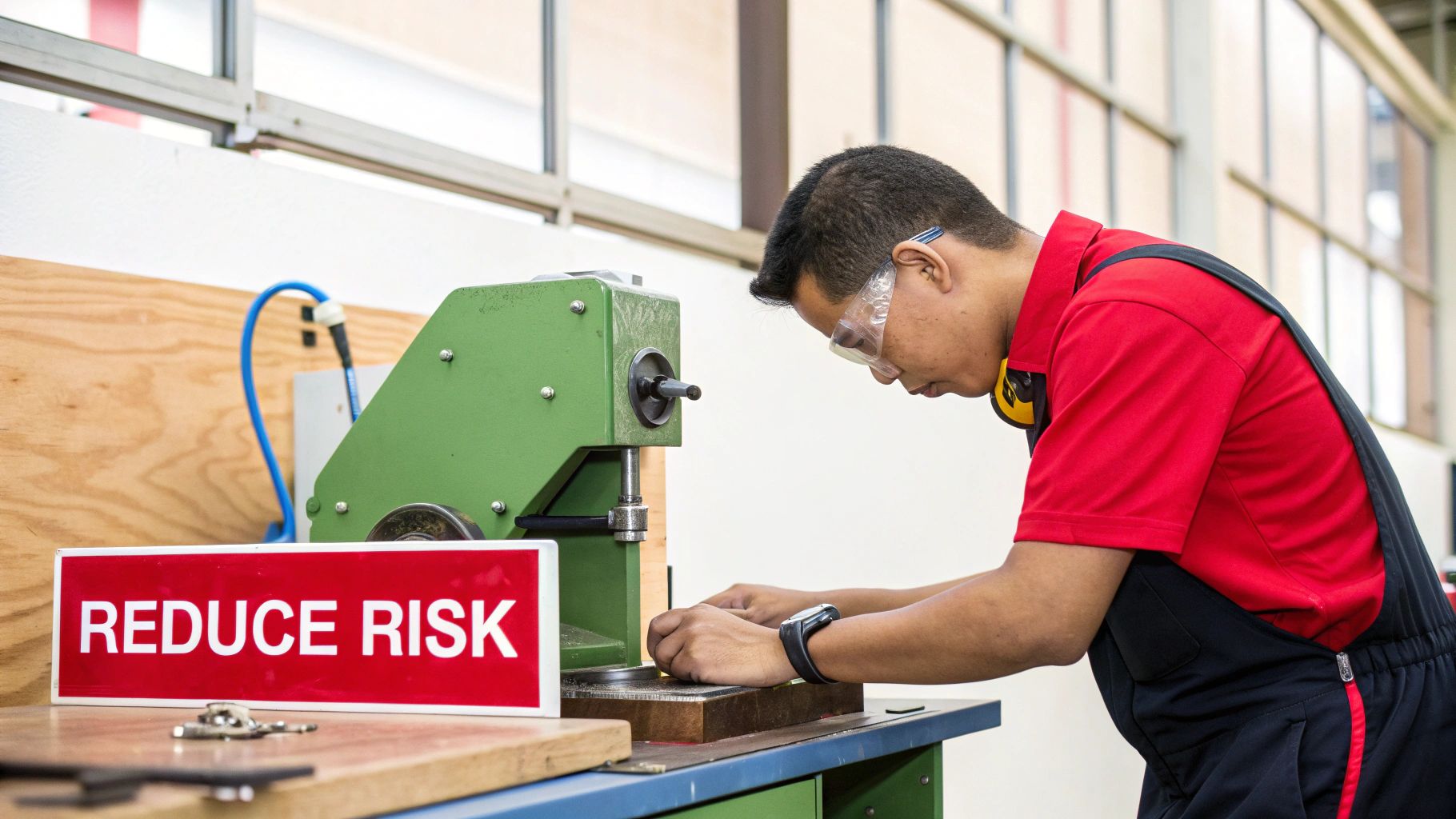
While having the right insurance for a jewelry store is critical, the best possible outcome is always preventing a breakdown in the first place. When you take proactive steps, you’re not just minimizing downtime—you’re also sending a clear signal to insurance underwriters that you’re a responsible, low-risk partner.
This commitment can often lead to better terms and a much smoother relationship with your insurer. Here at First Class Insurance Jewelers Block Agency, we believe in empowering our clients to be as resilient as possible. Let’s walk through some practical measures you can take to protect your business-critical equipment.
Implement a Preventive Maintenance Schedule
The single most powerful way to head off sudden equipment failures is a consistent, documented maintenance program. Just waiting for a machine to fail is a reactive, and frankly, very expensive strategy. A proactive approach always wins.
For a jeweler, implementing preventative maintenance programs is absolutely essential. This isn't just about your casting machines and polishers; it includes scheduling and tracking regular service for all your critical systems—from the HVAC units that protect your sensitive inventory to your digital security systems.
A well-documented schedule is proof that you’re actively working to mitigate risks, and that's something underwriters look for.
Invest in Protective Hardware and Training
Beyond routine check-ups, there are some smart, practical steps you can take to shield your equipment from the most common causes of failure. These are often simple, one-time investments that can save you from major headaches later on.
- Commercial-Grade Surge Protectors: This is non-negotiable. Install them on all your sensitive electronics, including your POS systems, computers, and digital security controls. It’s your best defense against damaging electrical surges.
- Regular Staff Training: Operator error is a huge source of mechanical stress and premature failure. Make sure every team member is properly trained on the correct startup, operation, and shutdown procedures for every piece of equipment in your workshop and showroom.
- Keep Detailed Service Logs: Maintain a clear, accessible logbook for every major piece of equipment. Record every service date, repair, and observation. This data is priceless for troubleshooting and shows a history of responsible ownership.
Taking these proactive steps transforms your approach from simply buying insurance to building a culture of risk management. It’s an investment in your business's long-term stability and success.
Ultimately, these measures are about more than just checking boxes off a list. They are foundational to running a secure and efficient jewelry business. By actively lowering your risk profile, you not only prevent costly claims but also position your operation as a preferred client for top-tier insurers. This responsible approach is fundamental to securing the best possible insurance for a jewelry store, ensuring you are protected on all fronts.
Frequently Asked Questions About This Coverage
Digging into the details of insurance for a jewelry business always brings up a few key questions. Once you understand the basics of equipment breakdown coverage, it's smart to clarify the finer points. Here are the straight-up answers to the questions we hear most often from jewelers.
My Property Insurance Covers My Building, So Why Do I Need This?
This is probably the most common—and most important—question we get. Think of it this way: your commercial property policy is designed to protect you from external threats. It’s for things like a fire, a hurricane, or a break-in.
But what it won't cover are internal failures. If a motor in your ventilation system seizes up or an electrical surge inside your ultrasonic cleaner fries its circuits, your property policy won't touch it. Equipment breakdown coverage is specifically built to fill that gap, covering the machinery itself when it suddenly and accidentally fails.
Does This Coverage Replace My Old Machine With A Brand New One?
That depends on your policy, but most modern plans are written for replacement cost value. This is a huge benefit. It means your policy will pay to replace your broken equipment with a brand-new, comparable model, without docking you for the years of wear and tear.
Some older or more basic policies might use "actual cash value," which does subtract for depreciation. This is a critical detail to confirm with your agent at First Class Insurance Jewelers Block Agency so you know exactly what to expect if you ever have to make a claim.
What About The Income I Lose While My Equipment Is Down?
This is where the policy truly proves its worth. A good equipment breakdown policy includes Business Interruption coverage, which acts as a financial lifeline when a critical machine fails.
This feature is designed to replace your lost net profits and cover ongoing operating expenses—like rent, payroll, and utilities—that don't stop just because your casting machine is out of commission. It's also a good reminder that proactive safety pays off; using tools like a comprehensive workplace fire safety checklist can help minimize risks across the board.
Is My Vintage Jewelry-Making Equipment Eligible For Coverage?
It absolutely can be, but it's a more specialized situation. For older or one-of-a-kind machinery, an underwriter will want to see its maintenance history and overall condition. They need to know that parts are still available and that the equipment has been well cared for.
Insuring unique equipment isn't a one-size-fits-all deal. The more information you can provide about your vintage tools—service records, recent inspections, photos—the easier it is for your agent to find a carrier willing to write the policy.
The best strategy is to give your agent a detailed inventory of every key piece of equipment in your workshop. That way, we can make sure every asset, from your new laser welder to your grandfather’s rolling mill, is properly protected as part of a complete insurance for a jewelry store plan.
Protecting your business requires a partner who understands every facet of your industry. At First Class Insurance, we specialize in creating complete insurance solutions that guard your inventory, your operations, and your peace of mind. Let our experts build the right plan for you. Get a Quote for Jewelers Block today and secure your business's future.