
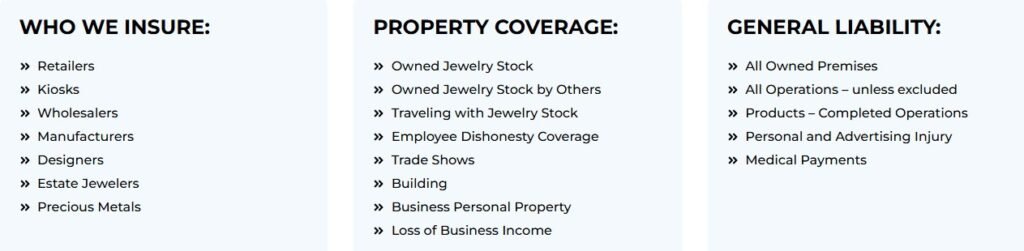
When it comes to protecting your inventory, UL safe ratings are the industry's gold standard. These certifications from Underwriters Laboratories (UL) aren't just a suggestion; they're an objective, non-negotiable benchmark that tells you exactly how a safe will perform against a determined attack or an intense fire. For any jeweler seeking Jewelers Block insurance, understanding these ratings is step one.
Why UL Safe Ratings Are a Jeweler's Best Friend
Picture this: your annual jewelry store insurance renewal is coming up. Your agent at First Class Insurance gives you a call, and one of the first things they ask is, "What's the UL rating on your safe?"
This isn't just a box to check. It’s probably the single most important question that will shape your coverage and premiums. For any insurance for a jewelry business, the safe isn't just a piece of heavy equipment—it's the core of your entire security plan.
A safe without a UL rating is a total mystery box. It might look impressive, but you have no real idea how it will hold up against a skilled burglar with modern tools. UL ratings cut through that uncertainty. They provide a universal language of security that underwriters around the world recognize and trust.
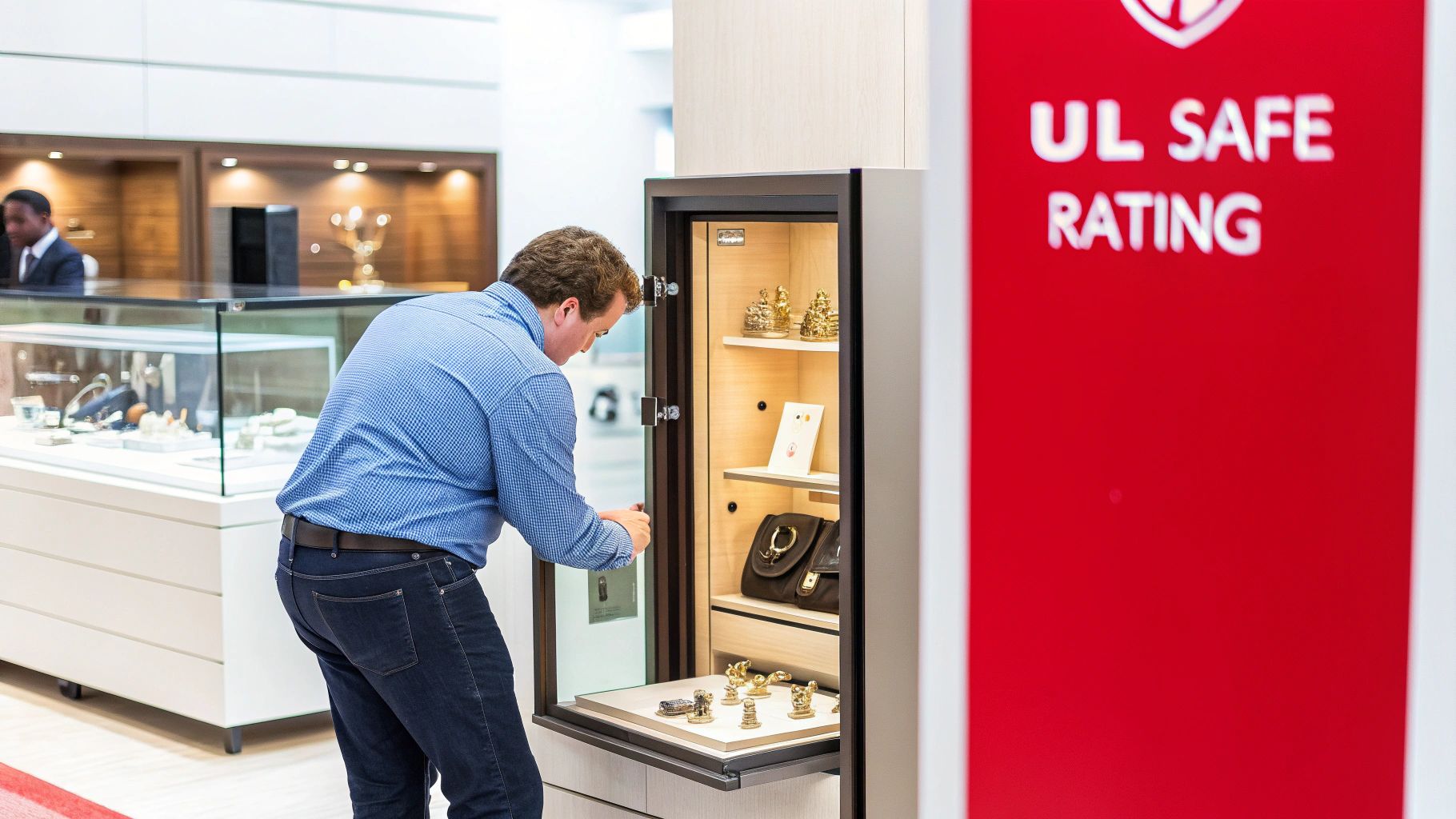
The Link Between Your Safe and Your Premium
Think of that UL tag as a verified report card for your safe. When an underwriter looks at your application for insurance for a jewelry store, their job is to calculate risk. A certified safe gives them hard data, proving it can protect your high-value inventory from a catastrophic loss.
This has a direct and immediate impact on your business:
- Lower Premiums: A higher UL rating signals lower risk, which almost always means more competitive insurance costs.
- Higher Coverage Limits: Insurers are far more willing to cover high-value inventories when they know the assets are locked away in a properly rated safe.
- Claim Confidence: If the worst happens, having a UL-rated safe that meets your policy’s requirements is critical for making sure your claim gets paid smoothly and without hassle.
A common mistake we see is jewelers assuming that sheer weight and thick steel mean top-tier security. The reality is, many heavy-looking safes can be opened quickly with the right tools. A UL rating is the only real proof of a safe's ability to resist a professional attack.
Ultimately, choosing the right UL-rated safe is one of the smartest financial decisions you can make. It's not just an expense; it's a foundational asset that protects your inventory, your reputation, and your ability to secure the best possible Jewelers Block insurance. You can see the kinds of assets we help protect, like this beautiful diamond ring on a black background, in our gallery.

Figuring out these requirements can feel overwhelming, but you don't have to go it alone. The experts at First Class Insurance are here to walk you through it. When you're ready to secure your business, Get a Quote for Jewelers Block and let us help you find the perfect coverage.
Decoding UL Burglary Ratings From TL-15 to TRTL-60
When you look at a UL-certified safe, that string of letters and numbers on the label might seem like a secret code. But for a jeweler, this is the most important language you can learn to protect your business. These ul safe ratings aren’t just arbitrary labels; they're the result of intense, hands-on testing that tells you exactly how much punishment a safe can take.
Think of it as a fortress's defense level. The code is actually pretty simple once you break it down into its two core components: Time and Tools. A basic rating means it can hold off common tools for a short period, while an advanced rating means it can withstand a prolonged, brutal assault from experts using powerful equipment.
For over 80 years, Underwriters Laboratories (UL) has been the gold standard for safe certification in North America, becoming the most trusted independent testing organization in the industry. Their reputation is so solid that insurance companies specializing in jewelers block coverage often demand UL certification as a non-negotiable part of their policies. This requirement directly impacts your coverage limits and what you pay in premiums.
Understanding the Language of UL Ratings
The most common burglary ratings you’ll encounter are part of the "TL" and "TRTL" series. Each part of that code tells you something specific about how tough the safe really is.
Let's break down the alphabet soup:
- TL: Stands for Tool Latency. This means the safe was tested against a barrage of common hand tools, picking tools, power drills, grinders, and saws.
- TR: Stands for Torch Resistance. A safe with this rating has proven it can stand up to attacks from high-temperature cutting torches.
- TX: This one is less common, but it stands for Explosive Resistance. It signals the safe can withstand a specific amount of nitroglycerin.
The number following these letters tells you the net attack time in minutes. For example, a TL-15 rating means the safe can fight off a tool-based attack for at least 15 minutes. A TRTL-30 rating means it can resist both torches and tools for 30 minutes.
The Brutal Reality of UL Testing
It's critical to understand that "net attack time" isn't the same as watching the clock for 15 or 30 minutes. The timer only runs when the testing team is actively grinding, drilling, or prying the safe. Any time spent changing tools, studying the blueprints, or taking a breather doesn't count.
A 15-minute UL test can easily take an hour or more in real-world time. The testing team is made up of experts who know exactly where a safe’s weak points are. They get the blueprints and can use any tool in their arsenal to try to get inside.
This grueling process ensures that a UL rating reflects a safe's true ability to protect your inventory in a worst-case scenario. It’s not about how long it would take an amateur to break in; it’s about how long it takes a professional.
Here’s a quick guide to the ratings most relevant to your jewelry business.
Understanding Common UL Burglary Ratings
This table breaks down the most common UL burglary ratings you'll see, explaining what they mean in terms of tool resistance and how long they're built to last under attack.
| UL Rating | Meaning (Tool Resistance) | Net Attack Time (Minutes) | Common Tools Used in Testing |
|---|---|---|---|
| TL-15 | Tool Resistant (Door Only) | 15 | Drills, grinders, pry bars, hammers |
| TL-30 | Tool Resistant (Door Only) | 30 | Same as TL-15, but for a longer duration |
| TL-30×6 | Tool Resistant (All Six Sides) | 30 | Full protection on the door, body, top, bottom, and back |
| TRTL-30 | Torch & Tool Resistant (Door Only) | 30 | All TL-30 tools plus cutting torches |
| TRTL-60 | Torch & Tool Resistant (Door Only) | 60 | All TRTL-30 tools plus more advanced equipment |
Knowing these distinctions is absolutely vital for your jewelry store insurance. An underwriter will match the value of your inventory to a specific UL rating, and getting it wrong can lead to serious coverage gaps. For another perspective on security ratings, check out this a complete guide to padlocks and their CEN ratings, which uses a similar framework to classify security levels.
Making the right choice ensures your inventory is secure and your insurance policy is sound. If you're unsure which rating your jewelry business requires, it's time to speak with an expert. Get a Quote for Jewelers Block from First Class Insurance, and let our team at the First Class Insurance Jewelers Block Agency help you align your security with your coverage needs.
Protecting Your Assets from Fire with UL Ratings
While a team of sophisticated burglars is a nightmare scenario for any jeweler, a fire can be just as devastating. A blaze doesn’t just put your inventory at risk; it can wipe out irreplaceable business records, client appraisals, and the very heart of your day-to-day operations.
This is where UL fire ratings come in, and it's absolutely critical to understand that they are a completely different ballgame from the burglary ratings we just covered.
Think of it like this: a firefighter's turnout gear is engineered to repel intense heat, but it won't stop a drill bit. In the same way, a safe's fire protection is all about insulation and heat resistance, while its burglary protection is about withstanding brute force and targeted tool attacks. They're two different sciences for two very different threats.
A common and costly mistake is buying a generic "fireproof" box from a big-box office supply store, thinking it offers legitimate protection. The gap between those products and a safe with a genuine UL fire rating is massive, reflecting a canyon-sized difference in testing, reliability, and real-world performance.
How to Read UL Fire Classifications
UL fire ratings are actually pretty simple once you know the code. They clearly tell you two key things: the maximum temperature the inside of the safe will reach and for how long it can hold that line during a fire.
A very common rating you'll encounter is UL Class 350 – 1 Hour. Let’s break that down:
- Class 350: This means the internal temperature of the safe is guaranteed not to climb above 350°F. This number is hugely important because paper starts to char and become unreadable right around 400°F.
- 1 Hour: This tells you the safe can endure the extreme heat of a testing furnace (often cranked up to 1700°F) for a full sixty minutes while keeping the interior below that critical 350°F mark.
To earn this rating, a safe has to survive a brutal trial by fire in a specialized furnace. It's not just about the heat, either. The test includes a cool-down period where internal temperatures can still spike. Some tests even involve a high-impact drop to simulate a floor collapsing in a burning building.
This diagram helps visualize how UL's testing boils down to time and tools—the two fundamental challenges a safe must overcome.
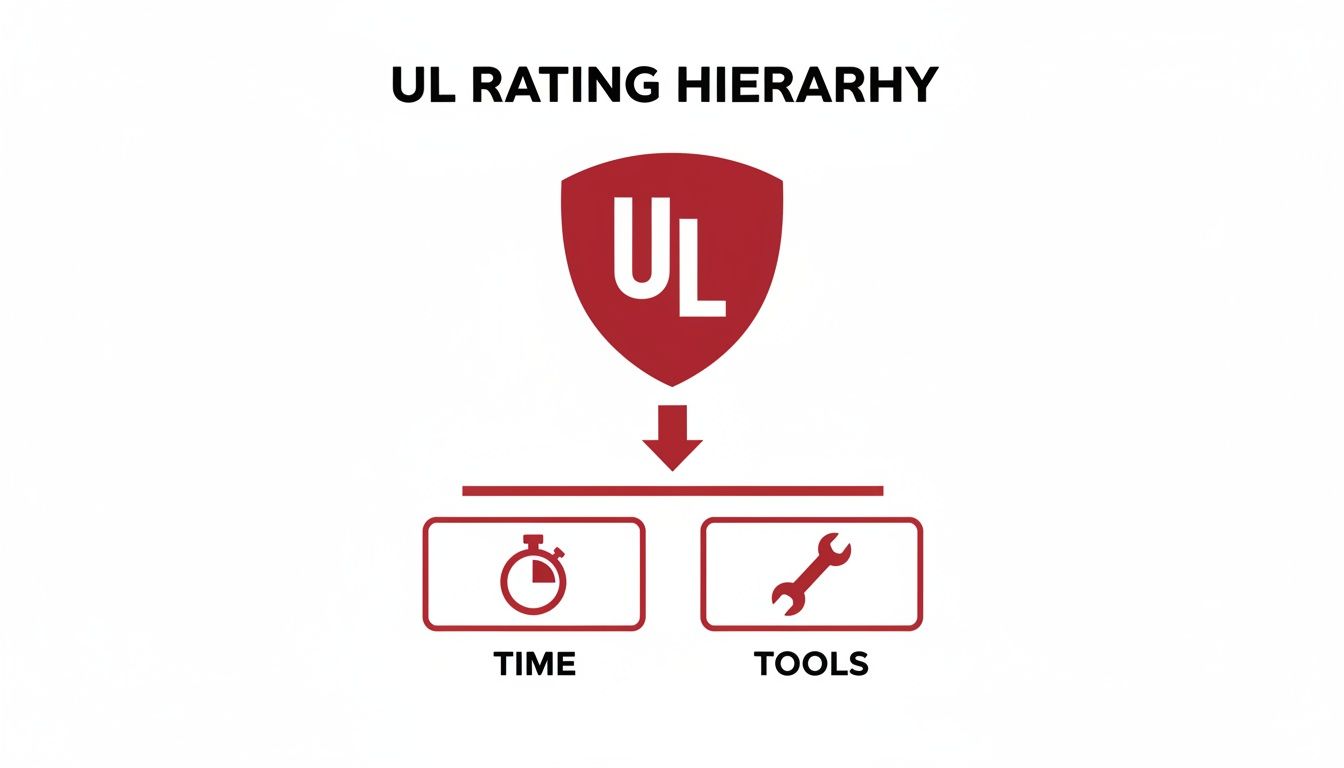
As you can see, UL ratings are a direct measure of how long a safe can hold out and what kind of assault it can withstand.
Why Fire Ratings Matter for Your Jewelry Business
For a jeweler, protecting your business means thinking beyond the gold and gemstones in the showcase. Your operation runs on paper—client records, sales receipts, GIA certificates, and financial documents. While your high-value inventory, like delicate antique jewelry, belongs in a high-security burglary safe, your vital records need their own proven fire protection.
A fire can destroy a business even if every piece of jewelry is accounted for. Losing years of financial records, customer data, and legal documents can be an extinction-level event for a small business. A UL fire rating provides verifiable proof that your operational backbone can survive the flames.
You'll find safes with different classifications for different needs. A UL Class 125 rating, for instance, is designed to protect digital media like backup hard drives, which can be damaged by temperatures as low as 125°F. And while a UL-rated safe is a non-negotiable last line of defense, every business should also implement comprehensive workplace fire prevention tips to protect the entire premises.
Investing in a safe with the right ul safe ratings for fire isn't an expense—it's a core part of a sound risk management strategy. It ensures that after the smoke clears, you have the documents you need to rebuild, file your Jewelers Block insurance claim, and get your business back on its feet.
How Underwriters Look at Your Safe for Insurance
When you fill out an application for Jewelers Block insurance, that little UL tag on your safe isn't just another box to check—it’s the main event. For an insurance underwriter, your safe is the single most important piece of physical security you have. It’s the final wall between your high-value inventory and a devastating loss.
Underwriters are in the business of measuring risk. A safe without a UL rating is a giant question mark; it’s an unknown, unpredictable variable. A safe with a verified UL safe ratings label, on the other hand, gives them hard, reliable data to work with.
A TL-30 rating, for instance, tells an underwriter that your inventory is locked inside a container proven to resist a 30-minute professional tool attack. That specific, measurable resistance translates directly into a lower risk profile, which ultimately leads to better coverage and better premiums on your insurance for a jewelry business.
Matching Your Inventory Value to the Right UL Rating
Underwriters don’t just pull these requirements out of thin air. They rely on established industry guidelines that directly connect the total value of your inventory with a minimum UL rating. It’s one of the most fundamental parts of underwriting jewelry store insurance.
Think of it as a tiered security system. The more you have to protect, the higher and stronger the fortress walls need to be. A safe that was perfectly fine for a modest starting inventory becomes a liability once your business grows and your stock value increases.
Here’s a realistic look at how those value thresholds typically line up:
- Up to $250,000 in Inventory: Insurers will almost always require at least a TL-15 rated safe. This gives you a solid baseline of protection against most common burglary attempts.
- $250,000 to $750,000 in Inventory: In this range, the standard requirement jumps to a TL-30 or TL-30×6 safe. This ensures it can withstand a much longer and more sophisticated attack.
- $750,000 to $1,500,000+ in Inventory: Once your inventory hits the high six figures and beyond, underwriters will be looking for torch-and-tool-resistant safes, like a TRTL-30×6 or even a TRTL-60.
These are solid guidelines, but the exact requirements can shift based on your store's location, your alarm systems, and the specific underwriter reviewing your application. This is where working with a specialist agent from a firm like First Class Insurance Jewelers Block Agency becomes so important—they know the nuances of what different carriers demand.
Seeing Risk Through an Underwriter's Eyes
From an underwriter's perspective, your safe is the absolute last line of defense. They work from the assumption that a determined criminal might eventually get past your alarms, gates, and other perimeter security. When that happens, the only question that matters is: can your safe hold out long enough for help to arrive?
"The UL rating on a safe is the underwriter’s most trusted data point for asset protection. It replaces speculation with certainty. A non-rated safe introduces a level of risk that often results in coverage limitations, higher deductibles, or in some cases, an outright refusal to offer a policy."
This is precisely why a safe without a UL tag can be such a deal-breaker. It doesn’t matter if it’s heavy and has thick steel walls. Without that independent verification, an underwriter has no proof of what it can actually do. For them, it’s an unacceptable gamble.
This situation usually leads to one of a few bad outcomes for a jeweler:
- Coverage Limitations: The insurer might put a strict sub-limit on how much inventory value is covered while it's inside that unrated safe.
- Higher Premiums: To make up for the unknown risk, your premium will be significantly higher than it would be with a properly certified safe.
- Potential Claim Denial: If a theft occurs and your safe didn’t meet the security standards outlined in your policy, you could put your entire claim payout in jeopardy.
This tough-but-fair approach to risk is the standard among top-tier insurers, including many who work through syndicates represented by the iconic Lloyd's of London logo, where verifiable standards are everything. An underwriter's job is to protect their company from taking on too much risk, and your UL-rated safe is the best proof you can offer that you're a serious partner in managing that risk.
To find coverage that matches your security, Get a Quote for Jewelers Block today.
Choosing and Installing Your UL-Rated Safe
Okay, you get the theory behind UL safe ratings. Now comes the part that really matters: turning that knowledge into a real-world security asset for your business. It’s not just about buying the toughest safe you can find; it's about making a smart choice that fits your needs and then—critically—installing it correctly.
This whole process starts with an honest look at your inventory. For any insurance for jewelry business, the safe's rating must be in sync with the total value of the assets it’s protecting. This isn’t just a recommendation; it’s a foundational piece of your Jewelers Block insurance policy that directly impacts your coverage limits and what you pay for them.
Matching Your Safe to Your Inventory
First things first: calculate the absolute maximum value you’ll have in that safe at any one time. That number is your North Star. As we covered, underwriters have very specific value thresholds tied to each rating, and your safe has to meet or beat the minimum for your inventory bracket.
Once you have your number, the search begins. But be careful—you need to make sure you're buying a genuinely certified safe, not a look-alike.
Here’s a quick checklist to make sure you’re getting the real deal:
- Find the UL Label: It should be a proper metal plate, usually on the inside of the door, showing the UL logo and the specific burglary or fire rating.
- Verify the Listing: A real label will have a UL file number. You can (and should) use this to look up the safe’s certification on the official UL database.
- Watch for Weasel Words: Be suspicious of safes advertised as "built to UL standards" or "UL-style." This language is a huge red flag that the safe hasn't actually been put through the wringer of independent testing.
One of the biggest mistakes we see is jewelers buying a safe from a big-box store or general retailer. They often don't grasp the specific demands of jewelry store insurance. Stick with a reputable safe and vault dealer who lives and breathes commercial security—they’ll know exactly what your underwriter is looking for.
The Critical Importance of Proper Installation
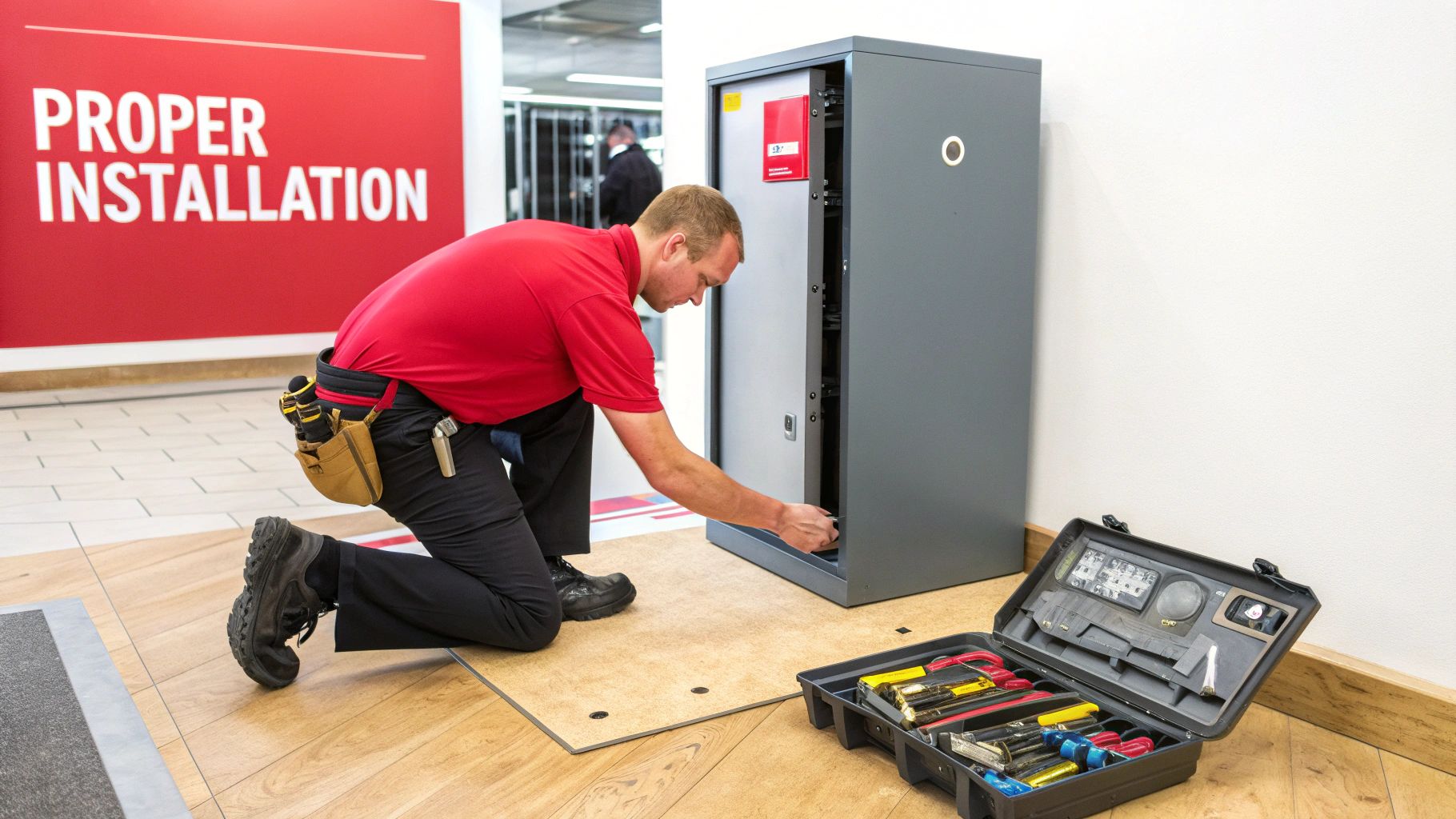
You could buy a TRTL-60×6—a veritable fortress of a safe—but if it’s just sitting on your floor, it’s a massive vulnerability. A smart crew of thieves isn't going to waste hours trying to crack it on-site. They'll bring dollies and pry bars, haul the entire thing out your back door, and open it later at their leisure.
This is exactly why professional installation is non-negotiable.
To an underwriter looking at your insurance for a jewelry store, a high-rated safe that isn't bolted down is almost as bad as having no safe at all. Your policy will almost certainly require the safe to be anchored securely to the building’s concrete slab or another major structural element.
Documenting Everything for Your Insurance Agent
After you’ve picked the right safe and had it professionally installed, there's one last step: documenting everything for your insurance agent. This paperwork is your proof that you’ve met your policy’s security requirements. It ensures you get the full credit (and the right premium) for your investment.
Make sure you send your agent at First Class Insurance Jewelers Block Agency these three things:
- Proof of Purchase: The sales receipt that clearly shows the safe's manufacturer and model number.
- Photos of the UL Label: A sharp, close-up picture of the UL certification plate inside the door.
- Installation Verification: A copy of the installer's invoice and photos that clearly show the safe is properly bolted to the floor.
Taking these steps gives your insurer a complete, verifiable file on your security measures. It makes negotiating your policy easier and becomes invaluable if you ever have to make a claim. If you’re ready to get your security and coverage perfectly aligned, Get a Quote for Jewelers Block today.
Costly Mistakes to Avoid with Your Safe and Insurance
Knowing your UL safe ratings is a great start, but how you apply that knowledge is what really protects your business. Even jewelers with the best intentions can make simple mistakes that end up costing them dearly, putting both their inventory and their Jewelers Block insurance at risk.
Let's walk through a few cautionary tales that show just how serious the consequences can be. These are the kinds of slip-ups that prove why careful planning and an expert eye are non-negotiable.
Mistake 1: The Heavy Safe with No Rating
A new jeweler buys a massive, thick-walled safe. It looks and feels impenetrable, and they assume its sheer weight means top-tier security. In reality, it has no official UL label. It’s a "Residential Security Container" (RSC)—fine for stopping a quick smash-and-grab at home, but completely outmatched by a determined, professional burglar.
When they apply for jewelry store insurance, the underwriter immediately flags the missing UL rating. The policy comes back with a shockingly low limit for overnight inventory, leaving the jeweler dangerously underinsured. If a theft had happened, they would have learned the hard way that their most valuable pieces were never really protected.
Mistake 2: The Unanchored Fortress
Another store owner does their homework and buys a genuine TL-30 safe to protect their growing inventory—a fantastic choice. But to save a few bucks on installation, they just leave the safe freestanding in the back room.
One night, a burglary crew shows up. They don't even bother with the safe’s sophisticated door. Instead, they use heavy-duty dollies and simply roll the entire 4,000-pound safe right out of the building. The claim is later denied because the insurance for a jewelry store policy explicitly required the safe to be bolted down, a standard clause for covering high-value assets.
An unanchored safe isn’t a security feature; it’s just a conveniently packaged container for thieves. Proper installation is every bit as critical as the UL rating itself, a detail that underwriters for any insurance for jewelry business will never overlook.
Mistake 3: The Silent Inventory Increase
A wholesaler has a fantastic holiday season, and their inventory value temporarily doubles. Their fully compliant, UL-rated safe was perfect for their usual stock levels, but it’s now holding far more value than it was rated for. Crucially, they forget to tell their insurance agent about the change.
A theft occurs. The insurer pays the claim, but only up to the limit tied to their original inventory value. The jeweler is left holding a massive, uncovered loss because their coverage didn't keep pace with their success.
These mistakes are costly, but they are also completely avoidable. Working with an expert from First Class Insurance Jewelers Block Agency ensures your security measures are perfectly aligned with your insurance requirements from day one. When you're ready for a professional review, Get a Quote for Jewelers Block.
Frequently Asked Questions About UL Safe Ratings
When it comes to the nitty-gritty of UL safe ratings, a few key questions always come up, especially when aligning your security with your Jewelers Block insurance policy. Let's clear up some of the most common things we hear from jewelers.
Splitting Inventory Between Two Safes
We often get asked if it’s a good idea to split a high-value inventory between two lesser-rated safes instead of buying one bigger, more expensive one. It seems like a practical workaround, but from an underwriter’s perspective, it’s a red flag.
Your jewelry store insurance policy is written with the assumption that your most valuable assets are consolidated and protected by a single safe that meets the required rating. Splitting your stock creates ambiguity in your coverage and can suggest to the insurance carrier that your primary security isn't up to the task. Before you ever go down this road, have a direct conversation with your insurance agent.
Official UL Label vs. "Built to UL Standards"
This is probably one of the most critical distinctions you need to understand. When a safe has an official UL label, it means it has survived brutal, independent testing by a third party. It’s a proven, certified piece of equipment.
The phrase "built to UL standards" is pure marketing speak, not a certification. It's a manufacturer's claim that they think their safe meets the criteria, but it has never been officially tested or verified by Underwriters Laboratories. For any insurance for a jewelry business, underwriters will only recognize and accept a genuine UL-certified label.
Re-Evaluating Your Safe's Rating
So, how often should you double-check that your safe is still up to snuff? A good rule of thumb is to review your safe’s rating against your current inventory value at least once a year, right before your insurance policy comes up for renewal.
But you should also do an immediate review any time your business sees a major jump in value. Did you just acquire a large estate collection? Heading into the holiday season with double the usual stock? Those are the times to make sure your security is keeping pace with your risk. Keeping your safe’s capability aligned with your inventory is non-negotiable for keeping your insurance for a jewelry store valid and effective.
Protecting your inventory starts with the right security and the right insurance partner. The team at First Class Insurance has the expertise to ensure your safe meets all underwriting requirements for your jewelry business. Visit us at https://firstclassins.com to get started.