
Your first line of defense against theft isn't an alarm or a camera—it's the physical space you create. A strong defense is both a practical barrier and a powerful psychological deterrent. It starts with a strategic store layout that maximizes visibility, moves to hardened showcases for your most valuable pieces, and finishes with strict access control at every entry point.
When you make your environment feel open, monitored, and controlled, you actively discourage would-be thieves before they even get a chance to act.
Fortifying Your Physical Defenses
Your store's physical environment is the most visible layer of your security. It’s more than just locks on the doors; it's a carefully crafted strategy that screams control and vigilance. A well-designed space can make a potential thief feel exposed and uncomfortable, often convincing them to walk away without ever making a move.
It all boils down to one core principle: maximizing visibility. Think of your layout as a natural surveillance system.
Are there tall displays creating blind spots where someone could pocket an item? Are your most valuable pieces tucked away in a dimly lit corner? By using low-profile shelving and maintaining wide, clear aisles, you empower your staff to keep an eye on the entire sales floor from almost any angle. It’s a simple concept that turns every corner of your store into a monitored zone.
Designing a Secure Store Layout
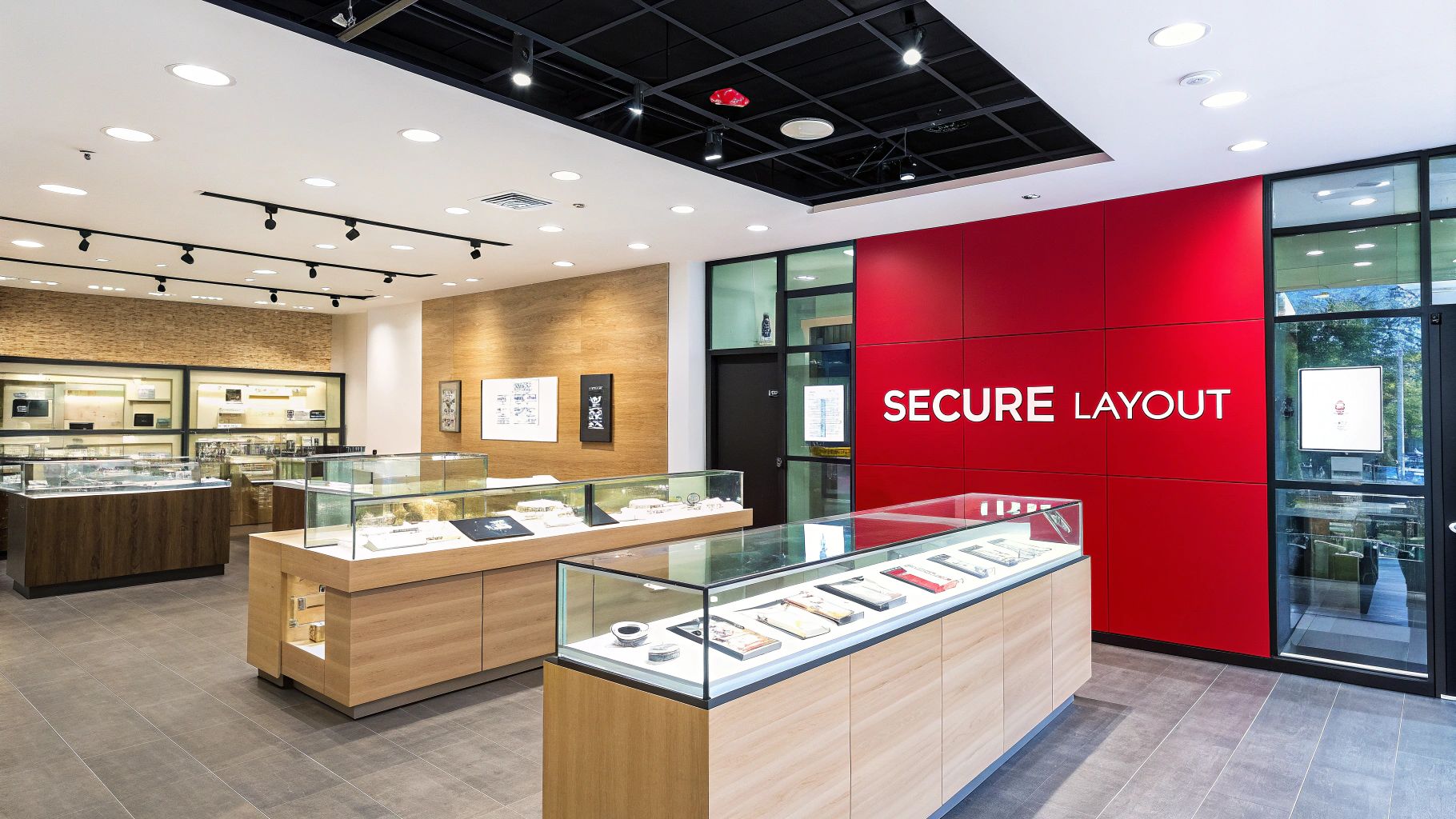
A smart layout does two things at once: it guides honest customers while exposing potential threats.
Position your sales counter near the entrance and exit. This gives your team a clear line of sight to every single person who comes and goes. It's not just great for customer service; it’s a powerful psychological hurdle for anyone with bad intentions.
Think about the flow of traffic. Arrange your displays to create a predictable path through the store. This makes it much easier for your team to monitor behavior and spot anyone lingering suspiciously or breaking from the normal shopping pattern. Keeping the space bright, clean, and organized also eliminates the clutter that thieves love to use for concealment.
Hardening Your Most Valuable Assets
For a jeweler, the showcases are the heart of the business—and the number one target. Standard glass just doesn't cut it. Investing in reinforced, high-quality showcases is absolutely non-negotiable.
- Laminated and Tempered Glass: In a smash-and-grab, this glass is designed to spiderweb, not shatter. That delay buys you precious seconds for alarms to blare and authorities to respond. I've seen major losses prevented simply because the showcase glass held up.
- High-Security Locks: The locks on your cases are just as important as the glass. Use high-quality, pick-resistant locks, and keep those keys under strict control.
- Secure Anchoring: Your cases must be bolted securely to the floor or wall. You don't want a brazen crew carrying the entire display out the door. You can see examples of how to protect high-value items like watches with this kind of robust security.

Another smart move is adding another layer of resistance to your storefront windows and glass doors with specialized solutions like security window film for enhancing physical defenses.
Your Essential Physical Security Checklist
This isn't just a list of suggestions; these are the foundational elements of a secure jewelry store. Use this table as a quick gut-check for your own operations.
| Security Layer | Key Action Items | Primary Threat Addressed |
|---|---|---|
| Store Layout | – Clear sightlines with no blind spots. – Sales counter near exit. – Well-lit and organized displays. |
Shoplifting, Grab-and-Run |
| Showcases | – Laminated/tempered glass. – High-security, pick-resistant locks. – Cases bolted to the floor/wall. |
Smash-and-Grab, Forced Entry |
| Perimeter | – Security film on exterior glass. – Reinforced doors and frames. – Bollards to prevent vehicle ramming. |
Burglary, Ram-Raiding |
| Access Control | – Key control for all sensitive areas. – Secure backroom and office doors. – A robust safe (UL-rated, of course). |
Internal Theft, Burglary |
Reviewing these points regularly helps ensure your physical deterrents remain as strong as possible.
Controlling Access to Sensitive Areas
Your security perimeter has to extend beyond the showroom. Backrooms, offices, and safes are prime targets for both outside criminals and dishonest employees. Robust access control is critical. This could be as simple as a strict key policy or as advanced as an electronic system that logs every time a door is opened.
The numbers don't lie. Without basic measures, only a shocking 1 in 48 shoplifters is ever caught, contributing to $68.9 billion in annual retail losses. But smart physical security pays off. For example, implementing something as straightforward as RFID tags on your pieces can slash that shrinkage by a massive 18% each year. These figures show the direct and powerful impact that physical security has on your bottom line.
Deploying Modern Surveillance and Alarms
Let's be blunt: a single, passive security camera recording grainy footage in a corner is a relic. It’s practically an invitation for trouble. Today’s surveillance and alarm systems are active, intelligent defense networks that serve as both a powerful deterrent and an absolutely essential tool for investigation. Building this technological shield is a non-negotiable step in protecting your store, especially if you're dealing with high-value merchandise like jewelry.
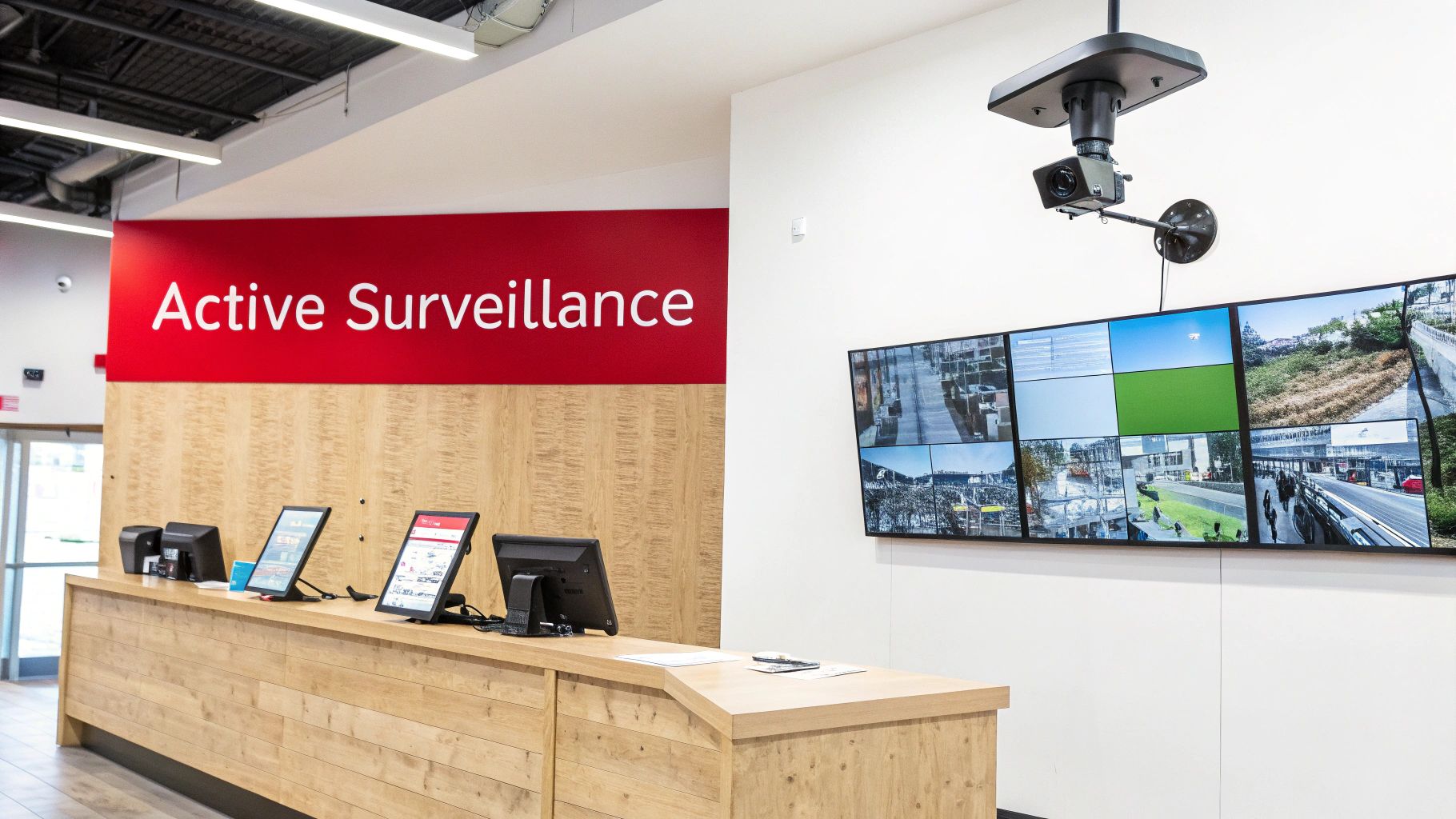
It all starts with seeing everything. Strategic placement of high-definition cameras is the foundation. You need complete, overlapping coverage of every critical angle: each display case, the point-of-sale area, all entrances and exits (don't forget the back door), and your stockroom. The objective is simple: eliminate any spot where a thief might feel unobserved.
Leveraging AI and Advanced Video Analytics
Modern security has evolved far beyond just hitting "record." The real power now lies in advanced features like AI-powered video analytics, which can turn your cameras from passive observers into proactive sentinels that flag suspicious behavior in real-time.
Think about these real-world scenarios:
- Loitering Detection: The system can automatically alert you if someone lingers near a high-value case for too long without talking to staff. It's a classic pre-theft indicator.
- Unusual Motion: It can detect sudden, fast movements consistent with a grab-and-run and trigger an immediate alert, giving you a chance to react.
- Facial Recognition: This technology can identify known offenders the moment they walk through your door, allowing your team to respond appropriately before an incident occurs.
This isn't just theory; it's proving its worth in the field. Recent 2025 data shows retailers saw a remarkable 20% reduction in theft after deploying these smart systems. When facial recognition was added, stores reported a 30% drop in repeat offenders. The numbers don't lie.
Key Takeaway: Your camera system shouldn't just record crimes; it should help you prevent them. Real-time analytics provide the actionable intelligence your team needs to intervene before you suffer a loss.
Integrating a Robust Alarm System
A state-of-the-art camera system is a fantastic start, but it's only half the equation. Its effectiveness multiplies when it's fully integrated with a multi-layered, responsive alarm system. When a threat is detected—whether by your staff or your AI—the response must be immediate and decisive.
Think of your alarm system in layers, starting from the outside in:
- Perimeter Alarms: Glass-break sensors on windows and showcases, along with door contacts, are your first line of defense against a smash-and-grab or after-hours break-in.
- Interior Alarms: Motion detectors blanket the inside of your store when it's closed, ensuring any unauthorized presence is immediately flagged.
- Silent Alarms: Panic buttons for your staff are an absolute must. Placed discreetly under counters and in the back office, they allow an employee to signal for help during a robbery without escalating a dangerous situation.
When planning your budget, it helps to get a realistic idea of the average cost of security cameras installation to make sure you can allocate enough for a truly comprehensive setup.
The Power of a Monitored System
Finally, and this is critical, your alarm system must be professionally monitored 24/7. A local alarm that just makes a loud noise might startle an amateur, but it won't stop a professional.
A monitored system ensures that when an alarm is triggered, a signal goes directly to a central station. There, trained professionals can verify the emergency and dispatch law enforcement immediately. This rapid response is crucial in a robbery scenario where every single second counts. It’s the final link in your technological defense, turning a potential disaster into a controlled incident and dramatically improving the odds of apprehension and recovery.
Your Staff is Your Strongest Defense
Your cameras, alarms, and reinforced showcases are crucial, but they’re static. They can’t adapt. Your most dynamic and effective security asset is your team.
A well-trained, vigilant staff is a living, breathing deterrent. They can spot trouble and shut it down with simple customer service long before an alarm ever needs to sound. It's about building a culture where protecting the store is everyone's job—a shared responsibility.
This starts by empowering your people. You have to give them the knowledge to see red flags and the confidence to act on them. Honestly, investing in your team's training is one of the single most effective moves you can make to prevent theft, tackling threats from both outside and within.
Spotting and Stopping External Threats
The best low-cost tool against shoplifting? Proactive, genuine customer service. It's that simple.
A friendly "Hello, welcome!" the moment someone walks in tells them they've been seen. That one small act can make a potential thief feel exposed and completely disrupt their plan. Train your staff to go beyond basic greetings and look for specific red flags:
- Behavioral Tells: Teach them to notice people who avoid eye contact, seem overly nervous, or are more interested in your camera layout than your merchandise.
- Distraction Tactics: Make them aware of common team-based strategies, where one person causes a scene to draw attention while an accomplice pockets an item.
- Suspicious Loitering: Show them how to recognize when someone is lingering for far too long without any real intent to buy.
The point isn't to make your team paranoid. It's about teaching them to trust their gut and use good customer service as a powerful security tactic. A simple, polite "Can I help you find something specific?" directed at someone acting suspiciously is often all it takes to make them walk right out the door.
Shutting Down Internal Theft
External theft grabs the headlines, but employee theft can be far more devastating to a jewelry business. It's a slow burn, often happening over a long period, making it incredibly difficult to detect without iron-clad procedures.
Your defense starts before you even hire someone. Running thorough, legally compliant background checks is a non-negotiable first step for anyone who will handle your high-value inventory. Once they're on the team, clear and consistently enforced policies are your best protection.
A strong internal security culture is built on clarity and consistency. When every team member understands the rules and knows they apply to everyone, the opportunity and temptation for theft are dramatically reduced.
Set up firm rules for things like employee purchases, bag checks, and how merchandise is handled. For example, personal bags and coats should be kept in a designated locker area, away from stock. Any employee purchase needs to be documented, signed off by a manager, and processed just like a customer's. These aren't signs of mistrust; they're professional standards that protect the business and your honest employees.
Making Security Training an Ongoing Habit
Security training isn't a one-and-done session during orientation. It has to be an ongoing conversation. Thieves' tactics evolve, and your team’s knowledge has to keep up.
Regular, quick meetings are perfect for this. Try holding a brief huddle once a week to cover topics like:
- Recent Trends: Discuss any incidents or new tactics you've heard about from nearby stores (without sharing sensitive details, of course).
- Quick Role-Plays: Run through a scenario, like how to respond to a customer asking to see five high-value rings at once.
- Procedure Reminders: Do a quick refresher on the protocol for opening and closing showcases or handling a voided sale.
This constant reinforcement is a massive force multiplier. With 88% of retailers reporting worse theft conditions in 2023, education is more critical than ever. Shoplifting incidents have skyrocketed 93% since 2019, and the average dollar loss per incident has jumped 90% in that same timeframe. You can dig into these retail shrinkage statistics to see just how serious the problem is.
Keeping security top-of-mind ensures your human firewall stays strong, alert, and ready to protect your assets.
Securing Inventory Beyond the Showroom
Real theft prevention goes way beyond what your customers see on the sales floor. Think about the entire journey of a high-value piece—from the moment it arrives at your back door to its final scan at the register. That whole path is lined with potential security gaps.
Ignoring these "backstage" operations is like locking your front door but leaving a window wide open. A disciplined approach here not only stops theft cold but also builds a rock-solid foundation for your entire business.
Implementing Ironclad Inventory Controls
You can't protect what you don't track. A solid inventory control system is your single source of truth, flagging problems the second they happen. Relying on a once-a-year count is a recipe for disaster; by the time you spot a missing piece, the trail is ice-cold.
The better approach? Frequent, targeted checks.
Cycle counting is a game-changer. Instead of a massive annual audit, you count small, specific sections of your inventory on a rotating basis. One week it's diamond engagement rings, the next it's luxury watches. This keeps the task manageable and shrinks the window between a potential loss and its discovery down to days, not months.
The golden rule of inventory security is simple: Relentlessly reconcile your physical stock with your digital records. A mismatch isn't just a typo—it's a red flag that needs immediate attention.
This discipline helps you figure out fast if a piece was sold, moved, or is genuinely gone, so you can act before it’s too late. To learn more about protecting specific high-value items, check out our guide on safeguarding antique jewelry.

Securing Your Shipping and Receiving Protocols
Some of the biggest risks your inventory faces are when it's on the move. High-value goods are a magnet for thieves, both on their way to your store and when you're shipping them out. You have to harden your logistics.
Start with your carriers. Don't just pick the cheapest option. You need to partner with trusted, insured logistics companies that specialize in high-value cargo and provide detailed tracking and signature confirmation.
Here are a few non-negotiable best practices for every single shipment:
- Use Discreet Packaging: Your boxes should be completely anonymous. Never use your store name or any branding that screams "jewelry inside."
- Inspect on Arrival: When a package comes in, check it for any signs of tampering before you sign off on it. Do this in a secure back room, away from prying eyes.
- Implement a Two-Person Rule: For opening high-value shipments, two staff members must be present to verify the contents against the packing slip. This simple check-and-balance system is a powerful deterrent against internal theft.
Fortifying Your Point-of-Sale System
Your POS terminal can be a hotbed for fraud, from both sophisticated criminals and dishonest employees. A modern, secure POS is a must, but the procedures you build around it are what really count.
Put strict controls in place to shut down common scams. For instance, any voided sale, high-value return, or manual discount should require a manager's override code. This simple step prevents an employee from, say, faking a return and pocketing the cash. You should also regularly audit your transaction logs for red flags, like one employee who has a suspiciously high number of "no sale" till opens.
By locking down your inventory from the moment it arrives to the final sale, you create a security net that protects your assets far beyond the showroom floor.
Understanding Jewelers Block Insurance
Let’s be realistic. You can install the best physical defenses, the most advanced surveillance, and train your staff to perfection, but even the tightest ship can spring a leak. A sophisticated criminal crew, a simple moment of human error, or just a bit of bad luck can bypass even your most careful plans.
This is where your final—and arguably most critical—layer of protection comes in: specialized jewelry store insurance.
I'm not talking about your standard business owner's policy. For a high-value operation like yours, you need a specific, powerful tool designed for your unique risks. You need Jewelers Block insurance. This is the ultimate safety net, built to cover the very scenarios that would give a general insurance provider nightmares.
Why Standard Insurance Falls Short
A regular business policy is great for covering a slip-and-fall in the showroom or a fire in the breakroom. But when it comes to the real-world threats a jeweler faces, it's often full of massive holes. These policies almost always come with strict, low limits on high-value inventory like jewelry and frequently exclude common loss scenarios altogether.
For instance, a standard policy probably won't cover your inventory if it's stolen while you're driving it to a trade show. It also likely won't cover a piece if it's damaged while in the care of a third-party appraiser. This is exactly where proper insurance for a jewelry business proves its worth.
Key Takeaway: Jewelers Block insurance is specifically designed to cover your inventory's entire lifecycle—from the moment it's in your possession to its final sale, no matter where it is.
This specialized coverage protects your assets "on premise" within your store, "in transit" when you're shipping or traveling, and "off premise" when it's with a salesperson or out with a customer on memo. That holistic protection is the core difference and the primary reason it's non-negotiable for any serious jeweler.
The infographic below really drives this point home, showing how inventory control and logistics are all part of a larger security ecosystem that your insurance has to support.
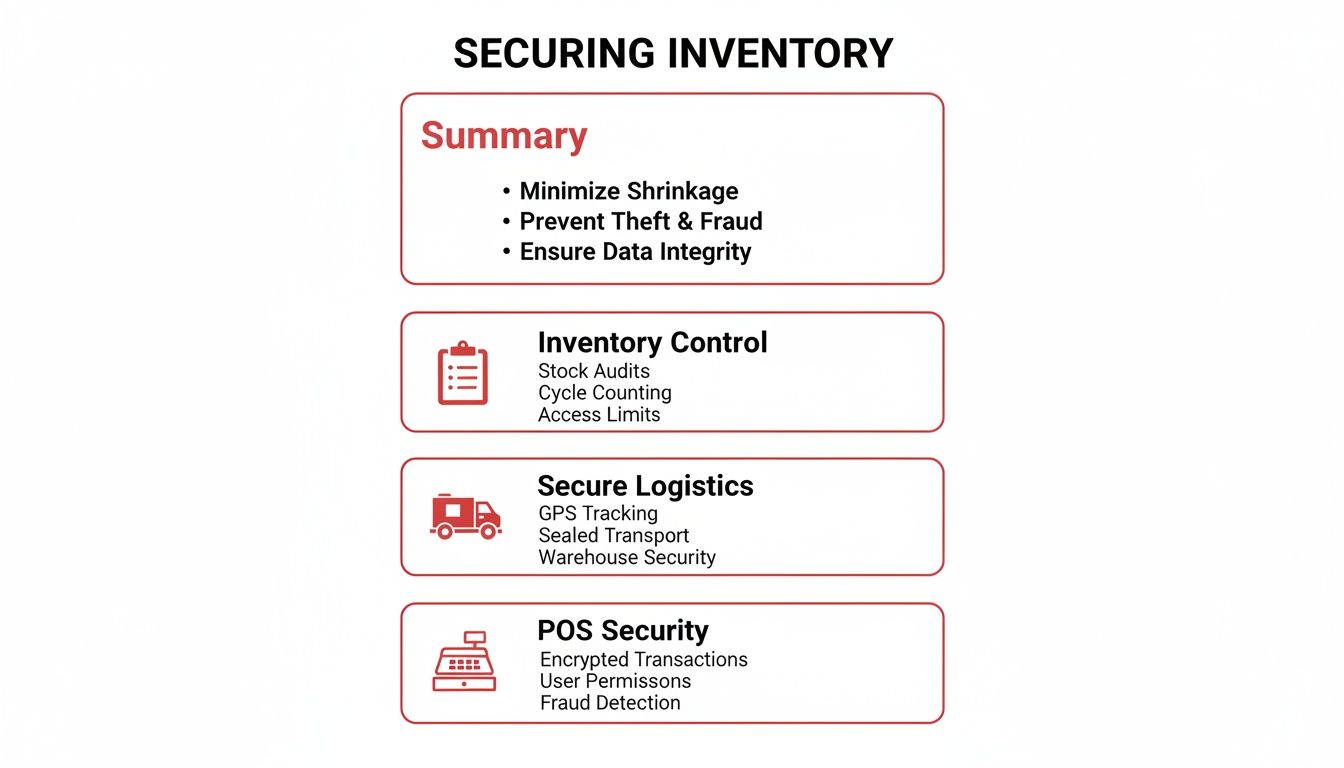
This visual shows how the security of your inventory, logistics, and sales are all linked. The chain is only as strong as its weakest link, and a Jewelers Block policy is specifically designed to fill in any potential gaps.
What Does Jewelers Block Actually Cover?
When you work with a specialist like a First Class Insurance Jewelers Block Agency, you're getting a policy that speaks the language of your industry. It’s built to address the specific, high-stakes risks of your trade, and it goes far beyond simple theft coverage.
Let's look at a head-to-head comparison to see where a standard Business Owners Policy (BOP) just doesn't measure up.
Jewelers Block vs Standard Business Owners Policy (BOP)
The differences in coverage are stark and highlight exactly why a specialized policy is essential for protecting your livelihood.
| Coverage Area | Jewelers Block Insurance | Standard BOP |
|---|---|---|
| Mysterious Disappearance | Covered. Protects against unexplained inventory loss where you can't prove a theft occurred. | Typically Excluded. If you can't prove a break-in, you're usually out of luck. |
| Off-Premise Coverage | Included. Covers inventory at trade shows, with traveling sales staff, or out on memo. | Very Limited or Excluded. Coverage is almost always confined to your store's physical address. |
| Stock in Transit | Included. Protects pieces being shipped via armored car, USPS Registered Mail, or FedEx. | Excluded or Requires a Separate, Expensive Rider. |
| Customer Property | Covered. Protects your clients' jewelry when you have it for repair, appraisal, or consignment. | Not Covered. This liability could fall on your general liability policy, which has very low limits for it. |
Relying on a generic policy is a major gamble. True insurance for a jewelry store understands that your business doesn't just exist inside four walls. It's built to safeguard your most valuable assets, like a stunning diamond ring that represents a significant investment, no matter what.

Getting the Right Coverage and Better Premiums
When it's time to get a quote for Jewelers Block, the underwriter will conduct a detailed risk assessment of your business. This is where all the hard work you've put into security really pays off.
The security measures we've walked through in this guide—from your UL-rated safe and alarm system to your staff training protocols and inventory controls—are exactly what insurers look for. A store with robust, multi-layered security is a lower risk, and that can directly lead to better coverage options and more favorable premiums.
Be ready to provide details on:
- Physical Security: The specs of your safes, vaults, locks, and showcase construction.
- Alarm and Surveillance: The details of your monitored alarm system and camera coverage.
- Inventory Management: Your procedures for tracking, auditing, and reconciling your stock.
- Operational Protocols: How you handle openings, closings, and showing merchandise.
Having this information organized and ready to go shows that you're a responsible, security-conscious operator. It makes you a much more attractive client to an insurance provider and puts you in the best position to secure great terms.
Common Questions Jewelers Ask About Security
Even after you've put a solid security plan in place, questions always pop up. It’s the details that matter, whether it’s picking the right camera or knowing what your jewelry store insurance really covers. Let's tackle some of the most common ones I hear.
What’s the Single Best Low-Cost Security Tactic I Can Use?
Forget fancy gadgets for a moment. The most powerful, immediate, and low-cost security measure you have is your team and how they engage with customers.
Seriously. Training your staff to make genuine eye contact and greet every single person who walks through the door is a massive deterrent. It’s a simple human interaction that sends a clear signal: "We see you." For a potential thief, that feeling of being watched and acknowledged is often enough to make them walk right back out. Combine that with a clean, open store layout with no blind spots, and you’ve made it incredibly difficult for someone to even think about slipping something into their pocket.
How Exactly Does Mysterious Disappearance Coverage Work?
This is a big one. Mysterious disappearance is a vital part of a good Jewelers Block insurance policy, and it covers losses that you simply can't explain. There's no obvious sign of a break-in, no security footage of a theft, but an item is just… gone. Standard business policies won’t touch this.
Imagine you're doing your daily count and a diamond engagement ring from a display case is missing. You've checked everywhere, reviewed the cameras, and there's no evidence of how it vanished. This is precisely what mysterious disappearance is for.
Key Insight: Without this specific coverage, an unexplained loss from your inventory becomes a 100% financial hit. It’s one of the most important distinctions that separates true insurance for a jewelry store from a generic business policy.
What Camera Features Actually Matter for a Jewelry Store?
Yes, the specific features on your security cameras make a world of difference. Don't just settle for any off-the-shelf system.
- High-Resolution (4K): You need to capture the tiny details—the sparkle of a specific stone, the features on a person’s face. 4K resolution is the standard now for a reason; it provides evidence that’s actually usable.
- Wide Dynamic Range (WDR): Jewelers have the worst lighting for cameras—bright, focused display lights and dark corners. WDR technology balances those extremes so your footage isn't a mess of washed-out bright spots and black shadows.
- AI-Powered Analytics: This is a game-changer. Modern cameras can be set up to automatically flag suspicious behavior. Think someone lingering too long by the Rolex case or a person reaching over a counter. The system can send an alert in real-time, turning your cameras from a passive recording tool into an active part of your defense.
How Often Do I Really Need to Do a Full Inventory Count?
A full, wall-to-wall physical inventory audit is something you should do at least once a year. But if you wait 12 months to discover something is missing, the trail has gone completely cold.
That’s why you have to supplement the big annual audit with frequent "cycle counts." Pick your most valuable or fastest-moving items—like your bridal section or luxury watches—and count them far more often. Weekly, or even daily, counts for those key showcases will help you spot a discrepancy almost immediately. This shrinks the window of loss and makes any investigation a thousand times easier. It's a fundamental discipline for preventing both internal and external theft.
Ready to make sure your insurance policy is as strong as your vault? The specialists at First Class Insurance live and breathe the jewelry business. Don't leave your life's work vulnerable. Get a Quote for Jewelers Block and get the peace of mind you deserve.