
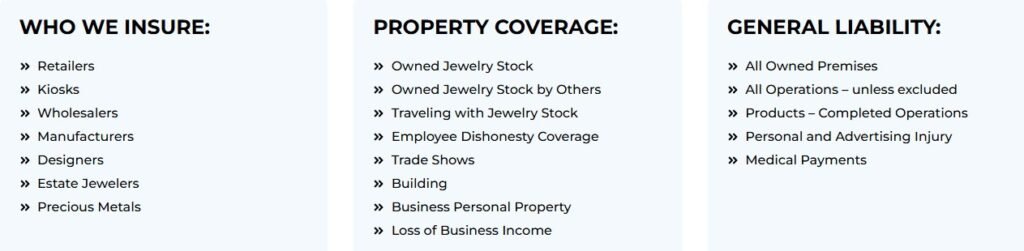
Picture this: your laser welder sputters and dies right in the middle of a crucial repair. Or maybe the electronic lock on your vault suddenly refuses to open, trapping your most valuable inventory inside.
It’s a nightmare scenario, and while your Jewelers Block insurance is fantastic, it wasn't built for this. It’s designed to handle external threats like a smash-and-grab or a fire, which leaves a huge, often overlooked, gap: internal equipment failure. This is where equipment breakdown coverage insurance comes in. Think of it as the specialized safety net for the machinery and electronics that keep your jewelry business running every single day.
Why Jewelers Block Is Not Enough
Your Jewelers Block insurance is the foundation of your entire risk strategy. It’s a powerhouse for covering your finished pieces, loose stones, and raw materials from catastrophic events. But here’s the thing—it was never meant to cover the sudden, accidental breakdown of the equipment you rely on to do your work.
This creates a hidden weak spot in your armor. A simple power surge could easily fry your point-of-sale system and your security cameras. A mechanical failure could seize your casting machine, and an HVAC system collapse could turn your showroom into a sauna, potentially even damaging delicate stock. When these things happen, your standard property policy won't lift a finger, leaving you to foot the entire bill for repairs, replacements, and the painful cost of downtime.
To really nail down why this coverage is so vital, let's look at a few common scenarios where a standard policy falls short.
Coverage Gaps for a Jewelry Business
| Failure Scenario | Covered by Standard Property/Jewelers Block | Covered by Equipment Breakdown Insurance |
|---|---|---|
| The compressor on your AC unit burns out, making your showroom unusable. | No | Yes |
| A power surge destroys the circuit board in your electronic vault lock. | No | Yes |
| An internal mechanical failure causes your casting machine to seize up. | No | Yes |
| Your server hosting your customer and inventory data crashes suddenly. | No | Yes |
| The motor in your polishing machine shorts out, stopping all bench work. | No | Yes |
As you can see, the gap is significant. Relying on your Jewelers Block policy for these kinds of internal failures is like asking a security guard to fix a burst pipe—it's simply not their job.
The Internal Failure Gap
Here’s a simple way to think about it: if a thief smashes your display case to steal inventory, your Jewelers Block insurance jumps into action. But if the motor in that same climate-controlled display case suddenly burns out, that’s an internal failure. This is exactly why equipment breakdown coverage is so critical for a modern jewelry business.
This distinction is only getting more important as jewelers rely on more complex and expensive technology. It's no surprise the global equipment breakdown insurance market has seen massive growth. Valued at roughly USD 7.35 billion, the market is expected to climb to USD 12.59 billion by 2031 as more businesses wake up to the crippling costs of equipment failures. You can discover more insights about this growing market trend and what it means for businesses like yours.
A standard property policy protects your business from what happens to it from the outside. Equipment breakdown coverage protects your business from what happens inside its most critical machinery.
This specialized policy is built to cover the costs that come from a sudden and accidental failure of your mechanical, electrical, and pressurized systems. Let's be clear: this isn't a warranty or a maintenance plan. It's real insurance for a jewelry store against an unexpected internal collapse. It covers a specific and expensive risk that is flat-out excluded from most other commercial policies, making sure the operational heart of your business stays secure. Without it, you're only halfway protected.
What Your Breakdown Policy Actually Covers
When you hear "equipment breakdown coverage," it can sound a little vague. But this isn't some abstract concept—this policy is built on four distinct pillars of protection, each designed to tackle a specific financial mess that follows a sudden equipment failure. Getting your head around these four pillars is the key to understanding its real-world value for your jewelry business.
Here's an easy way to think about it: your standard Jewelers Block insurance is the security guard at the door, protecting you from external threats like theft or fire. Your equipment breakdown coverage is the expert technician inside, ready to fix the critical machinery that powers your operations and cover the financial fallout when it fails.
This is how these two essential coverages work together to give you a complete shield.
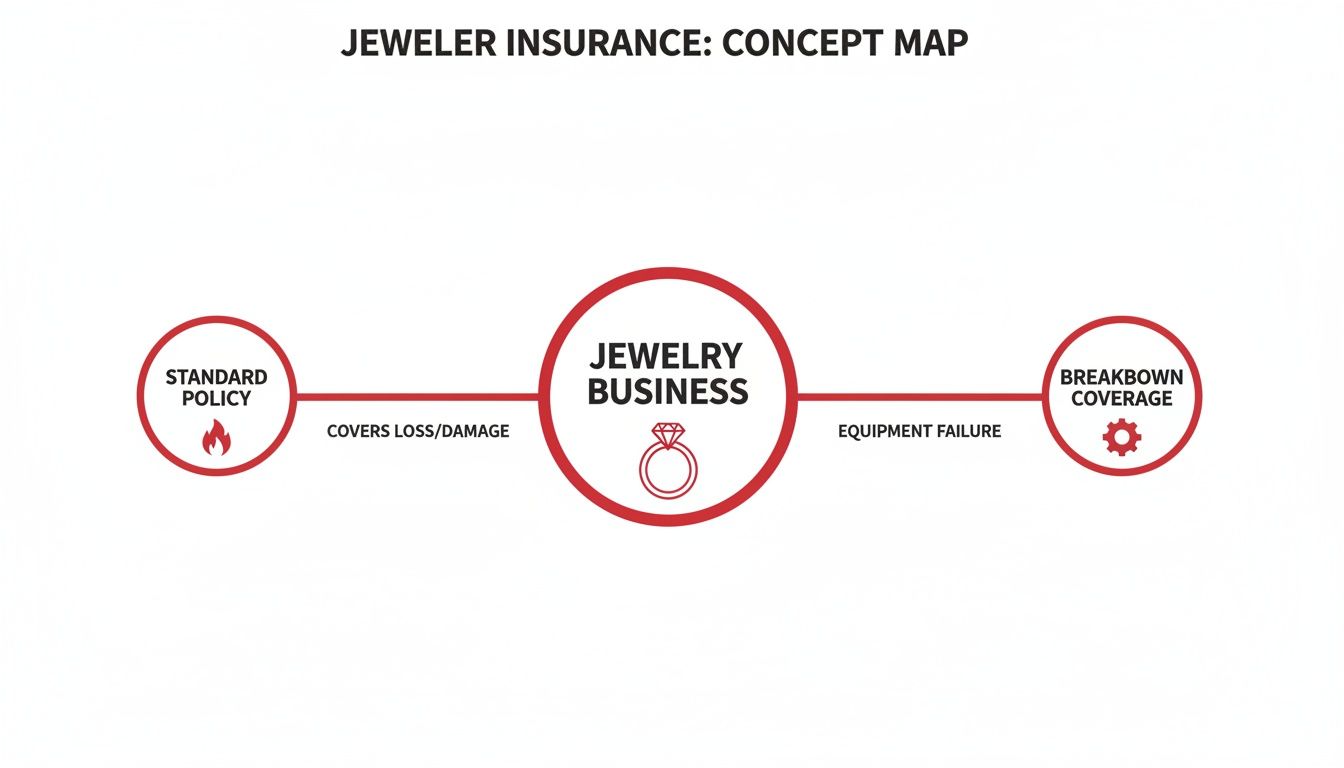
As you can see, the standard policy handles external risks like a fire. But for an internal failure, like a mechanical short in your casting machine, you need specialized breakdown coverage to protect your assets.
Direct Property Damage
This is the most straightforward piece of the puzzle. It covers the cost to repair or flat-out replace the piece of equipment that broke.
If a power surge fries the motherboard in your expensive laser welder or a mechanical fault seizes your casting machine, this is the part of the policy that kicks in. It pays for the parts, the labor, and even the full replacement if the unit is a total loss. Without it, you're looking at that entire bill out-of-pocket, which can easily climb into the thousands for specialized jeweler's equipment.
Business Interruption
So, your laser welder is down for a week waiting for a part. What happens to your income? Every single day of downtime means lost repair jobs, delayed custom orders, and clients who are getting more frustrated by the hour. This is where Business Interruption coverage proves its worth.
This pillar reimburses you for the net income you lose. It also covers the normal operating expenses that don’t stop just because your production has—things like rent and payroll. It’s a financial lifeline that keeps your business stable during the recovery, turning a potential disaster into a manageable bump in the road.
For a jewelry business, downtime isn't just an inconvenience; it's a direct hit to your revenue and reputation. Business Interruption coverage is the financial bridge that gets you from the moment of failure to the moment you're back in business.
This isn't just an add-on; it's a core component of equipment breakdown coverage. It acknowledges that the true cost of a failure goes far beyond the price tag of the machine itself.
Spoilage Damage
Jewelers often skim past this one, but it can be surprisingly critical. This coverage protects you against the loss of perishable stock and materials that are ruined as a direct result of an equipment failure. You might not have "spoilage" like a restaurant, but think about the specialized, sensitive materials you rely on.
Imagine your workshop’s HVAC system dies in the middle of a July heatwave. The extreme temperatures could easily ruin sensitive adhesives, casting waxes, or specialized chemical solutions. Spoilage Damage coverage would reimburse you for the value of those ruined materials, stopping a secondary financial loss in its tracks.
Expediting Expenses
When a critical piece of equipment fails, every second counts. Every hour you're waiting for a technician or a replacement part is another hour of lost income. That’s where Expediting Expenses coverage gives you a huge advantage.
It covers the reasonable extra costs you incur to get your business back up and running as fast as humanly possible.
This can include things like:
- Overnight shipping for a replacement motor from overseas.
- Paying a technician overtime rates to finish a repair after hours.
- The extra cost to rent a temporary piece of equipment until yours is fixed.
These expenses add up fast, but they are almost always a smart investment when compared to the much larger cost of prolonged business interruption. This coverage lets you make the best decision for your business without having to worry about the premium price of a quick recovery.
Protecting the Tools of Your Trade
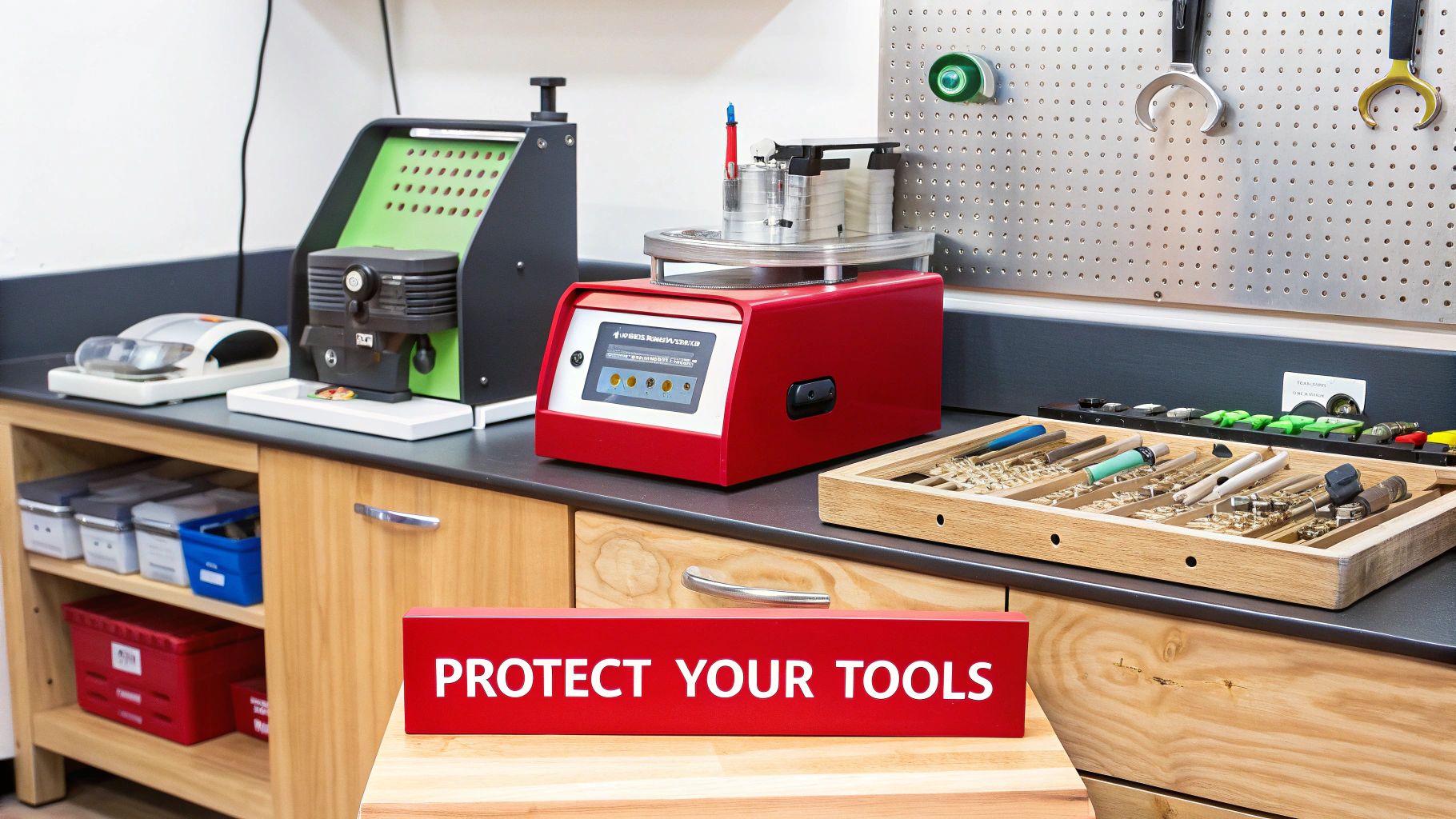
When you think about your jewelry business, the mind immediately goes to sparkling display cases and finished pieces. But behind that brilliant facade is an entire ecosystem of machinery that keeps your operation running.
This is what equipment breakdown coverage is really for. It’s not just for a single big machine; it protects the whole interconnected system that powers your business. To see where the risks really are, let's look at the different categories of equipment you depend on every single day.
Workshop and Bench Tools
This is the creative heart of your operation, where raw materials become art. The equipment here is often highly specialized, expensive, and absolutely essential for production. When a machine in the workshop goes down, your ability to create—and sell—stops cold.
Think about what could happen:
- Laser Welders: A power surge fries the delicate electronics, and suddenly you can’t do precise repairs or complex assembly.
- Casting Machines: A mechanical failure causes the motor to seize. Just like that, all new production grinds to a halt, delaying custom orders for weeks.
- Ultrasonic Cleaners: The transducer dies, and you lose a critical finishing step. The quality of every piece is now at risk.
Of course, beyond insurance, simply implementing effective workshop organization and storage ideas can go a long way in preventing physical damage and making your tools last longer.
Showroom and Security Systems
The equipment that protects your assets and serves your customers is just as critical as your bench tools. A failure here can shut down your retail operations or leave you dangerously exposed.
A broken HVAC system on a sweltering summer day will clear out your showroom faster than anything. Likewise, a failed electronic safe lock doesn't just inconvenience you—it locks you out of your own inventory.
Common points of failure include:
- HVAC Systems: A compressor burnout can make your store unbearable for both staff and customers, forcing you to close during your busiest season.
- Point-of-Sale (POS) Terminals: An internal short circuit bricks your system. Now you can't process a single sale or track transactions.
- Electronic Safes & Surveillance: A sudden electrical fault could disable your security cameras or, even worse, leave your main vault completely inaccessible.
Office and Operations Technology
Finally, there’s the tech that runs your back office. This is the central nervous system of your business—handling inventory, customer records, appraisals, and shipping. A breakdown here can cause chaos.
A server crash could wipe out your entire customer database. A specialized appraisal printer failing could hold up a high-value sale waiting on documentation. Even something as small as a shipping label printer breaking down can bring your entire e-commerce operation to a standstill. You have to think about how to protect your luxury assets like valuable watches from every possible angle.

To make this crystal clear, let's map out how a single failure can ripple through your business.
Jewelry Business Equipment Risk Matrix
This table highlights just a few examples of how quickly a single equipment breakdown can impact your bottom line.
| Equipment Type | Common Failure Scenarios | Potential Business Impact |
|---|---|---|
| Laser Welder | Power surge, cooling system failure | Inability to perform custom work or complex repairs, leading to lost revenue and customer dissatisfaction. |
| HVAC System | Compressor burnout, refrigerant leak | Uncomfortable showroom forces closure, resulting in lost foot traffic and sales, especially during peak seasons. |
| Electronic Safe | Electrical fault, keypad malfunction | Inability to access high-value inventory, preventing sales and creating major operational bottlenecks. |
| POS System | Hard drive crash, internal short circuit | Halts all in-store transactions, leading to direct revenue loss and a poor customer experience. |
| Inventory Server | System crash, data corruption | Loss of critical sales and customer records, creating administrative chaos and delaying order fulfillment. |
As you can see, each piece of equipment—from the casting machine to the credit card terminal—is a potential point of failure. A solid jewelry store insurance policy understands this, ensuring that when one link in the chain breaks, your entire business doesn't fall apart with it.
What Isn't Covered? Common Policy Exclusions
Knowing what your equipment breakdown coverage insurance protects is only half the battle. To really get a handle on your risk, you have to understand what it doesn’t cover. These policies are built for sudden, accidental failures—not predictable problems.
Think of it this way: understanding the exclusions isn’t about finding flaws in your policy. It’s about preventing that awful surprise when you file a claim. This knowledge lets you have much smarter conversations with your insurance agent to build protection that actually fits your jewelry business, with no dangerous gaps.
The "Wear and Tear" Rule
One of the biggest and most common exclusions is for damage that happens over time. We’re talking about normal wear and tear, rust, corrosion, or any kind of slow, gradual decay. Your insurance for a jewelry business is there for an unexpected accident, not as a stand-in for a maintenance plan.
For example, if the motor on your casting machine suddenly seizes because of an internal mechanical defect, that’s a covered breakdown. But if that same motor just gets less and less efficient over ten years and finally gives out? That’s considered wear and tear. Insurance isn’t designed to pay for equipment that has simply reached the end of its life.
Equipment breakdown coverage is for the sudden and unforeseen, not the slow and inevitable. Regular maintenance and planning for replacements are key business strategies that insurance is meant to support, not replace.
Outside Forces and Other Exclusions
Your equipment breakdown policy is a specialist. It’s laser-focused on internal failures. Because of that, it won't cover damage from external events that fall under other policies, like your Jewelers Block insurance or Commercial Property coverage.
Common external causes that are excluded include:
- Fire and Floods: If a fire sweeps through your workshop and melts your laser welder, that's a job for your property policy, not your breakdown coverage.
- Theft and Vandalism: Damage from a smash-and-grab is another classic example of something covered by your main property or Jewelers Block policy.
- Human Error: While some policies have a little wiggle room, significant damage caused by an employee using equipment the wrong way is often excluded.
- Software Meltdowns: A standard breakdown policy usually won't touch software glitches, viruses, or data loss unless you've specifically added a cyber endorsement.
This separation is intentional. It prevents you from paying for overlapping coverage and makes sure each policy is doing the specific job it was designed for.
Plugging the Gaps with Endorsements
This is where you can turn a standard, off-the-shelf policy into a shield built specifically for your business. An endorsement is simply an add-on that changes the original policy terms, usually by adding back coverage for something that was previously excluded.
For a jeweler, endorsements are incredibly powerful. They let you patch the very specific vulnerabilities in your operation. For instance, a basic policy probably won't cover that portable engraving machine you take to trade shows. By adding the right endorsement, you can extend protection to that machine even when it’s hundreds of miles from your shop.
Here’s another big one: what if your cloud-based inventory system goes down because of an outage at the provider's data center? A standard policy wouldn't touch that. But a specific "off-premises service interruption" endorsement could cover your lost income and the extra costs of getting by, protecting you from a critical digital risk. Talking through these real-world scenarios with your agent at First Class Insurance Jewelers Block Agency is how you craft a policy that truly has your back.
How Your Insurance Premiums Are Calculated

Figuring out the premium for equipment breakdown coverage insurance isn’t just guesswork. It's a careful calculation based on your specific risk profile. Underwriters dig into several key factors to understand how likely a claim is and what it might cost, making sure the price you pay is a fair reflection of the protection you get.
Think of it like a jeweler appraising a diamond—every facet of your operation gets examined to determine its unique risk.
The process kicks off with a detailed inventory of your most important equipment. The type, age, and replacement value of your machinery are the biggest drivers of your premium. A brand-new, high-tech laser welder simply has a different risk profile—and cost—than a ten-year-old polishing machine.
This is especially true in the United States, a massive part of the North American equipment breakdown insurance market. In fact, our region accounts for about 45% of the global market share, valued at USD 2.95 billion and growing. With businesses facing average failure costs over $100,000 per incident before lost income is even factored in, you can see why insurers look so closely at your equipment. You can read the full research about these market dynamics.
Key Factors Influencing Your Premium
Beyond the machinery itself, a few other things come into play. Your operational history and even your address help paint a clearer picture of your risk.
- Maintenance History: Can you show a documented history of regular, professional maintenance? If so, you’re telling the underwriter you're a lower risk, which can absolutely lead to better rates.
- Business Location: Your physical spot on the map matters. If your jewelry store is in an area known for frequent power surges or brownouts, the risk of electrical damage to your sensitive equipment is higher, and your premium may reflect that.
- Deductibles and Limits: Just like with any insurance, the choices you make here have a direct impact. A higher deductible will lower your premium, while higher coverage limits will, of course, increase it.
Your premium is a direct reflection of your risk. The more you can do to actively manage and reduce that risk—through maintenance, protective measures, and smart policy choices—the more control you have over your final cost.
How to Potentially Lower Your Costs
You aren't just a passenger in this process. By showing that you're a proactive risk manager, you can actively work toward securing more favorable rates.
Simple, strategic moves can make a real difference in how an insurer sees your business. For instance, installing commercial-grade surge protectors for all your critical electronics shows a serious commitment to preventing common electrical failures. The same goes for creating and documenting a preventive maintenance schedule for your HVAC, casting machines, and bench tools.
The key is to discuss these proactive steps with your agent at First Class Insurance. When you work with specialists who understand the unique risks of the jewelry industry—like those backed by major players such as Lloyd's of London—you can make sure your hard work is actually recognized and reflected in your premium.

Get a Quote for Your Jewelry Business
Choosing the right insurance partner is a lot like selecting the perfect diamond for a custom piece. You need a specialist who gets the unique pressures of the jewelry industry, not a generalist who thinks your casting machine is just another piece of office equipment. This is where real expertise becomes your most valuable asset.
With over 30 years of dedicated experience, First Class Insurance doesn't do one-size-fits-all policies. We know the difference between a CAD server's vulnerability and a laser welder's potential for sudden failure. Our process always starts with a deep dive into your workshop, showroom, and security setup to pinpoint every potential point of failure.
Why a Specialist Matters
A generic insurance provider just doesn't see the full picture. For them, a failed HVAC system is an inconvenience. For you, it can halt showroom traffic and even damage sensitive materials. A malfunctioning electronic safe doesn't just block access; it freezes your most valuable inventory. We understand these interconnected risks because we live and breathe this industry.
Our primary goal is to build an equipment breakdown coverage insurance policy that fits perfectly with your existing Jewelers Block insurance, creating a solid wall of protection with zero gaps.
This focused approach makes sure your coverage is precise. We protect the specific tools of your trade, so your policy responds exactly as you need it to when a crisis hits. You get the peace of mind that comes from knowing true industry experts are watching your back.
Securing Your Custom Quote
Getting started is simple. We'll walk you through the process, making sure we capture all the necessary details about your operation to give you an accurate and competitive quote. Protecting your business means understanding every facet of it. You can see the kind of stunning assets we help protect, like this diamond ring on a black background, to appreciate the level of detail we bring.

To get a sense of the wider world of specialized business services, you might find it useful to see what an Acceptance Agency Insurance and Notary provides. It’s a great example of why working with entities that focus on specific needs is so important.
Ready to protect your business with a policy built by jewelers, for jewelers? Contact First Class Insurance today to get a quote and feel the confidence that comes with specialized protection.
Frequently Asked Questions
When you get down to the details of insurance, specific questions always pop up. Here are some straightforward answers to the most common ones we hear from jewelers about equipment breakdown coverage.
Is This Covered by My Jewelers Block Policy?
This is probably the most critical distinction to get right. Your Jewelers Block insurance is built to protect your equipment and inventory from outside forces—think fire, theft, or a burst pipe.
Equipment breakdown coverage, on the other hand, is for internal failures.
Here’s a simple way to think about it:
- If a fire rips through your workshop and melts your laser welder, your Jewelers Block policy is designed to handle that claim.
- But if that same welder just sputters and dies one morning because of an internal electrical short, only an equipment breakdown policy will cover the repair or replacement costs.
They’re two different specialists. One guards against external threats, while the other protects the complex internal mechanics that keep your business running.
Do I Still Need This if My Equipment Has a Warranty?
Absolutely, and it’s a mistake to think they do the same job. A manufacturer's warranty and an insurance policy are two completely different animals. A warranty is the manufacturer’s promise to fix defects in their own materials or workmanship, and it usually only lasts for a short time.
A warranty might cover a bad circuit board, but it’s never going to pay for the income you lost while your CAD mill was out of commission. It also won't cover failures from a power surge or simple operator error.
Equipment breakdown coverage casts a much wider net. It protects against a whole range of failures and—most importantly—can include business interruption coverage to help you recoup lost profits and cover extra expenses while you’re down. The two are meant to work together, with insurance picking up where the warranty leaves off.
What Is the Claims Process Like?
The whole point is to get you back up and running as fast as possible. While every claim has its own quirks, the process generally follows these steps:
- Secure the Equipment: Your first move is to stop any further damage. Unplug the machine and make sure the area is safe for everyone.
- Call Your Agent: Get on the phone with us at First Class Insurance right away. The sooner we know, the faster we can get the ball rolling.
- Document Everything: Pull out your phone and take clear photos or videos of the broken equipment. Grab any service records or maintenance logs you have on hand.
- File the Claim: We’ll walk you through the official claim forms and help you submit all the documentation.
- Adjuster Review: The insurance carrier will assign an adjuster to look into the failure, assess the scope of the damage, and confirm what happened.
- Resolution: Once the claim is approved, your policy pays out for the repair or replacement, along with any covered business income losses (minus your deductible).
Having an agent who already understands the kind of equipment you use makes this whole process infinitely smoother.
Can I Insure My Custom or Older Equipment?
In most situations, yes. Getting coverage for custom-built or older legacy equipment is definitely doable, though the insurer will want to take a closer look. They need to be confident the machinery is in good working order before they’ll agree to cover it.
For these unique pieces, an underwriter will probably ask for a couple of things:
- Proof of Regular Maintenance: A solid service history shows you’re taking good care of your assets.
- A Professional Appraisal: This establishes a fair replacement value, which is crucial for custom or rare equipment. It ensures you’re not underinsured.
This is another spot where a specialist agency makes all the difference. The team at First Class Insurance knows how to explain the value of a jeweler’s specialized tools to an underwriter and find a carrier that gets it, ensuring every critical piece of your operation is properly protected.
Ready to secure your jewelry business with expert equipment breakdown coverage insurance? The specialists at First Class Insurance are here to build a policy that closes every gap, protecting your tools, your income, and your peace of mind. Get a Quote for Jewelers Block and comprehensive equipment protection today.