
When you operate a jewelry business, you're not just managing a retail store—you're overseeing a high-stakes operation in a high-risk environment. That’s where Jewelers Block insurance comes in. Think of it as a specialized shield for your entire business, from your precious inventory to your customer's property left in your care. It’s a comprehensive, industry-specific policy designed to protect your financial investment from the unique threats your business faces every day.
Why Your Jewelry Business Needs Its Own Insurance Policy
Embarking on owning or running a jewelry business is an exciting venture. It also introduces a whole new world of risks that standard business insurance was never designed to handle. While general property insurance might cover a fire, it leaves critical gaps when it comes to the specific needs of a jewelry store.
It helps to think of it this way: a standard business owner's policy is like a general security guard for a shopping mall. Jewelers Block insurance, on the other hand, is the dedicated security detail for the entire jewelry store, protecting your diamonds, gold, customer pieces, and your total investment from threats like theft, fire, or damage.
The two policies have fundamentally different jobs, but a Jewelers Block policy is the only one designed to ensure your jewelry business isn't left exposed.

As you can see, different policies protect very different assets, and having the right insurance for a jewelry store is key to complete coverage.
A Quick Look at the Gaps
Let's break down where a standard business policy might fall short and how a Jewelers Block insurance policy steps in to fill those crucial gaps.
| Risk for a Jewelry Business | Standard Policy Coverage (Potential Gap) | Jewelers Block Insurance Solution |
|---|---|---|
| Theft of Inventory | Usually has low limits for high-value items like jewelry and may not cover mysterious disappearance or theft by employees. | Explicitly covers your entire inventory (stock) from theft, including burglary, robbery, and often mysterious disappearance. |
| Damage to Customer Property | Coverage is typically very limited or non-existent for property you hold but don't own ("care, custody, and control"). | Designed specifically to cover customers' jewelry left with you for repair, appraisal, or consignment. |
| Goods in Transit | Coverage is often denied for property once it leaves your premises, such as when shipping to a customer or attending a trade show. | Provides coverage for your inventory while it's off-premises, in transit, or at an exhibition, essential for a modern jewelry business. |
| Employee Dishonesty | You might have to add a separate crime policy, and limits may be insufficient for the value of jewelry. | Can be endorsed to cover theft by employees, a major risk when dealing with small, high-value items. |
Having a Jewelers Block policy in place means you aren't left fighting with your insurer over a technicality after a devastating loss. You're simply made whole so you can get your business back on track.
The Growing Need for Specialized Coverage
The necessity for this kind of policy isn't just a recommendation—it's become standard practice for anyone in the jewelry business. Jewelers Block insurance has become the go-to solution for the industry. At the same time, organized retail crime and smash-and-grab thefts have climbed 15%, driven by the high resale value of precious metals and gemstones.
For a jeweler, this trend is a major red flag. This is where First Class Insurance's expertise in protecting high-value assets comes in, providing robust jewelry store insurance to shield your inventory, customer property, and business from these exact threats. You can see more on these 2026 construction market outlook from Gallagher Bassett.
As the business owner, you're the one with everything on the line. It only makes sense for you to structure the insurance to protect your investment, letting you decide on the right limits and coverage types for your unique operations.
Taking control of your insurance for a jewelry store gives you a direct line to claim negotiations and ensures any payout comes straight to you. This guide will walk you through exactly what this essential coverage does and how to secure it for your business.
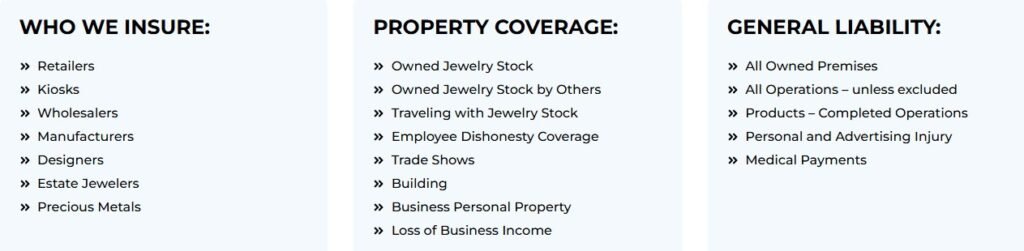
What Jewelers Block Insurance Actually Covers
So, what does a Jewelers Block insurance policy actually pay for when you run a jewelry store? Let’s move past the theory and get right to the practical protections. This isn't just another line item on a policy; it's a financial lifeline designed for the unique chaos of the jewelry trade.
Think of it as a comprehensive, high-strength shield over your entire operation. A standard business policy protects some assets, but it wasn't built for the risks of holding and moving millions in inventory. Jewelers Block insurance is what steps in to protect your direct financial stake in the business itself.

Core Protection for Your Most Valuable Assets
At its most basic, Jewelers Block is property insurance for your inventory. Its main job is to cover the "hard costs"—all the tangible, physical things that make up your business's wealth.
For a jeweler, this is where the policy really proves its worth. It covers the essential components of your business:
- Your Inventory (Stock): This is your precious and semi-precious stones, finished jewelry, watches, gold, and silver. If a thief smashes your cases and makes off with your display, the policy pays to replace it.
- Customer Property: Your reputation is built on trust. If a customer's heirloom ring is stolen from your safe or damaged in a fire while in for repair, this coverage reimburses them, protecting your good name.
- Raw Materials: This covers loose stones, findings, and metals used in custom designs and repairs. If they’re stolen or ruined by a sudden storm, this coverage foots the bill for replacements.
- Property in Transit or Off-Site: What happens if a package of diamonds is lost in the mail or a case of watches is stolen from your car on the way to a trade show? A well-written policy covers your inventory even before it arrives or after it leaves your store.
From the moment you acquire a piece until the moment it's sold, your inventory is protected from the heightened risks of the jewelry trade—like fire, theft, and mysterious disappearance.
Demystifying Other Essential Coverages
A major loss can bleed you dry financially, even beyond the cost of the stolen goods. This is exactly what other components of a Jewelers Block insurance policy are designed to prevent.
These coverages are the financial shock absorbers of your jewelry business. They pay for the frustrating, unexpected expenses that pile up after a covered disaster, ensuring one setback doesn’t sink your entire business.
Jewelers Block insurance is your financial safety net. It pays for the direct loss of inventory and can be structured to cover the frustrating, unexpected business expenses that accumulate while you’re stuck waiting to reopen, ensuring one setback doesn’t ruin your livelihood.
Picture this: A fire tears through your showroom, forcing you to close for three months. Your policy could be structured to help you with:
- Business Interruption: The lost profits and continuing expenses (like rent and payroll) you now face because your store is closed.
- Extra Expense: The money you have to spend to set up a temporary location or expedite repairs to get back in business faster.
- Building Coverage: Protection for your physical store, including custom-built showcases, vaults, and security systems.
- Professional Fees: Fees for public adjusters or security consultants needed after a major loss.
Without this comprehensive insurance for a jewelry store, you’re paying for these losses out of your own pocket, adding a massive financial burden to an already stressful situation. While this policy is for your business, it's also smart to understand how other policies work, like the details of water damage coverage under homeowners insurance. An experienced agent helps you see the full picture. Of course, the materials in a jewelry business are a world apart, as you can see in our guide to high-value assets.

Understanding Exclusions and Finding the Right Add-Ons

While a Jewelers Block insurance policy is a powerful shield, it's critical to know it doesn't cover everything. Just like any policy, a Jewelers Block policy has its own set of rules and boundaries. Honestly, understanding what isn’t covered is just as important as knowing what is.
Think of a standard Jewelers Block policy as your protection against big, external events—theft, fire, or damage. But it has conditions and warranties that must be met. Recognizing these built-in limits is the first step to ensuring your jewelry business is truly secure.
What Your Standard Policy Usually Won't Cover
Every Jewelers Block policy comes with a list of standard exclusions and warranties. These are risks the policy isn't built to handle or conditions you must meet for coverage to apply.
Common exclusions or situations that can void coverage include:
- Breach of Security Warranties: If you state in your application that you have a certain safe or alarm system, you MUST use it. If you have a loss and the safe was left open, the claim could be denied.
- Unattended Vehicle Exclusion: If you leave jewelry in an unattended vehicle, even for a moment, any theft from that vehicle will almost certainly be excluded.
- Mysterious Disappearance / Unexplained Loss: While some policies include this, many basic forms exclude it. This refers to inventory that is discovered missing during an audit with no explanation.
- Earthquakes and Floods: Much like a standard property policy, damage from earth movement or major flooding typically requires separate, specialized coverage, especially if your business is in a high-risk area.
Knowing these exclusions isn't about finding fault with the policy. It’s about preventing a false sense of security and making sure you operate your business in a way that keeps your coverage intact.
The point of reviewing exclusions isn't to poke holes in your coverage. It's to build a complete risk management plan. By seeing what's left out, you can proactively find the right solution to protect your business from every single angle.
Closing the Gaps With Essential Endorsements
This is where you can truly tailor your protection. An endorsement, sometimes called a rider or an add-on, is simply a modification to your base policy that adds coverage for a specific risk. For a high-value jewelry business, these aren't just a "nice-to-have"—they're absolutely essential.
An experienced agency like First Class Insurance, a First Class Insurance Jewelers Block Agency, that lives and breathes the jewelry industry will know exactly which endorsements you need. This is how you transform a generic policy into a custom-fit safety net for your unique business.
Must-Have Add-Ons for a Jewelry Business
When you're running a jewelry store, you're not just selling products; you're shipping, receiving, appraising, and traveling. Your insurance for jewelry business has to reflect that reality.
Here are the add-ons you should consider non-negotiable for your Jewelers Block policy:
Shipping Coverage: This is critical. It protects high-value items while they're being shipped to customers or other dealers. A standard policy may have very low limits for shipping, but this endorsement ensures you're covered for the full value.
Travel & Trade Show Coverage: This protects your inventory while you are traveling or exhibiting at a trade show. It specifies your coverage limits for when you are away from your main business premises.
Appraisal Liability (Errors & Omissions): If you provide appraisals, this is a must-have. It covers you if you make a mistake on an appraisal that causes a financial loss for your client, and they sue you.
Employee Dishonesty: As we discussed, internal theft is a major risk. This endorsement covers losses caused by your own employees stealing from you, a risk often excluded from base policies.
Partnering with an insurance specialist who gets the difference between a clothing boutique and a high-end jewelry store is the key. They can navigate these details, ensuring your Jewelers Block policy is perfectly aligned with your business, leaving no expensive surprises down the road.
How to Secure Your Jewelers Block Policy Step By Step
Getting the right Jewelers Block insurance isn't nearly as complicated as it sounds. Think of it like putting together a business plan—the clearer and more organized your information is, the faster you get the protection you need.
The whole point is to give the underwriter a crystal-clear picture of your operation. They need to see your inventory values, security measures, and the specific risks involved to craft a policy that actually protects your investment. A clean, well-organized submission doesn't just speed things up; it shows you’re a serious partner.
Step 1 Gather Your Essential Business Documents
Before you can even get a quote, you need to get your paperwork in order. This is the foundation of your entire application. An underwriter's first job is to understand exactly what they’re being asked to insure.
Think of it as your business’s resume. Here’s what you’ll need to have ready:
- Detailed Inventory Values: This includes your maximum inventory value at any given time, as well as separate values for what's in the safe, out of the safe during business hours, and in display windows.
- Security & Protection Details: This includes specifics about your safes (UL rating), alarm system (central station monitoring), and any surveillance cameras.
- Business Operations Information: Be prepared to share your annual sales, how much you ship, if you travel for trade shows, and your history of any prior losses.
- Personal Jewelry History: Underwriters will want to know the background and experience of the business owners in the jewelry industry.
Having these items ready from day one makes the entire process incredibly smooth. It shows you've done your homework.
Step 2 Underwriting and Risk Assessment
Once your documents are in, the underwriting process kicks off. This is where an insurance expert digs into your business’s specific risks to figure out a fair premium. For a high-value jewelry business, underwriters are going to look extra hard at security.
They’ll focus on a few key factors:
- Owner Experience: Have the owners been in the jewelry business for a long time? A seasoned pro with a solid track record is a huge plus.
- Store Security Measures: What's the plan for securing the premises? This includes your safe, alarm, cameras, and operational procedures like showing only one item at a time.
- Geographic Location: The store's location matters a lot, especially when it comes to risks like theft, smash-and-grabs, or exposure to natural disasters.
This is where working with a specialist really pays off. At First Class Insurance, we know the unique risks that come with a jewelry business. We know how to present your business’s strengths to underwriters and can often turn around a quote within 24 hours.
Step 3 Review Your Quote and Finalize Coverage
After the underwriter has done their analysis, you’ll get a formal quote. This document breaks down the proposed coverage, limits, endorsements, exclusions, and the final price. It’s absolutely critical to review this with your insurance agent, line by line.
Your insurance quote is more than just a price—it's the blueprint for your financial protection. Scrutinize every detail to ensure it aligns perfectly with your business's scope and value, leaving no room for expensive surprises later.
Navigating the insurance market is also key. For instance, while some insurance premiums are stabilizing, rates for jewelry businesses in catastrophe-prone or high-crime areas are still climbing. For a jeweler, this highlights the advantage of working with an expert who knows the market inside and out. With 30+ years of experience, we can find the right Jewelers Block insurance to close gaps and navigate these market shifts. You can read more about these trends in property coverage from recent market reports.
Once you're confident the policy meets your needs—and includes crucial add-ons for a jeweler, like shipping and travel coverage—you give your final approval, pay the premium, and the policy is officially in force. You'll then receive your policy documents, confirming your business is protected from day one. You can explore more about our trusted partners through our materials on industry leaders.

What to Do When You Need to File a Claim

Even the most carefully run jewelry business can go sideways. A robbery, a fire, or a grab-and-run can bring your business to a dead stop. When a disaster hits your store, knowing exactly what to do next can make the difference between a manageable hiccup and a catastrophic loss.
The first few moments after a loss are absolutely critical. Your immediate priority is always safety, followed by preventing the damage from getting any worse. Once the site is secure and the authorities have been called, your focus has to shift to documentation and communication.
Your Immediate Action Plan
When your business is hit with unexpected damage or theft, the initial recovery steps after property damage are non-negotiable. Moving quickly and methodically lays the groundwork for a smooth and successful Jewelers Block insurance claim.
Here are the first three things you must do:
Secure the Premises & Notify Authorities: Your first job is to ensure everyone is safe and call the police immediately in the event of a crime. Preserve the scene as best you can for their investigation. If it's a fire or water damage, take reasonable steps to prevent further loss.
Document Everything: Before a single thing is moved or cleaned up (after police allow), create an undeniable visual record. Take tons of photos and videos from every conceivable angle. Get wide shots of the entire scene and then zoom in for close-ups of the specific damage. This proof is your single most powerful tool for your claim.
Notify Your Insurance Agent Immediately: Don't wait. Call your agent at First Class Insurance as soon as it's safe to do so. They'll walk you through the exact requirements of your policy and get the official claims process rolling.
Navigating the Claims Process
Once you’ve reported the loss, the insurance company will assign a claims adjuster to your case. The adjuster’s role is to investigate what happened, evaluate the extent of the damage, and calculate the value of the covered loss based on your policy. They will want to review your records and may come to the site.
During this time, it is vital to keep perfect records of all your communications. Log the dates, times, and notes from every single call and email with the adjuster. You also need to begin compiling a detailed inventory of what was lost or damaged, complete with purchase invoices or other proof of value.
Your insurance agent is your most valuable ally during a claim. A dedicated partner like First Class Insurance advocates on your behalf, ensuring the adjuster has all necessary information and working to secure a fair and timely settlement.
Having an expert in your corner takes an enormous weight off your shoulders. While you focus on recovering from the event, your agent is handling the tough insurance negotiations. This partnership ensures you get the money you're owed without fighting for it, letting you get your jewelry business back on track.
Frequently Asked Questions About Jewelers Block for Jewelers
When you're dealing with something as specific as Jewelers Block insurance for a jewelry store, a lot of questions come up. Let's cut through the noise and get you some straight answers so you can protect your business with confidence.
Does Jewelers Block Insurance Cover My Building?
Sometimes, but not always. A basic Jewelers Block policy is primarily designed to cover your "stock"—your jewelry inventory. However, it can be endorsed or packaged with other coverages to include your building, business personal property (like computers and furniture), and business interruption.
This is a critical conversation to have with your agent. A specialist from a First Class Insurance Jewelers Block Agency can help you build a comprehensive package that protects your inventory, your physical store, and your ongoing income, leaving no gaps.
My Landlord Has Insurance. Isn't That Enough?
This is a common, and very risky, assumption. Your landlord's insurance covers the building structure itself—the shell. It does absolutely nothing to protect your inventory, your showcases, your computers, or your liability if someone gets hurt in your store. More importantly, it won't pay you for lost income if the building burns down.
As the business owner, you’re the one on the hook for those losses.
A Jewelers Block policy provides "first-party" coverage. That means it pays you—the owner—directly for the loss of your inventory. It protects your most valuable assets and keeps you from going out of business after a major theft or fire.
What if My Inventory Value Changes Throughout the Year?
Inventory fluctuation is a fact of life in the jewelry business. Your policy should be written with a limit high enough to cover your maximum expected inventory at any one time, such as during the holiday season. You will be asked for your average and maximum values.
Being proactive is everything here. If you anticipate a major purchase that will exceed your policy limit, call your agent before it happens. Coverage can often be temporarily increased. Keeping your agent informed ensures you are never underinsured when you are most vulnerable. You can also explore our resources on navigating industry events and trends to stay informed.

Is Jewelers Block Only for Retail Stores?
Not at all. Jewelers Block insurance is essential for almost any type of jewelry business, including wholesalers, manufacturers, designers, and appraisers.
The policy is highly customizable. Whether you operate out of a private office, travel the country for trade shows, or run a large manufacturing facility, the policy can be tailored to protect your specific operational risks. It’s designed to fit your business model, making it essential for any professional in the jewelry industry.
Ready to secure your business and protect your investment? The experts at First Class Insurance have over 30 years of experience crafting policies specifically for the jewelry industry. Get a Quote for Jewelers Block today.