
You lock the showcases. You reconcile the till. You review the day’s repairs and incoming shipments. Everything looks normal until one tray doesn’t.
No smashed glass. No alarm. No obvious break-in. Just a few missing pieces that should be there and aren’t.
That’s how many jewelry losses start. Not with a dramatic robbery, but with a quiet discrepancy. A trusted employee skims small items over time. A package signed out for delivery never reaches the client. A stone goes missing between the bench and the case, and nobody can say exactly when it disappeared. In a jewelry business, the most painful losses are often the ones that leave the fewest clues.
The Threat Hiding in Plain Sight
A jewelry store owner usually prepares for the obvious threat. Cameras. Buzzer entry. Safes. Better locks. Those matter.
But the losses that create the most coverage disputes are often subtle. A repair item can vanish without forced entry. A memo parcel can be mishandled. A staff member with full access can remove one small piece at a time, staying below the level that triggers immediate suspicion.

Quiet losses hit jewelers differently
Jewelry creates a unique crime profile because the inventory is compact, high value, and easy to move. A laptop is easy to identify. A one-carat diamond, a signed bracelet, or a loose colored stone can disappear into a pocket, a repair envelope, or a shipment with far less attention.
That’s why generic business insurance often falls short for this trade. Many standard forms are built around visible property damage or straightforward theft. Jewelry losses don’t always look like that. They often involve trust, access, handling errors, and the kind of uncertainty that turns a claim into an argument.
A strong visual reminder of that exposure is this jewelry inventory image: specialty jewelry risk profile.

The hardest jewelry losses to insure aren’t always the largest. They’re the ones that don’t fit neatly into a standard property claim.
Why crime coverage insurance matters now
The need for specialized crime protection isn’t theoretical. The global crime insurance market was valued at $13.7 billion in 2022 and is projected to reach $47.7 billion by 2032, growing at a CAGR of 13.5%, according to Allied Market Research’s crime insurance market analysis. That growth is tied to rising fraud and cybercrime, but the takeaway for jewelers is simpler. Businesses with valuable, portable assets are buying more focused protection because broad policies don’t fully address modern theft and fraud risk.
For a jeweler, crime coverage insurance isn’t an add-on for edge cases. It’s part of the foundation. If your business handles high-value stock, customer property, repair intake, memo goods, or shipments, you need coverage built for dishonest acts and unexplained loss scenarios, not just broken doors and broken glass.
Defining Your Financial Shield Against Crime
Property insurance protects the building and contents against covered physical events. Crime coverage insurance does a different job. It protects the business when someone steals money, securities, or property through dishonest or fraudulent acts.
Think of it this way. A deadbolt protects the front door. Crime insurance protects what happens after someone gets around the door, the process, or the person in charge.

What a crime policy is built to do
A commercial crime policy is designed to respond to intentional wrongdoing. In practice, that usually means losses tied to theft, fraud, forgery, robbery, burglary, employee dishonesty, and certain forms of funds transfer or social engineering if the policy includes that wording.
For a jewelry business, that matters because many serious losses happen through access and deception, not blunt force. Someone may manipulate records, divert a payment, remove stock during normal business hours, or exploit trust inside the store.
Crime coverage insurance focuses on the act itself. It asks: was there a covered dishonest act that caused direct financial loss?
Internal crime and external crime are different exposures
A good jeweler’s insurance review separates two broad categories:
- Internal threats include employee theft, embezzlement, forged endorsements, or dishonest handling of inventory and customer property.
- External threats include robbery, burglary, forgery by outsiders, funds transfer fraud, and certain social engineering losses if endorsed.
- Blended threats sit in the middle. A criminal might impersonate a vendor while an employee unknowingly helps complete the fraud.
That distinction matters because different insuring agreements respond to different facts. Store owners often assume “theft is theft.” In policy language, it isn’t.
What crime insurance does not replace
Crime coverage insurance is important, but it doesn’t replace other core policies.
It doesn’t stand in for:
- Commercial property insurance for physical premises and standard contents loss
- Cyber insurance for data breaches, system compromise, and cyber response costs
- Transit and floaters for goods moving between locations or people
- Jewelers Block insurance for the broader, jewelry-specific risk package discussed later
That’s where many buying mistakes happen. A retailer buys a basic business package policy and assumes it covers every kind of theft. Then a loss occurs, and the carrier points to an exclusion, a sublimit, or the absence of a specific crime insuring agreement.
Practical rule: If a loss could happen without visible damage to your store, don’t assume your property policy will handle it.
The promise and the limitation
The core promise of crime insurance is straightforward. If a covered person commits a covered dishonest act, or an outside party commits a covered crime under the policy wording, the insurer may reimburse the direct financial loss.
The limitation is just as important. These policies are technical. Coverage often depends on exact definitions, discovery timing, proof of direct loss, and whether the event fits a named insuring agreement or endorsement.
That’s why jewelry businesses need more than a generic explanation of “theft coverage.” They need policy language that reflects how inventory moves through a showroom, a repair counter, a bench area, a vault, and a shipping process.
Key Crime Perils in the Jewelry Trade
Jewelry stores don’t face one crime problem. They face several, and each one shows up differently in the policy.
Some losses are obvious. Others surface weeks later during inventory review. The danger is assuming all theft-related events fall under one broad bucket. They don’t. The exact peril matters.
The losses that show up most often
Employee dishonesty is one of the first places I look in any jewelry account. A staff member may have legitimate access to cases, repair intake, memo parcels, or loose stones. If that person steals, the claim usually turns on whether the policy covers direct loss from employee theft and how the facts are documented.
According to The Hartford’s crime coverage analyzer, employee dishonesty coverage reimburses direct financial losses from employee theft but typically excludes indirect losses like lost profits. That matters. If an employee steals a diamond ring, the policy may address the direct loss of the ring. It typically won’t cover the downstream profit you expected from selling it later. The same source also notes that internal fraud accounts for 30-40% of losses in the retail sector.
A useful visual reference for the type of high-value inventory exposed to these risks is this image of antique jewelry and portable stock.

Crime Coverage for Jewelers At-a-Glance
| Crime Type | What It Covers | Jewelry Store Example |
|---|---|---|
| Employee dishonesty | Direct loss caused by employee theft, forgery, or embezzlement where covered | A sales associate removes small diamond studs from stock over time |
| Forgery | Loss tied to forged checks or altered financial instruments where covered | A fraudster uses a forged check to acquire a high-value item |
| Robbery | Property taken by force or threat | A store is held up during business hours and items are taken from showcases |
| Burglary | Theft involving unlawful entry, often after hours | Someone breaks in overnight and empties a section of the vault or cases |
| Mysterious disappearance | Certain unexplained losses if the policy includes this protection | A tray of rings is present in the morning count and missing by afternoon with no sign of forced entry |
| In-transit loss | Property stolen or lost while being moved, shipped, or delivered if covered | A package sent to a client or trade show never arrives |
Employee dishonesty
This is the slow-drip loss that hurts the most. It often starts small. A missing charm. A loose stone not entered properly. A customer trade-in that doesn’t match the paperwork later.
The practical issue isn’t only the theft. It’s proof. If your inventory system, camera retention, intake forms, and dual-control procedures are weak, you may know something happened without being able to show exactly how or when.
Forgery and payment fraud
A jeweler may accept a check, release merchandise, and find out later the instrument was forged or altered. In wholesale settings, the same problem can appear in account instructions, endorsements, or vendor payment requests.
This peril sits in the financial side of the business, not the showcase. Owners sometimes focus so much on protecting stock that they overlook how easily money can leave through fraudulent paperwork.
Don’t separate inventory risk from accounting risk. Criminals don’t.
Robbery and burglary
These are the classic events most owners picture first. A daytime hold-up. An after-hours break-in. Forced entry into the premises or vault area.
They’re still important, but they’re usually easier to identify than an internal theft or unexplained disappearance. There’s visible evidence, police involvement, and a more familiar claims path. The mistake is assuming these obvious losses are the whole crime picture.
Mysterious disappearance
For jewelers, this is one of the most important concepts in the entire insurance discussion. A piece may go missing from a tray, a safe transfer, a repair envelope, or a client presentation without signs of violence or forced entry.
That’s where generic business policies often disappoint. If there’s no visible break-in and no identifiable thief, a standard form may resist the claim or exclude it altogether. In jewelry operations, unexplained disappearance is not rare enough to ignore.
In-transit loss
Every time inventory leaves the store, the risk changes. Delivery to a customer. Shipment to a show. Transfer between locations. Memo movement. Vendor return.
Loss in transit can involve theft, misdelivery, simple vanishing, or chain-of-custody problems. If your policy language doesn’t specifically address transit exposure, you may discover too late that your best-protected inventory was only covered while sitting inside the premises.
A hiring detail many owners miss
The Hartford source also notes that policies can be enhanced to modify prior criminal record exclusions for minor offenses. That can matter in retail hiring, especially when a carrier’s default wording would otherwise create complications over employee eligibility.
That doesn’t mean ignoring background checks. It means understanding that hiring realities and policy wording need to match. A jeweler should know exactly how the policy treats employee history before a loss ever occurs.
Why Jewelers Block Is Your Ultimate Coverage
A standard crime policy can be useful. For a jewelry business, it usually isn’t enough on its own.
That’s because jewelers don’t just need protection from dishonest acts. They need one insurance framework that follows inventory in the case, in the vault, on the bench, with a salesperson, in a shipment, and sometimes in the hands of a customer or outside service provider.

Generic policies leave awkward gaps
Most off-the-shelf business insurance was not written with diamonds, estate pieces, custom mountings, repair intake, memo goods, and daily shipment activity in mind. That’s the core issue.
A generic crime form may cover some theft scenarios. A property policy may cover some premises loss. A separate inland marine form may address some movement of goods. But piecing those together often creates gray areas.
The biggest gray area for jewelers is often unexplained or non-forced loss. According to Liberty Specialty Markets’ discussion of commercial crime coverage gaps, standard property policies often exclude mysterious disappearance or non-forced entry thefts. The same source states that jewelry thefts rose 15% in major US markets in 2025 and that recovery rates were under 20%. For a jewelry store owner, that’s the warning. The loss most likely to create stress is also one of the losses least likely to fit a basic policy.
Why Jewelers Block fits the trade better
Jewelers Block insurance exists because jewelry businesses have a distinct risk profile. The inventory is highly portable, highly concentrated in value, frequently moved, and vulnerable to both visible theft and subtle disappearance.
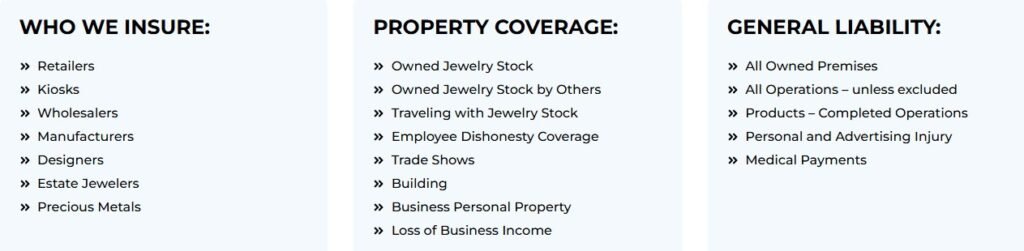
A proper Jewelers Block program is built to address issues such as:
- Store stock exposure in showcases, safes, vaults, and back-office handling
- Customer property exposure for repairs, remounts, cleaning, and consignment-related handling
- Transit exposure when goods move to clients, trade shows, appraisers, setters, or other locations
- Employee and internal theft concerns that overlap with crime coverage
- Mysterious disappearance concerns that standard property forms often handle poorly
That’s the difference. Instead of asking one policy to cover the building, another to cover theft, and another to cover movement of goods, Jewelers Block is designed around the way jewelers operate.
Crime coverage insurance still matters inside Jewelers Block
This isn’t an either-or choice. Crime coverage insurance still matters. It’s one of the engines inside a stronger overall protection strategy.
For a jeweler, the better question is not “Do I need crime insurance or Jewelers Block?” It’s “How does my Jewelers Block program address crime-related loss, internal dishonesty, unexplained disappearance, and shipment exposure together?”
That integrated view matters more than a low premium or a broad marketing label.
A quick overview can help frame that difference:
Specialist placement matters
Jewelry insurance is one of those areas where market access and wording control matter as much as price. A generalist can often get a quote. That doesn’t mean they can build the right structure.
Specialist programs often involve established markets, including underwriters recognized in the high-value asset space, such as those associated with Lloyd’s-backed specialty capacity. What matters to the insured is not the logo. It’s whether the person placing the policy understands memo stock, repair intake, transit habits, showcase concentration, employee access, and the claim problems that arise when policy forms are mismatched.

If your insurance program treats a diamond ring like office furniture, it’s the wrong program.
Navigating Policy Limits Endorsements and Exclusions
A jewelry owner can buy the right category of policy and still be underinsured. The problem usually sits in the fine print. Limits, sublimits, endorsements, and exclusions decide how a claim pays.
The number on the declarations page isn't the whole story
If your policy shows a large overall limit, that’s only the start. You still need to know whether different causes of loss have smaller caps built inside the form.
Social engineering is a good example. According to Marsh’s review of current crime insurance conditions, crime insurance premiums recently increased by 7.57%, and underwriters are focusing closely on internal controls, loss history, and employee counts. The same source notes that social engineering fraud coverage is often sublimited to $250,000.
For a high-value jewelry operation, that should get your attention. If a policy has a strong overall limit but a much smaller sublimit for a specific fraud scenario, the practical protection may be far less than the owner expects.
Terms every jeweler should pin down
Here are the policy mechanics that matter most:
- Per-occurrence limit means the most the policy will pay for one covered event.
- Aggregate limit means the most it will pay during the policy period for all covered events combined.
- Sublimit means a smaller cap applies to a certain category of loss, even when the main policy limit is higher.
- Deductible is the amount the insured absorbs before coverage responds.
- Discovery provision governs when a loss must be found and reported.
If you want a plain-language refresher on how insurers structure claim caps, this guide on insurance policy limits explained is useful background before you review your own forms.
Endorsements that can make or break protection
In jewelry accounts, endorsements aren’t optional extras. They often determine whether the coverage matches the operation.
Look closely at whether the policy includes or addresses:
- Social engineering coverage for vendor or executive impersonation scams
- Funds transfer fraud wording that matches how payments are initiated
- Employee dishonesty enhancements where staffing realities require careful underwriting
- Third-party dishonesty extensions if you handle customer property
- Transit-related endorsements if staff, vendors, or carriers regularly move inventory
One endorsement can fix a dangerous gap. Another can create a false sense of comfort if the sublimit is too low.
Exclusions owners regularly overlook
These are the issues I see misunderstood most often:
- Owner acts are commonly excluded. If the wrongdoing involves an owner or partner, many crime forms won’t respond.
- Indirect losses are often excluded. Lost profits, reputational harm, and business slowdown usually sit outside the policy.
- Inventory shortage language can be restrictive. If the only proof is a count discrepancy, the claim can become difficult.
- Voluntary parting problems can arise. If stock was handed over because of deception, coverage may depend on specific wording.
The lesson is simple. Don’t buy on premium alone. For a jewelry store, the right limit with the wrong sublimit is still a weak program.
Managing a Claim and Mitigating Future Losses
When a jewelry loss is discovered, the first few hours matter. So do the procedures you had in place before the loss happened.
A claim is easier to prove when the store can show who handled the item, where it was logged, when it moved, and what controls governed the transaction.

What to do right after a loss
Don’t rush to fill in gaps with assumptions. Secure the facts first.
- Secure the area: Limit access to the showcase, vault, bench station, repair intake area, or office involved.
- Preserve records: Pull video footage, POS records, intake forms, shipping logs, staff schedules, and inventory movement history.
- Notify the carrier promptly: Delayed reporting creates avoidable problems.
- File the necessary reports: Police involvement may be required depending on the event and policy conditions.
- Separate facts from suspicion: Identify who had access, but don’t present guesses as proof.
A good claim file starts before the adjuster arrives. It starts with your daily controls.
What strengthens a jewelry claim
The strongest claims usually have clean supporting records. That includes:
| Claim support item | Why it matters |
|---|---|
| Inventory logs | Shows the item existed and where it was assigned |
| Repair intake forms | Establishes customer property details and custody |
| Camera footage | Helps confirm handling, timing, and access |
| Shipping records | Documents transit chain and delivery status |
| Employee access records | Narrows who could reach the property |
Controls that reduce losses and help renewals
Underwriters pay attention to internal discipline, especially on crime-related exposures. Good controls help prevent loss, but they also help you qualify for better terms.
Focus on the basics that work:
- Dual authorization for payments: Don’t let one person alone release a wire or change vendor payment details.
- Tight repair intake procedures: Photograph customer pieces, record stone counts, and document condition before work begins.
- Segregation of duties: The person receiving, logging, and reconciling high-value items shouldn’t be the same person throughout the process.
- Background checks and access controls: Match access to role. Not every employee needs full reach into every part of inventory.
- Regular exception reviews: Investigate voids, markdowns, memo returns, and adjustment entries, not just year-end shortages.
One overlooked coverage issue
If your business has employee benefit plans, many crime policies include ERISA fidelity bonding. But jewelers also need to think about the property of others in their care.
According to Hanover’s fidelity and crime coverage overview, many crime policies include ERISA fidelity bonding, but businesses handling customer property should make sure they have a third-party dishonesty extension. The same source notes that payroll fraud hit 18% of small retailers. For jewelers, that’s a reminder that internal controls need to cover both money movement and entrusted property.
Secure the Right Protection for Your Jewelry Business
A jewelry business can’t insure itself like a standard retailer. The inventory is too concentrated in value, too portable, and too exposed to quiet forms of loss.
That’s why crime coverage insurance matters. It addresses dishonest acts that don’t always leave physical evidence. But crime coverage by itself still isn’t the full answer for most jewelry operations. Effective protection comes from a program built around showroom stock, repair intake, employee access, customer property, and transit risk.
A lot of owners focus first on visible security, and they should. Cameras, access control, safes, and a professionally installed security system help reduce loss opportunities. But physical security alone won’t solve policy gaps. If the wording excludes mysterious disappearance, limits social engineering too aggressively, or fails to address customer property and transit, you can still be left holding a major uninsured loss.
The right approach is practical:
- Review how inventory moves through your business
- Match coverage to those movements instead of buying a generic package
- Stress-test every exclusion and sublimit before a claim happens
- Use a specialist broker or agency that understands jewelry operations, not just small business insurance generally
That last point matters most. A specialist knows the difference between stock on premises, memo goods, repairs, transit, and unexplained disappearance. They know where generic forms break down. They know which questions underwriters ask because they’ve seen the claims.
If you own a jewelry store, run a wholesale operation, or handle customer pieces at the bench, don’t wait until a discrepancy turns into a denial. Get a quote for Jewelers Block and make sure your crime protection is built for the trade you are in.
First Class Insurance helps jewelers secure specialized protection built for high-value, portable inventory, employee dishonesty risks, mysterious disappearance, and transit exposures. If you need Jewelers Block insurance, jewelry store insurance, or insurance for a jewelry business, request a custom quote from First Class Insurance.