
Think of your main insurance policies—like general liability or commercial auto—as the first line of defense for your jewelry business. They're designed to handle the most common threats you face. But what happens when a claim is so big, so catastrophic, that it blows right past those limits?
That's where excess/umbrella liability insurance comes in. It's not a replacement for your primary policies; it's a critical second layer of financial armor that activates only after your other coverage has been completely used up. It’s built to protect your business from the kind of lawsuit that could otherwise wipe you out.
Why Your Jewelry Business Needs a Financial Safety Net
Let's be realistic. A standard liability policy, while absolutely essential, often isn't enough for a business built around high-value inventory and a sophisticated clientele. Over 43% of small business owners have been threatened with or have faced a lawsuit. The costs can be staggering.
A single major claim—a severe slip-and-fall in your showroom or a bad accident involving a company vehicle—can easily rocket past a typical $1 million policy limit. Once that happens, you’re on the hook for the rest, and that can put everything on the line.
Beyond Your Standard Policy Limits
Without this extra layer of protection, your business assets, your future profits, and even your personal wealth could be seized to cover a massive legal judgment. An umbrella policy sits on top of your existing coverage, giving you the peace of mind that comes from knowing you’re prepared for a worst-case scenario.
It works hand-in-hand with the policies you already have:
- Jewelers Block Insurance: This is your core coverage for the physical assets you handle every day—your inventory and your customers' property.
- Commercial General Liability: This covers claims of bodily injury or property damage happening on your premises or because of your operations.
- Commercial Auto Liability: This protects you against claims from accidents involving your business vehicles.
An excess or umbrella policy is your ultimate backstop. It's a surprisingly cost-effective way to ensure a single devastating event doesn't destroy the business you've worked so hard to build.
Covering All the Angles
The day-to-day work of a jeweler is full of unique risks. From intricate custom designs to managing specialized services like jewellery repair in bustling areas such as Hatton Garden, a simple mistake with an irreplaceable item could lead to a massive claim.
An excess/umbrella liability policy does more than just give you higher coverage limits; it reinforces your entire financial security structure. It's the kind of foresight that separates a truly resilient business from one that’s just one bad day away from disaster.
Umbrella vs. Excess Liability: What's the Difference?
When you’re looking to add protection on top of your primary insurance, you'll hear two terms thrown around: "umbrella" and "excess" liability. They both give you higher limits, which is great, but they absolutely are not the same thing. For a jeweler, understanding how they work is key to building a real financial safety net, not just a taller fence.
Think of excess liability insurance as just adding more bricks to the top of your existing walls. It sits directly over a single policy—like your commercial general liability—and simply increases the dollar limit. It doesn’t change what that policy covers; it just gives you more of it.
An umbrella liability insurance policy is different. It's more like a massive, protective shield that covers your entire financial fortress. It extends over multiple policies at once (general liability, commercial auto, employer’s liability) and can even "drop down" to cover claims your primary policies don't touch.
This diagram shows you exactly how these layers fit together in a well-built insurance program.
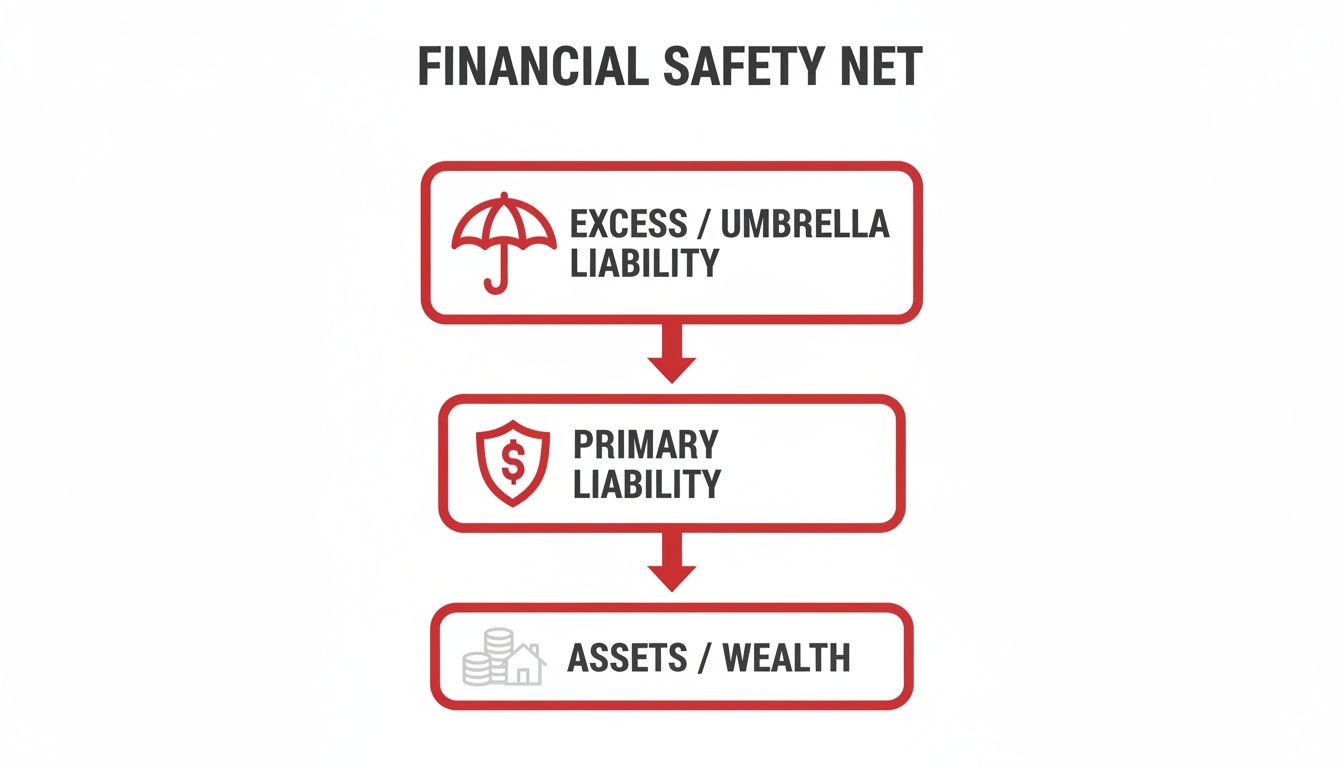
As you can see, your primary liability is the foundation. The umbrella or excess policy provides that critical upper layer of defense you need when a claim goes from bad to catastrophic.
A Deeper Dive Into How They Work
Excess liability is wonderfully straightforward. If a claim blows past your primary policy’s limit, the excess policy steps in to pay what’s left—but only for a risk that was already covered. Say your general liability limit is $1 million and you have a $5 million excess policy on top of it. You now have $6 million in total coverage for the exact same perils your primary policy covers. Simple.
Umbrella policies are far more versatile. Not only do they boost your limits across several policies, but they can also plug critical coverage gaps. Imagine your jewelry store gets sued for libel, but your general liability policy specifically excludes it. An umbrella policy might just drop down and provide coverage where you had none before, but you'll first have to meet a self-insured retention (SIR). Think of the SIR as a deductible you pay out-of-pocket before the umbrella policy kicks in for a claim not covered by any of your primary policies.
The core difference really comes down to breadth. Excess liability adds more of the same coverage. Umbrella liability adds more coverage and can provide broader protection against risks your other policies won't touch.
This distinction is more important than ever. The excess liability insurance market is currently valued at USD 15.89 billion and is projected to climb to USD 20.94 billion by 2029. That kind of growth shows just how seriously businesses are taking this extra layer of security, especially when you’re managing high-value assets like a jewelry store. You can explore more data on these market trends and what they mean for the industry.
Umbrella Liability vs Excess Liability at a Glance
To make the choice crystal clear, let's break down the key differences side-by-side. This comparison should help you figure out which policy type better fits the unique risks you face with your insurance for a jewelry store.
| Feature | Excess Liability Insurance | Umbrella Liability Insurance |
|---|---|---|
| Coverage Scope | Follows the exact terms of one underlying policy ("follow form"). | Can be broader than underlying policies, covering claims they exclude. |
| Policy Interaction | Sits on top of a single primary policy. | Sits on top of multiple primary policies (e.g., CGL, Auto). |
| Drop-Down Feature | Does not offer drop-down coverage for excluded claims. | Can "drop down" to act as primary insurance for uncovered claims. |
| Common Use Case | Increasing the financial limit for a specific, known risk. | Creating a wide-ranging safety net for various liability exposures. |
Ultimately, choosing between the two comes down to your specific needs. Do you just want to raise the limit for a single, high-risk area? Or do you need a broader shield to protect you against a wider array of potential lawsuits? For most jewelers, the comprehensive protection of an umbrella policy offers far more complete peace of mind.
How These Policies Protect Jewelers in the Real World
Policy documents are one thing, but seeing how coverage plays out in real life is where the true value of excess/umbrella liability insurance really hits home. Let's move past the theory and look at a few concrete examples. These are the kinds of situations that can turn a normal business day into a financial nightmare—and show why this coverage is so critical.

We'll walk through three distinct scenarios that any jeweler can easily imagine. Each one shows how quickly a claim can spiral and the exact moment an umbrella policy steps in to save the business.
Scenario 1: The Showroom Slip-and-Fall
Picture this: a long-time client is in your showroom to view a new collection of estate diamonds. Your staff just polished the marble floors, and despite a "wet floor" sign, the client slips, suffering a serious hip fracture and a head injury.
The aftermath is a lawsuit for medical bills, ongoing physical therapy, and lost income. The court sides with the client and awards a $2.5 million judgment. Your standard Commercial General Liability (CGL) policy, however, caps out at $1 million.
Here’s how the insurance payout would work:
- Your Primary Policy Pays First: The CGL policy kicks in and pays its full $1 million limit.
- You're Left with the Gap: That still leaves a staggering $1.5 million shortfall. Without another layer of protection, that money comes directly out of your business assets. For many, that means liquidation.
- The Umbrella Policy Rescues the Business: Thankfully, you have a $5 million umbrella policy. It activates the second your CGL is exhausted, covering the entire remaining $1.5 million judgment and the associated legal defense costs.
In a flash, the umbrella policy absorbed a catastrophic financial hit, keeping your business intact.
Scenario 2: The Catastrophic Delivery Accident
One of your most reliable employees is driving the company van to make a special delivery of a custom piece. He glances down at the GPS for a split second, misses a red light, and causes a multi-car pileup. The accident results in severe injuries to three people and totals two luxury vehicles.
The combined liability from the lawsuits and property damage claims quickly adds up to $3 million. Your commercial auto policy has a liability limit of $1 million.
This is a classic example of how a routine business operation can escalate into a multimillion-dollar liability. The costs of a serious auto accident can quickly dwarf standard policy limits, making an umbrella policy an absolute necessity for any business with vehicles on the road.
The financial chain of events plays out just like our first scenario:
- Your commercial auto policy pays its $1 million limit.
- You're on the hook for the remaining $2 million.
- Your umbrella policy steps in to cover the entire $2 million balance, protecting your business from insolvency.
Scenario 3: The Reputation-Damaging "Drop-Down" Claim
Now for a more complex situation. In a heated discussion in an online forum for jewelers, you post a comment about a competitor that they claim is libelous. They argue your comment cost them a major corporate account and sue your business for slander, seeking $750,000 in damages.
You review your General Liability policy and find a specific exclusion for "personal and advertising injury" claims like libel and slander. Your primary policy won't cover a penny. This is where an umbrella policy’s unique "drop-down" feature is a game-changer, especially for jewelers whose entire business is built on trust and reputation. After all, the elegant designs in your showroom, like this stunning collection of antique jewelry, are backed by your good name.

Here's how this plays out:
- Primary Policy Denies the Claim: Your CGL insurer sends a denial letter, pointing to the exclusion.
- Umbrella Policy "Drops Down": Your umbrella policy, which was written to provide broader coverage, doesn't have that exclusion. It "drops down" to act as your primary insurance for this specific type of claim.
- You Pay the SIR: Before the policy pays out, you have to cover a "Self-Insured Retention" (SIR), which functions like a deductible in these situations. Let's say yours is $10,000.
- Coverage Kicks In: Once you've paid the $10,000 SIR, your umbrella policy covers the remaining $740,000 of the settlement, plus legal fees.
These real-world examples make it clear: a robust excess/umbrella liability insurance program isn't a luxury. It's an essential part of any serious jeweler's risk management strategy.
Navigating the Challenging Insurance Market
Getting the right excess/umbrella liability insurance for your jewelry business isn’t the straightforward process it once was. The entire insurance world has gotten more complicated and more expensive, thanks to some powerful economic and social shifts. If you want to protect your assets, you first need to understand what you’re up against.
Two big trends are making things tough. First is social inflation, which is just a fancy way of saying that the cost of insurance claims is rising much faster than normal inflation. The second, and far more dramatic, factor is the explosion of "nuclear verdicts"—jury awards that are so massive they can reach tens or even hundreds of millions of dollars.
When juries hand out awards that big, it sends a shockwave through the insurance industry. Carriers are forced to pay out far more than they ever anticipated, so to stay in business, they have no choice but to charge higher premiums and get much stricter about how much coverage they’re willing to sell.
What Underwriters Scrutinize in Your Jewelry Business
When you apply for coverage, an underwriter’s job is to figure out how much of a risk your business is. They’ll put your operations under a microscope to decide if they want to insure you and, if so, for how much. For a jeweler, that microscope is especially powerful.
Here’s what they’ll be digging into:
- Claims History: A track record of frequent or severe liability claims is a massive red flag. It tells them something might be wrong with your safety protocols or day-to-day procedures.
- Security and Safety Protocols: They want to see proof that you take risk management seriously. This means everything from the quality of your safes and alarms to your formal procedures for handling high-value pieces and managing appointments.
- Underlying Policy Adequacy: No insurer will sell you an umbrella policy if your primary coverage is weak. They’ll make sure your foundational policies, like your Jewelers Block insurance and Commercial General Liability, meet their minimum limits. Think of these as your first line of defense.
- Employee Training: A well-trained team is a less risky team. Underwriters look for formal training programs covering security, safety, and how to handle customer interactions to prevent situations that could lead to a lawsuit.
The bottom line is that insurers reward jewelers who are proactive about managing risk. If you can show a serious, documented commitment to safety and security, you make your business a much more attractive partner for them.
The New Reality of Coverage Limits and Costs
This tough market has directly hit both the price and the availability of coverage. On average, umbrella policy rates have jumped 10% to 20%, but some businesses considered high-risk have seen staggering increases of up to 300%.
Perhaps more concerning for jewelers is the dramatic shift in how much coverage carriers are willing to provide in a single policy. Just a few years ago, lead umbrella limits of $25 million were common. Today, many insurers cap their initial offerings at just $2 million to $3 million.
This trend means that to get higher levels of protection, you now have to stack multiple policies from different carriers on top of each other. It's a complex process that absolutely requires specialized expertise. You can read more about the forces driving these costs up and what it means for businesses like yours.
In this new environment, working with an experienced broker is more critical than ever, especially one with access to global markets like those represented by
. They have the connections and know-how to build the layers of protection you need to be truly secure.
Integrating Umbrella with Your Jewelers Block Policy
One of the biggest points of confusion for jewelers is figuring out how an excess/umbrella liability policy fits with their cornerstone coverage—their Jewelers Block insurance. It’s easy to think more coverage just means more of the same coverage, but these two policies are fundamentally different.
They aren't competitors; they're essential partners in a complete risk management plan.
Think of it this way: your Jewelers Block policy is the high-security vault protecting your physical inventory. It covers your diamonds, gold, customer pieces, and other tangible assets against threats like theft, mysterious disappearance, or damage. Its job is to replace the actual items you lose.
An umbrella policy, on the other hand, acts as a financial fortress protecting your business's bank accounts and future earnings. It has nothing to do with stolen inventory. Instead, it shields you from the kind of massive liability lawsuits that could otherwise drain your company dry.
Why Strong Primary Policies Are Non-Negotiable
You can't just buy an umbrella policy on its own. Insurers see it strictly as a secondary layer of protection, which means you must have a solid foundation of primary insurance in place first. Before an underwriter even considers an umbrella quote, they will do a deep dive into your existing coverage.
They’ll want to see:
- Jewelers Block Insurance: Are your limits for inventory, goods in transit, and customer property high enough for the scale of your business?
- Commercial General Liability (CGL): Underwriters will require minimum liability limits, often starting at $1 million, to handle everyday claims like a slip-and-fall.
- Commercial Auto Liability: If you use company vehicles, you’ll need a robust primary auto policy before an umbrella will extend over it.
The underwriter's logic is simple: they aren't in the business of patching up weak or inadequate primary insurance. An umbrella policy is built for catastrophic, once-in-a-blue-moon events, not for filling gaps left by flimsy foundational coverage.
A Layered Defense for Your Entire Business
Your Jewelers Block insurance is the first and most critical line of defense for the physical heart of your insurance for a jewelry business. It protects the beautiful pieces that define your brand, like the ones in this stunning diamond ring showcase. Your umbrella policy then creates that vital second layer, safeguarding your financial health from lawsuits that could bankrupt the company.

This layered approach is more important than ever. Demand for coverage against complex, high-stakes risks has caused specialty insurance markets to grow significantly. In fact, surplus lines premiums recently shot up 13.2% year-over-year to $46.2 billion in just the first half of the year, as businesses scramble for protection that standard carriers won't touch. You can get more details on this trend by reviewing the latest excess and casualty market update.
For jewelers, working with a specialty agency that gets these dynamics is the key to building an insurance program that truly protects you. Ultimately, these policies work together to ensure that whether a threat is to your inventory or your bank account, you have a powerful defense ready to go.
How to Secure the Right Liability Program
Putting the right excess or umbrella liability insurance in place isn't something you do at the last minute. It’s a deliberate process that requires a bit of homework. For a jeweler, this means taking a structured approach that shows underwriters you’re serious about managing risk. This is the final step where you turn your knowledge into a real, protective asset for your business.
The whole journey kicks off with a clear-eyed look at the insurance you already have. You have to know exactly where you stand before you can build any higher.
Step 1: Conduct a Thorough Policy Audit
Before you can stack another layer of protection on top, you need to understand the foundation it will sit on. It’s time to pull out all your existing commercial policies and really dig into their limits and—just as critically—their exclusions.
Your audit should cover:
- Jewelers Block Insurance: Are your limits for inventory, customer property, and goods in transit a true reflection of your current business volume and value?
- Commercial General Liability: Check your per-occurrence and aggregate limits. A $1 million limit is typically the bare minimum an insurer will require before they’ll even consider writing an umbrella policy.
- Commercial Auto Liability: If you use company vehicles for deliveries or errands, make sure those liability limits are high enough to satisfy the underwriter's requirements.
This review will quickly shine a light on any gaps or underinsured spots that need to be fixed before you even think about applying for excess coverage.
Step 2: Document Your Risk Management Protocols
Insurers want to back businesses that are actively trying to prevent losses. Your next move is to put together a detailed presentation of your security and safety procedures. Think of it as your business’s risk management resume.
Your documentation should be a clear, professional showcase of your operational integrity. It’s your best opportunity to prove to underwriters that your jewelry business is a well-managed, lower-risk client worthy of excellent terms and pricing.
Compile everything. I mean everything—from your alarm system specs and vault ratings to your employee training manuals on opening/closing procedures and handling emergencies. The more thorough you are, the more confidence you’ll build with potential carriers. This prep work is absolutely crucial for getting the right insurance for your jewelry business.
Step 3: Partner with a Specialist Agency
This is, without a doubt, the most important step. The world of excess liability is complex, especially for a high-value industry like jewelry. It demands expert guidance. A generalist broker simply won't have the market access or the deep industry knowledge needed to build the best program for you.
You need to work with a specialist like First Class Insurance Jewelers Block Agency—a team that lives and breathes the jewelry industry. An expert agency gets the unique risks a jeweler faces, from showroom security to the logistics of secure transport. They already have relationships with the right underwriters, both here and abroad, who specialize in insuring businesses just like yours. They know how to navigate the market, layer your coverage correctly, and negotiate the best possible terms on your behalf. Don't wait—Get a Quote for Jewelers Block and the essential liability protection you need today.
Frequently Asked Questions
When it comes to excess and umbrella liability insurance, a few key questions always come up. We hear them from jewelers all the time. Here are some straightforward answers to help you understand how this critical coverage fits into your business's protection plan.
Does My Umbrella Policy Cover Jewelry Theft?
Absolutely not. This is one of the most important distinctions to understand.
Theft of your inventory is a property loss, and that's the job of your Jewelers Block policy. That policy is designed from the ground up to protect your physical assets—your rings, watches, and loose stones. An umbrella policy deals exclusively with liability, protecting your financial assets from a massive lawsuit. It has nothing to do with stolen inventory.
How Much Umbrella Coverage Do I Need?
There’s no one-size-fits-all answer here. The right amount of coverage for your insurance for jewelry business is tied directly to your specific risk profile. We look at factors like your store's total value, your annual revenue, where you're located, and even the type of clientele you serve.
A specialized insurance broker can run a full risk analysis to pinpoint the right number. For most established jewelry stores, we typically see policies in the $2 million to $10 million range, but it's not uncommon for larger operations to need significantly more.
Can I Buy Umbrella Insurance by Itself?
No, you can't. Think of it as the top layer of a multi-layered defense. It's supplementary coverage that can only exist on top of your primary policies.
Insurers won’t even give you a quote for an umbrella policy unless you first have foundational policies like Commercial General Liability and Commercial Auto in place, and those policies must meet certain minimum limits.
Is an Umbrella Policy the Same as Jewelers Block Insurance?
Not at all—they serve two completely different, though equally vital, functions. It's like having both a vault for your inventory and a legal team for your business. You need both.
- Jewelers Block Insurance: This is your specialized property insurance. It protects your inventory and other physical business assets.
- Umbrella Liability Insurance: This is liability coverage. It protects your bank accounts and financial assets when a lawsuit exhausts your primary liability limits.
A smart risk management strategy for any serious jeweler includes both. They work together to provide complete protection.
Protecting your business requires layers of specialized coverage. At First Class Insurance, we build robust insurance programs that shield both your inventory and your bottom line. To ensure your business is fully protected, let our experts create a plan tailored to your needs. Get a Quote for Jewelers Block.