
If you're running a jewelry store, you already know the uncomfortable version of this question. It isn't academic. It usually comes up when you're looking at what sits in the safe tonight, what's going out by carrier tomorrow, what's in the repair envelope from a customer, and what would happen if one of those pieces vanished.
For a business owner, how does jewelry insurance work isn't really about a personal ring rider or a line item on a homeowners policy. It's about whether your business can absorb a theft, a transit loss, a breakage claim, or a mysterious disappearance without wrecking cash flow. In the trade, that answer usually starts with one policy type: Jewelers Block insurance.
What Is Jewelers Block Insurance and Why You Need It
A jewelry store doesn't have ordinary property risk. You handle compact, high-value inventory that moves constantly. Pieces go from showcase to bench, from vault to counter, from your store to a customer, from your location to a trade show, and sometimes into the hands of outside vendors. Standard business insurance wasn't built around that movement.
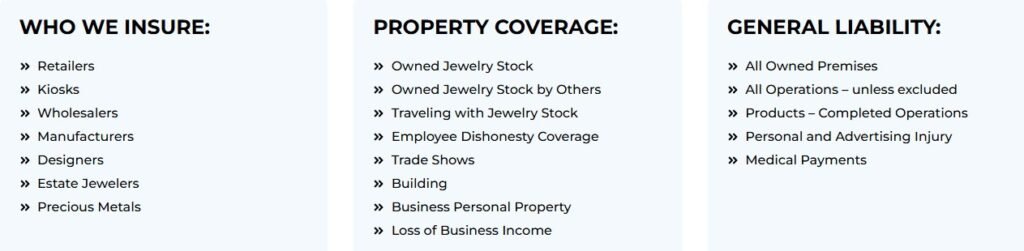
Jewelers Block insurance is the specialty policy designed for the jewelry trade. In practical terms, it's the coverage built to respond to the losses jewelers face, including loss, theft, damage, and mysterious disappearance. Specialty Jewelers Block policies are typically written on an all-risk basis in the insurance sense, meaning they cover accidental loss unless a peril is specifically excluded, with common exclusions including wear and tear, intentional damage, war, and manufacturer defects, as explained in Brite's overview of jewelry insurance mechanics.
A standard Business Owner's Policy, or BOP, can still matter for premises liability, building damage, and ordinary business property concerns. But it often leaves major gaps once you're dealing with jewelry inventory, customer property, goods in transit, and loss scenarios that don't fit cleanly into a simple theft claim.
Where business owners get tripped up
The most common mistake is assuming broad business coverage means jewelry-specific coverage. It usually doesn't.
Another mistake is treating commercial jewelry exposure like personal jewelry exposure. Personal policies often revolve around item scheduling for an individual owner. A jewelry business has to think about inventory turnover, memo, repairs, temporary custody, staff handling, shipping practices, and concentration of value in one location.
Practical rule: If your stock moves, travels, gets repaired, gets shown, gets shipped, or belongs to customers while it's in your care, you need coverage built for the trade, not just for a storefront.
For a broader view of how owners protect concentrated assets outside of insurance alone, this guide on Protect Your Wealth is useful context. The same principle applies in jewelry retail. Risk transfer works best when it sits alongside disciplined asset protection habits.
Jewelers Block vs Standard Business Insurance
| Risk Type | Jewelers Block Policy | Standard Business Owner's Policy (BOP) |
|---|---|---|
| Jewelry inventory | Built for stock, often with item-specific or category-based treatment depending on the operation | Often limited or not tailored to high-value jewelry stock |
| Mysterious disappearance | Commonly addressed in specialty forms | Often a problem area or narrower than owners expect |
| Customer property in your care | Can be structured for repair, appraisal, or temporary custody exposures | May not respond the way a jeweler expects without specific coverage |
| Off-premises exposure | Better suited for transit, trade show, and traveling stock issues | Frequently narrower once property leaves the insured premises |
| Claims settlement | Often aligned to replacement with like kind and quality, depending on the form | Can be less favorable if coverage applies through a general property form |
| Valuation approach | Built around jewelry-specific proof of value and insured amounts | Less precise for constantly changing, high-value stock |
Why the policy exists at all
Jewelry is easy to move, easy to conceal, expensive to replace, and difficult to value casually. That's why generic insurance language often fails business owners at the worst time. Jewelers Block exists because the trade needs tighter definitions, tighter documentation, and a claims process that understands what a comparable replacement actually means.
Understanding Your Coverage Perils and Protected Property
A Jewelers Block policy works only if you know what property it applies to and what kind of loss triggers it. Too many owners buy the policy name and never work through the operating reality.

What property a jeweler usually needs to protect
Your own inventory is the obvious category. That includes finished goods, loose stones, precious metal stock, work in process, and sometimes display property depending on the form.
Then there's property that isn't technically yours but can still create a real loss. Customer pieces left for repair, resizing, cleaning, custom work, or appraisal can become your problem the moment they enter your custody. Consignment goods and memo pieces create another layer. If ownership sits elsewhere but the loss happens while the item is with you, the insurance discussion gets serious quickly.
A useful mental check is simple. Ask where the piece is, who owns it, who controls it, and who would write the check if it disappeared today.
For stores handling older collections, estate pieces, or period inventory, this visual reference to antique jewelry in a retail setting reflects the kind of stock that often needs especially careful scheduling and valuation support.

Which perils matter most in real operations
Specialty Jewelers Block policies are typically all-risk in structure, which means accidental loss is covered unless excluded. In plain language, the policy is built around the losses jewelers see: loss, theft, damage, and mysterious disappearance. Common exclusions still matter, especially wear and tear, intentional damage, war, and manufacturer defects, as noted in the earlier-cited specialty insurance guidance.
That distinction matters because business owners often confuse a quality issue with a covered loss. A defective setting from manufacture isn't the same as accidental damage during handling. Normal deterioration isn't the same as a sudden covered event.
When a policy says all-risk, read it as broad but not unlimited. The exclusions do the real shaping.
How this plays out day to day
A salesperson carrying trunk stock on the road creates a different exposure than inventory locked in a vault. A parcel handed to a shipping carrier creates a different exposure than a ring taken from the case during store hours. A customer's heirloom bracelet missing after intake creates a different exposure than a scratched watch crystal caused by ordinary use.
The policy has to track those operational differences. Good coverage isn't just a promise to pay after a bad day. It's a map of where your property sits, who handles it, and what can happen in each step.
A broker who understands jewelry operations will usually ask detailed questions about:
- Storefront handling: How pieces move between showcase, vault, bench, and customer viewing
- Transit practices: Which carrier methods you use and how often goods leave the premises
- Custody mix: The volume of customer property, consignment items, and memo inventory
- Travel exposure: Whether staff travel with stock for appointments or trade events
If those questions aren't being asked, the quote may be too generic to trust.
How Valuation and Limits Define Your Financial Protection
A loss can be fully covered on paper and still hit your cash flow hard if the policy settles value in a way that does not match how your store buys, replaces, or owns jewelry. For a jewelry business, valuation is not technical fine print. It determines whether insurance restores inventory and customer obligations without forcing you to absorb the gap.
Replacement cost, actual cash value, and agreed value
Jewelers Block policies are built for commercial jewelry risk, so the valuation question starts with business reality. If a one-carat branded ring is stolen from stock, the issue is not what it was worth years ago. The issue is what it will cost your store to replace with like kind and quality, from a supplier you can use, in the current market.
That is why replacement-cost language usually serves jewelers better than actual cash value. Actual cash value can reduce a settlement for age, wear, or depreciation. That approach creates obvious problems for fine jewelry, watches, estate pieces, and branded items that do not behave like ordinary consumer goods.
Agreed value has a place too. It is often worth discussing for unusual items, rare stones, antiques, one-off custom pieces, and property where market comparables are thin. The advantage is predictability. The trade-off is that agreed values need to be supported and reviewed, or they can drift away from the actual replacement number over time.
Why records decide how much the policy can actually pay
Insurers do not like valuing jewelry after it disappears. Neither should you.
If the file is weak, the settlement discussion becomes slower, more expensive, and more subjective. For stock, customer goods, memo items, and consignment property, the business should be able to show what the item was, who owned it, what condition it was in, and what basis supports the claimed value.
Use a disciplined record set for each meaningful item class:
- Acquisition support: Vendor invoices, purchase orders, receiving records, and memo or consignment terms
- Item identification: Photos, gemstone details, metal quality, serial numbers, mount descriptions, and distinguishing features
- Value support: Appraisals when appropriate, sales history, cost records, and documentation for custom or unusual pieces
- Change history: Repairs, remounts, stone swaps, sizing, refinishing, and any alteration that changes value
The image of a diamond ring documented for insurance review reflects the level of item detail that helps support larger values and speeds up settlement decisions.

Build valuation support into daily inventory control. Do not wait until renewal or until a claim forces the issue.
Limits and deductibles
Policy limits should match your peak exposure, not a quiet weekday average.
Start with concentration of value. Many stores carry their largest exposure in one place at one time: the safe overnight, the showcases during business hours, a shipping day before holiday cutoffs, or a travel case headed to an appointment or trade event. If the limit only reflects average inventory, a single bad loss can leave part of the claim uninsured.
Sublimits matter just as much as the main policy limit. A policy may have separate caps for off-premises property, transit, customer goods, employee dishonesty, or property at trade shows. Owners often miss this point because the top-line limit looks adequate. The claim problem appears later, when a loss falls into a narrower bucket with a much lower cap.
Deductibles are a balance-sheet decision. A higher deductible can reduce premium, but it also means the business retains more small and mid-sized losses. That works for stores with strong cash reserves and disciplined controls. Stores with tighter liquidity often do better with a lower deductible, even if the premium is higher, because the policy responds sooner and protects operating cash.
A good Jewelers Block structure does two things at once. It values property the way a jewelry business replaces it, and it sets limits where your real concentrations of risk sit. That is what turns policy wording into usable financial protection.
Navigating the Claims Process from Loss to Recovery
A customer's engagement ring is checked in for sizing on Tuesday. By Friday afternoon, the pickup envelope is empty, the customer is coming in at 5:30, and nobody can say with confidence who had the ring last.
That is how Jewelers Block claims start in practice. For a store owner, the claim is not just an insurance event. It is a cash-flow issue, a customer trust issue, and sometimes a legal issue if the property belongs to someone else.

A common loss scenario
A customer leaves a ring for repair. Intake is clean. Photos were taken. The repair envelope is logged. During final handoff from bench to pickup staging, the ring cannot be located.
Start the claim file the same day. Do not wait to see if it turns up next week, and do not give the customer a guessed answer before the facts are documented.
Build the timeline first. Record who accepted the item, who moved it, where it was stored, when the discrepancy was discovered, and what search steps were completed. If theft is suspected, notify law enforcement promptly. If the loss involves shipment, outside repair, or a trade event, preserve carrier scans, signed transfers, and every custody record.
Then pull the supporting file. For Jewelers Block claims, especially those involving customer property, adjusters usually want the records that prove three things: the item existed, the store had custody, and the claimed value is supportable. That means intake forms, job envelopes, customer communications, photos, invoices, appraisals if available, bench notes, and surveillance footage.
What helps an adjuster approve a claim faster
Clean records shorten the back-and-forth. Weak records create questions, and questions slow payment.
The file should usually include:
- A specific description of the item with metal type, stone details, hallmarks, serial numbers, or distinguishing features
- Value support such as a sales invoice, supplier invoice, memo, appraisal, or prior repair documentation
- Proof of custody showing the piece was accepted into your care, custody, and control
- Incident documentation including police, carrier, or third-party reports when applicable
- Photos or video from intake, repair handling, transfer points, or store surveillance
A complete file gives the adjuster a workable basis to confirm coverage, ownership, and value.
Settlement terms deserve attention before any loss happens. Many Jewelers Block forms settle on a replacement basis for like kind and quality, and the carrier may control sourcing or pay a replacement vendor directly. That can protect against inflated valuations, but it also means the insured may not receive an unrestricted cash payment. Carriers operating in specialty markets, including those associated with the Lloyd's market identity used on many specialty insurance materials, often handle these claims with tighter documentation standards than a standard property policy.

A short explainer on settlement expectations can help owners frame those conversations before a loss occurs.
Repair, replacement, or cash
The outcome depends on the item and the policy wording.
A chipped center stone may lead to repair approval. A stolen stock piece may be replaced through an approved source. A custom item with no close market equivalent can turn into a valuation dispute, especially if the original workmanship or antique characteristics are hard to duplicate. Owners should read the loss settlement clause the same way they read the theft clause.
Consumer carriers describe similar claim options in personal jewelry policies, including direct payment to a jeweler or repair vendor, in Progressive's consumer explanation of jewelry claim payment methods. The business lesson is narrower. Do not assume a commercial Jewelers Block claim will end in a check made payable to the store for the full amount you had in mind.
Documentation standards also matter after the claim is reported. If your internal procedures for customer property intake, repair authorization, and release are documented as clearly as your Gaya AI service fulfillment terms, you put the adjuster in a far better position to confirm what happened and what the policy should pay.
Where claims break down
The hardest files to recover usually have the same defects.
- Poor intake controls: customer goods were accepted without signed documentation or clear photos
- Weak value support: the store can describe the piece but cannot support the amount claimed
- Broken chain of custody: multiple employees handled the item without logged transfers
- Confusion about settlement terms: the owner expected cash, while the policy allowed repair or insurer-directed replacement
Claims are decided by records, procedure, and policy wording. That is the fundamental function of Jewelers Block insurance for a business owner. It turns a serious loss into a defined financial process, but only if the store can prove what it had, what happened, and what it will cost to make the customer whole.
Key Factors That Drive Your Insurance Premiums
A store with the same inventory value can pay a very different premium than its competitor across town. In Jewelers Block underwriting, price follows exposure. The question is not only how much stock you carry, but how often that stock is exposed to theft, loss, transit damage, employee handling, and weak internal control.

Underwriters usually start with total values, then move quickly to concentration risk. A million dollars spread across secure storage, controlled showcases, and limited off-premises movement is a different account from a million dollars concentrated in open display, frequent travel, or loosely documented memo activity. That distinction affects both premium and terms.
What underwriters examine first
Security is still the first serious pricing variable. Carriers want details on your safe or vault, alarm monitoring, camera placement, door and window protection, key control, opening and closing routines, and who can access high-value goods after hours. If your procedures exist only in the owner's head, expect underwriters to assume more uncertainty.
Location also affects rating, but not in a simplistic way. A luxury retail corridor may have stronger policing, hardened neighboring tenants, and better cameras, yet it can also attract organized theft. A quieter suburban store may face less foot traffic risk but weaker physical barriers or slower police response. Underwriters price the actual exposure, not the ZIP code alone.
Market choice matters too. Some Jewelers Block placements go through specialty insurers and Lloyd's of London specialty jewelry markets, where submissions are reviewed closely and operational detail carries real weight.
The operating habits that change pricing
Good pricing usually follows disciplined operations. Carriers look for evidence that your store can prevent small losses before they become expensive claims.
- Inventory controls: cycle counts, full reconciliations, exception reporting, and documented stock transfers reduce unexplained shortage concerns.
- Display practices: limiting how many high-value items are out at once lowers open-counter exposure.
- Transit handling: approved shipping methods, discreet packaging, and signed handoffs matter if goods move between locations, shows, vendors, or customers.
- Employee controls: separation of duties, restricted bench access, and clear rules for customer property intake reduce both theft risk and claim disputes.
- Repair and memo procedures: stores that document incoming items, condition, stated value, and release authorization present a cleaner risk to the market.
Underwriters price the habits behind the application.
Clear documentation also affects how credible your risk management looks before a loss happens. The standard is similar to the process discipline reflected in the Gaya AI service fulfillment terms. Insurance is a different product, but the practical lesson is the same. Defined responsibilities and documented procedures reduce confusion, and confusion costs money.
What usually improves terms
Stores rarely get better pricing by arguing that they are careful. They get better pricing by proving it. That means current inventory reports, written security procedures, alarm certificates, shipping protocols, employee access rules, and a credible explanation of how customer goods and memo pieces are tracked.
Deductible selection also changes the premium, but it is a trade-off. A higher deductible can reduce annual cost, yet it pushes more routine loss expense back onto the business. For many jewelers, the better decision is not the lowest premium alone. It is the deductible and limit structure the store can absorb without hurting cash flow.
A specialty agency can help present the account properly. First Class Insurance places Jewelers Block programs for jewelry businesses and can help organize inventory, transit, and security information in a form underwriters can evaluate efficiently.
Your Checklist for Getting the Right Jewelers Block Quote
A Jewelers Block quote is only useful if it reflects how your business operates. Use this checklist before you bind anything.
Questions worth asking your broker
- Does the policy cover mysterious disappearance? If the answer is vague, keep asking.
- How is property valued at claim time? You need the settlement method explained in plain language.
- What property is covered besides owned inventory? Ask specifically about customer property, consignment goods, memo pieces, and work in process.
- What are the off-premises and transit terms? If stock leaves the store, this isn't optional.
- How are claims paid? Confirm whether the policy allows repair, replacement, vendor payment, cash settlement, or some combination.
- What are the important exclusions? Wear and tear, defects, and intentional acts should be discussed before a loss.
- What documentation will the carrier expect? If your current recordkeeping won't support a claim, fix that before policy inception.
- Are limits aligned with concentration risk? Check the safe, vault, showcase, travel, and shipment exposures separately.
- What deductible applies to each loss type? Don't assume one deductible governs every scenario.
The standard I use for a good quote
A good quote doesn't just show premium. It tells you what property is insured, where it's insured, how value is determined, how losses are settled, and what documentation will make the claim defensible.
If the proposal is heavy on broad promises and light on operational detail, it probably isn't ready.
If you want a Jewelers Block quote that matches your inventory, transit exposure, customer property, and daily procedures, contact First Class Insurance. A specialized review should clarify what your current coverage does, where the gaps are, and what documentation you need before a loss turns into a cash-flow problem.