
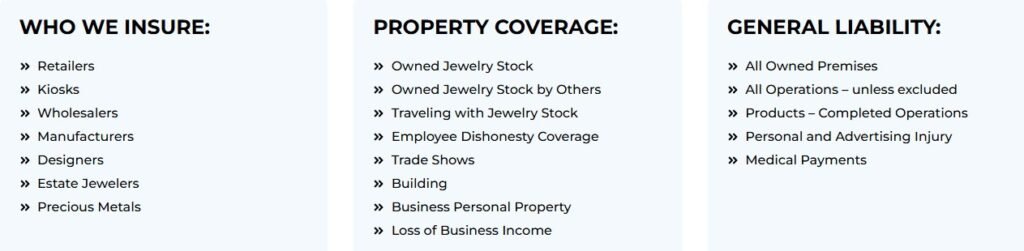
When it comes to high-value jewelry, your storage system is everything. It’s a carefully orchestrated combination of physical separation, environmental control, and rock-solid security. This isn't just about keeping things tidy—it's about protecting the value of your inventory and satisfying the strict requirements of your insurance policy.
Forget the simple jewelry box. True professional storage is your first and best line of defense.
The Foundations of Professional Jewelry Storage
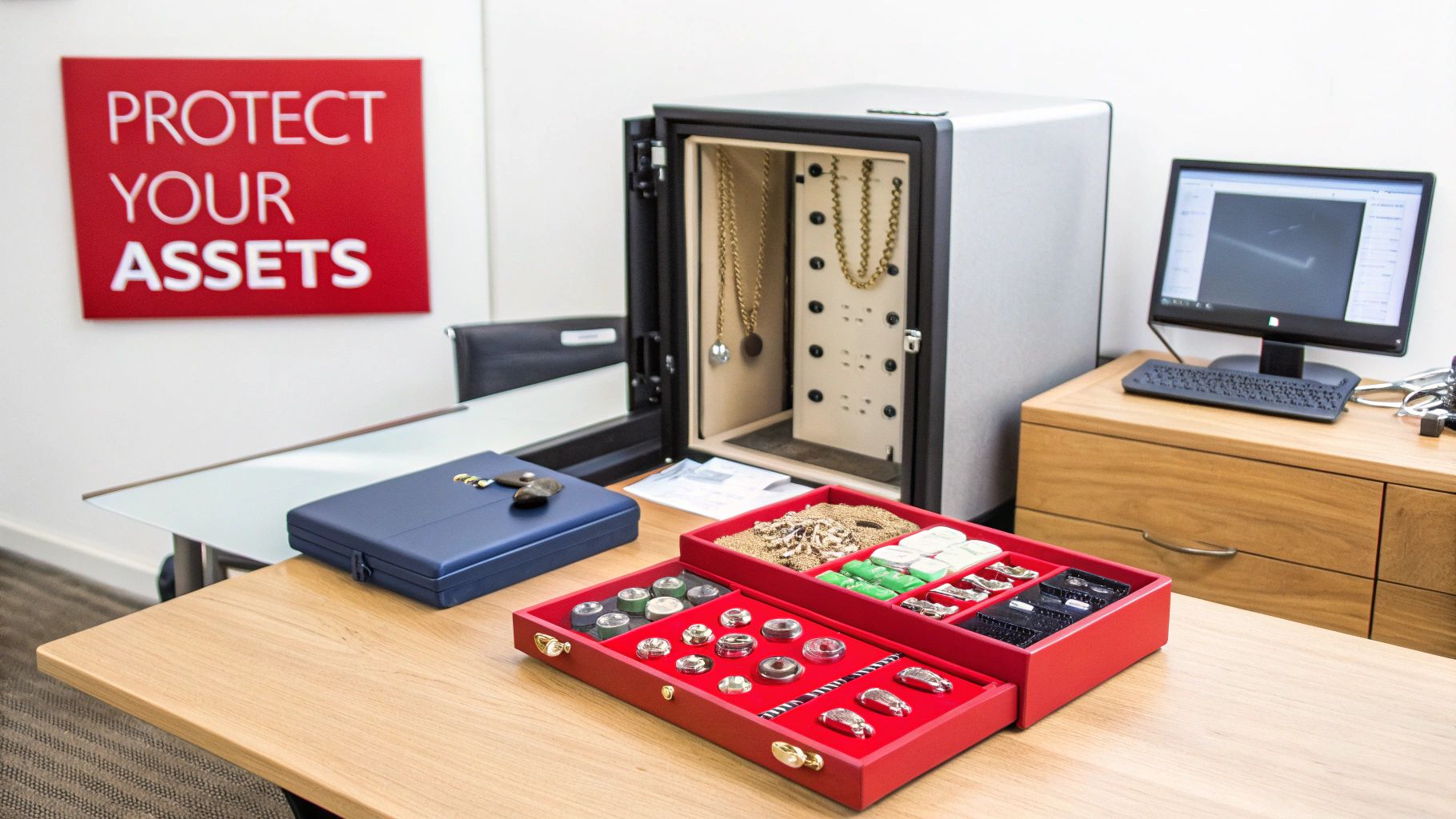
For anyone in the jewelry business, how you store your pieces isn't an operational detail; it's the core of your asset protection plan. Each item in your inventory is a significant investment. Guarding it against every conceivable threat—from a subtle scratch to a devastating theft—is what keeps your business secure.
Think of your storage protocol as a complete system, not just a single action. It’s this system that stands against physical damage, theft, and slow environmental decay.
More importantly, it’s the bedrock of your risk management strategy, something underwriters will pore over when you apply for Jewelers Block insurance. This specialized coverage is designed to protect your unique assets, but that coverage hinges on you proving you’ve got professional-grade security and storage protocols in place.
Why a System-Based Approach Is Non-Negotiable
A haphazard or weak storage setup is an open invitation for problems. Shoving everything into a safe and calling it a day just doesn't cut it. You have to think about the specific needs of different materials. Diamonds will shred pearls. Silver will tarnish if the air is too damp.
Every part of your storage plan has to work in harmony to create a truly secure environment.
- Physical Protection: This is ground zero. You have to separate hard stones from softer gems and metals to stop scratches before they happen. Individual soft pouches or fabric-lined trays are non-negotiable.
- Environmental Control: Keeping temperature and humidity levels stable is critical. Big swings can damage delicate settings, wreck organic gems like pearls and opals, and accelerate tarnish on metals.
- Security and Insurance: The physical security measures you take, from your safe's rating to your alarm system, are directly wired to your insurability. A robust, well-documented system proves to insurers that you're a low-risk partner.
For any serious jewelry business, insurance isn't an afterthought—it's a core operational necessity. A comprehensive Jewelers Block policy is the ultimate safety net, covering everything from armed robbery to mysterious disappearance. Getting a solid quote should be one of your first priorities.
Protecting an Ever-Growing Market
The need for this level of care has never been more critical. The global jewelry market was recently valued at around USD 366.79 billion and is on track to hit USD 578.45 billion by 2033. As the market grows, so does the need to protect these assets, whether for a retail business or a private collector.
The right storage strategy doesn't just protect what you have now; it underpins your business’s long-term stability and growth. Our team can walk you through these measures, even showing you some of our top protective methods to get you started.

To make this easier to digest, let's break down the core principles into a simple framework.
Core Principles of Professional Jewelry Storage
This table summarizes the fundamental pillars of a professional storage strategy, connecting each practice to its direct benefit and its impact on your insurance.
| Storage Principle | Primary Goal | Relevance to Jewelers Block Insurance |
|---|---|---|
| Separation & Isolation | Prevent scratches, abrasions, and chemical reactions between pieces. | Demonstrates due diligence in preserving inventory value, which can positively influence premiums. |
| Environmental Control | Protect against tarnish, moisture damage, and degradation of organic gems. | Reduces the risk of "slow" damage claims and shows a commitment to long-term asset care. |
| Physical Security | Deter and prevent theft through high-rated safes, vaults, and access controls. | A primary factor in determining insurability and policy costs. Higher security equals lower risk. |
| Inventory Management | Maintain accurate, real-time records for accountability and loss detection. | Essential for proving the value of items in a claim; disorganized records can delay or deny payouts. |
Ultimately, these principles work together. A great safe is meaningless if the humidity inside is destroying your opals. And perfect environmental controls won't stop a smash-and-grab. A holistic system is the only real answer.
Handling Your Collection With Material-Specific Care
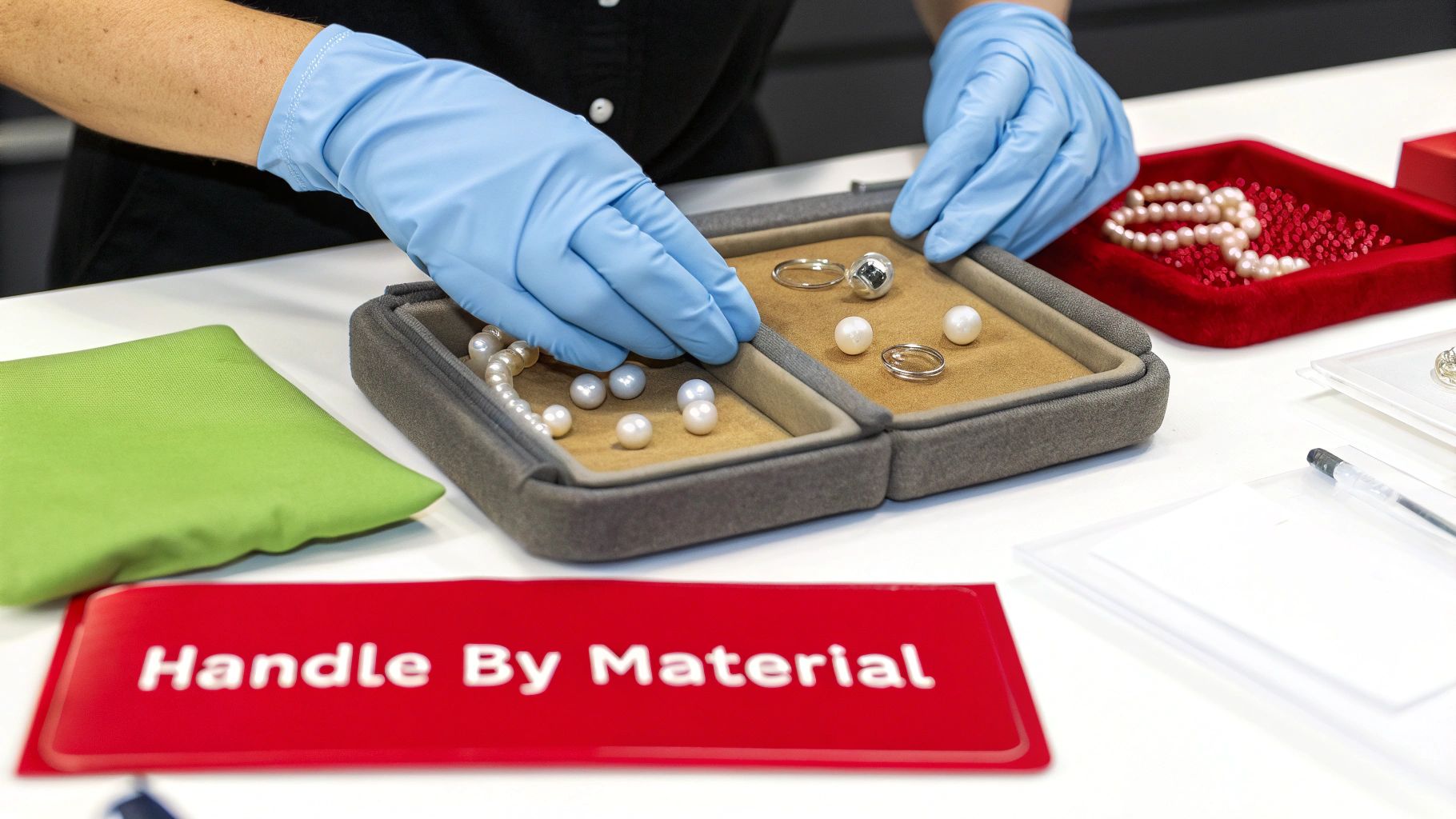
Treating every piece in your collection the same way is a recipe for disaster. A diamond's incredible hardness makes it a real threat to softer metals, while a pearl’s organic nature leaves it wide open to damage from common chemicals. If you want to truly master how to store your jewelry, you have to accept that material-specific care isn't just a good idea—it's non-negotiable for preserving both value and appearance.
This goes beyond just preventing obvious dings and scratches. We're talking about stopping the slow, silent degradation that happens over time when pieces are stored improperly. Every material has its own set of needs and vulnerabilities that demand a tailored approach.
The good news? Getting this right doesn't require a massive overhaul. It's more about making thoughtful adjustments to your current system. From precious metals to the most delicate gemstones, there are clear best practices that are surprisingly easy to follow.
Protecting Precious Metals From Tarnish and Scratches
Gold, silver, and platinum are the backbone of most jewelry businesses, but they are far from indestructible. Silver is especially notorious for tarnishing—that ugly discoloration is just a chemical reaction with sulfur compounds floating in the air. Even high-karat gold, like 22k or 24k, is shockingly soft and scratches easily.
To fight back, isolation is your best friend.
- Individual Storage: Keep each piece in its own soft, non-abrasive pouch or a separate, lined compartment. This simple step stops items from rubbing against each other, which is hands-down the number one cause of scratches.
- Anti-Tarnish Solutions: For anything sterling silver, tuck in some anti-tarnish cloths or strips. These little workhorses absorb the airborne pollutants that cause tarnish, dramatically slowing down the process.
A small detail that makes a huge difference is using protective linings like acid-free tissue paper. It’s a simple, cheap way to prevent both tarnish and scratches, preserving your metals for the long haul.
Managing Gemstones From Hard to Soft
Not all gemstones are created equal. Their position on the Mohs scale of hardness dictates exactly how they need to be stored. A diamond, a perfect 10 on the scale, will effortlessly scratch any other gem or metal it bumps into.
On the other end of the spectrum, softer stones like opals (5.5-6.5) or fluorite (4) are incredibly delicate. They can be easily damaged by much harder, more common gems like sapphires (9) or even quartz (7). This is precisely why a "one box fits all" approach is so dangerous for a diverse inventory.
The most common and costly storage mistake is failing to separate hard gemstones from softer materials. Tossing a diamond ring into the same pouch as an emerald bracelet is a fast track to scratches and abrasions that can permanently devalue the softer piece.
Always organize your gemstone storage by hardness. Diamonds, rubies, and sapphires need to be kept completely separate from softer stones like emeralds, opals, tanzanite, and turquoise. This isn't just a pro tip; it's a foundational principle of professional jewelry care. It’s especially critical for unique and delicate antique jewelry, which often features fragile settings from a different era.
The Special Needs of Organic Gems Like Pearls
Organic gems—we're talking pearls, amber, coral, and ivory—are in a class all their own because they originated from living things. This makes them porous and extremely sensitive to their environment. Chemicals in everyday things like perfume, hairspray, and household cleaners can cause permanent discoloration and literally eat away at their surface.
Pearls, in particular, have a unique relationship with moisture.
- Avoid Dryness: Storing pearls in a very dry or hot environment, like a bank safe deposit box for long stretches, is a terrible idea. It can cause them to become brittle and crack. They need to "breathe" and actually benefit from ambient humidity.
- Last On, First Off: This is the golden rule. Pearls should be the last thing you put on (after makeup and perfume) and the first thing you take off. Before putting them away, give them a gentle wipe with a soft cloth to remove any oils or residue from the day.
- Store Flat: Never hang your pearl necklaces. The weight will stretch the silk thread over time. Always lay them flat in a fabric-lined box or drawer to protect their integrity.
It seems the world is catching on. The market for jewelry boxes was valued at roughly USD 2.3 billion in 2023 and is projected to hit USD 3.5 billion by 2032. This isn't just about pretty packaging; it shows a growing understanding from both businesses and consumers that proper storage is a vital investment, not just an afterthought.
Creating the Ideal Environment for Long-Term Preservation
Beyond keeping pieces physically separated, some of the biggest threats to your jewelry inventory are completely invisible. Environmental factors—I'm talking about temperature, humidity, and light—can inflict slow, silent, and often irreversible damage. Mastering how to properly store your jewelry means creating a controlled space where these elements are managed with precision.
This isn’t just good business; it’s a critical part of risk management that underwriters for Jewelers Block insurance will absolutely look at.
Think of your storage area, whether it’s a safe or a full-sized vault, as more of a preservation chamber. Its primary job is to shield your assets from the subtle, destructive forces of a fluctuating environment. Dropping the ball here can lead to costly damage that no amount of polishing can fix.
Keep Your Temperatures Stable
Extreme temperature swings are a hidden enemy of fine jewelry. Metals expand in the heat and contract in the cold. While this movement is microscopic, over time it places enormous stress on delicate settings. A prong holding a valuable diamond can gradually loosen, and suddenly you’re facing the risk of a stone falling out and vanishing.
That’s why a stable, moderate temperature is non-negotiable. You should aim for a consistent range, somewhere between 65-75°F (18-24°C). It's common sense, but avoid storing high-value inventory in places prone to drastic changes, like uninsulated attics, damp basements, or right next to heating vents and sun-drenched windows.
A stable environment is a cornerstone of professional asset protection. Documenting your climate control measures, like a dedicated HVAC system for your vault, shows a real commitment to preservation. That’s a positive factor that can work in your favor when you get a quote for Jewelers Block coverage.
Control Humidity to Stop Corrosion in its Tracks
Humidity is another silent destroyer, especially for metals and organic gems. All that moisture in the air is the number one cause of tarnish on sterling silver. Given enough time, it can also lead to corrosion on less-noble metals used in clasps and settings, completely compromising their integrity.
For organic gems like pearls and opals, the stakes are even higher. High humidity can cause pearls to swell or even mold. On the flip side, an environment that’s too dry will dehydrate them, making them brittle and prone to cracking.
Here are a few practical ways to manage moisture levels:
- Silica Gel Packs: For smaller safes and display cases, tossing in a few silica gel packs is a cheap and effective way to absorb excess moisture. Just remember to replace or "recharge" them regularly based on the manufacturer's instructions.
- Dehumidifiers: If you have a larger vault or a dedicated storage room, investing in a quality dehumidifier is a must. It gives you precise control over the ambient moisture, protecting your entire inventory at once.
- Hygrometers: You can't manage what you don't measure. Stick a reliable hygrometer inside your safe or vault to monitor humidity levels. The sweet spot you're aiming for is a stable range between 40-50%.
Proper humidity control is a fundamental part of any solid jewelry store insurance strategy. It reduces the risk of gradual damage, which can be a tricky thing to claim if it looks like it was caused by negligence. A proactive approach here is always your best bet.
Understand the Impact of Light Exposure
While great for the showroom, direct and prolonged exposure to light can be incredibly damaging to certain gemstones. The ultraviolet (UV) rays in sunlight and some artificial lighting can literally bleach the color out of gems like amethyst, kunzite, and certain types of topaz over time. Once that color is gone, it’s gone for good, and so is a significant chunk of the stone's value.
Pearls, amber, and ivory are also at risk. Light and heat can dry them out, leading to discoloration and brittleness.
Whether it’s for display or long-term storage, follow these lighting best practices:
- Avoid Direct Sunlight: This is a simple one. Never store or display valuable pieces where the sun can beat down on them all day.
- Use LED Lighting: Make the switch to LED lights in your showroom and storage areas. They emit very little UV radiation and produce minimal heat compared to old-school halogen or incandescent bulbs.
- Store in Darkness: The absolute best place for any jewelry not on display is in complete darkness. A lined jewelry box, a drawer, or a safe provides the ideal light-free environment to keep your pieces safe from harm.
Securing Your Inventory On Site and In Transit
Physical security is the absolute bedrock of protecting your jewelry. It's also a non-negotiable requirement for any credible Jewelers Block insurance policy. This is all about creating layers of defense that work together to deter, detect, and delay any attempt at theft.
Without a rock-solid security plan, all the careful material handling and environmental controls in the world won't matter.
Your insurance provider needs to see that you've taken every possible precaution to protect your assets. This goes way beyond a simple lock and key. It means investing in high-grade equipment and establishing strict protocols for your main location and for any items that leave the premises.
The whole process starts with making your physical location a fortress.
Fortifying Your On-Site Storage
When an underwriter looks at your risk profile, your on-site security is the very first thing they’ll scrutinize. They are looking for specific, industry-standard measures that prove you’re serious about loss prevention. Vague promises won’t fly; they need to see real, high-quality systems in action.
Your safe is the heart of your on-site security. Insurers look for specific Underwriters Laboratories (UL) ratings that show how well it can resist an attack.
- TL-15 Safes: This rating means the safe door can resist professional tool attacks for at least 15 minutes. It’s pretty much the minimum standard for a commercial jewelry business.
- TL-30 Safes: A step up in protection, a TL-30 rated safe door can withstand tool attacks for a full 30 minutes. This is what most insurers prefer to see for businesses with higher-value inventories.
- TRTL-30×6 Safes: For maximum security, this rating means the safe can resist both tools and torches for 30 minutes on all six sides.
Beyond the safe, your overall security needs to be layered. A comprehensive alarm system with motion detectors, glass-break sensors, and a cellular backup is essential. This must be paired with a high-definition camera surveillance system covering all entry points, showrooms, and storage areas, with the footage stored safely off-site.
A well-protected storefront is a fundamental requirement for any legitimate insurance for a jewelry store. Proving you've invested in top-tier safes, alarms, and surveillance not only makes you a better risk but can also directly lower your premiums when you get a quote for Jewelers Block.
Protecting Jewelry On the Move
Your security responsibilities don't end when your inventory leaves the store. In fact, jewelry is often most vulnerable when it's in transit—whether it's being shipped to a customer, carried to a trade show, or moved between locations. Having a plan for mobile security is just as critical as your on-site measures.
This is where many jewelers get into trouble with their insurance. Policies almost always have an "unattended vehicle" clause, which can void your coverage if items are stolen from a vehicle left alone, even for a second. Understanding the fine print of your insurance for a jewelry business is crucial if you want to avoid a denied claim.
Here’s a quick visual reminder of the key environmental factors you need to manage for proper jewelry preservation.
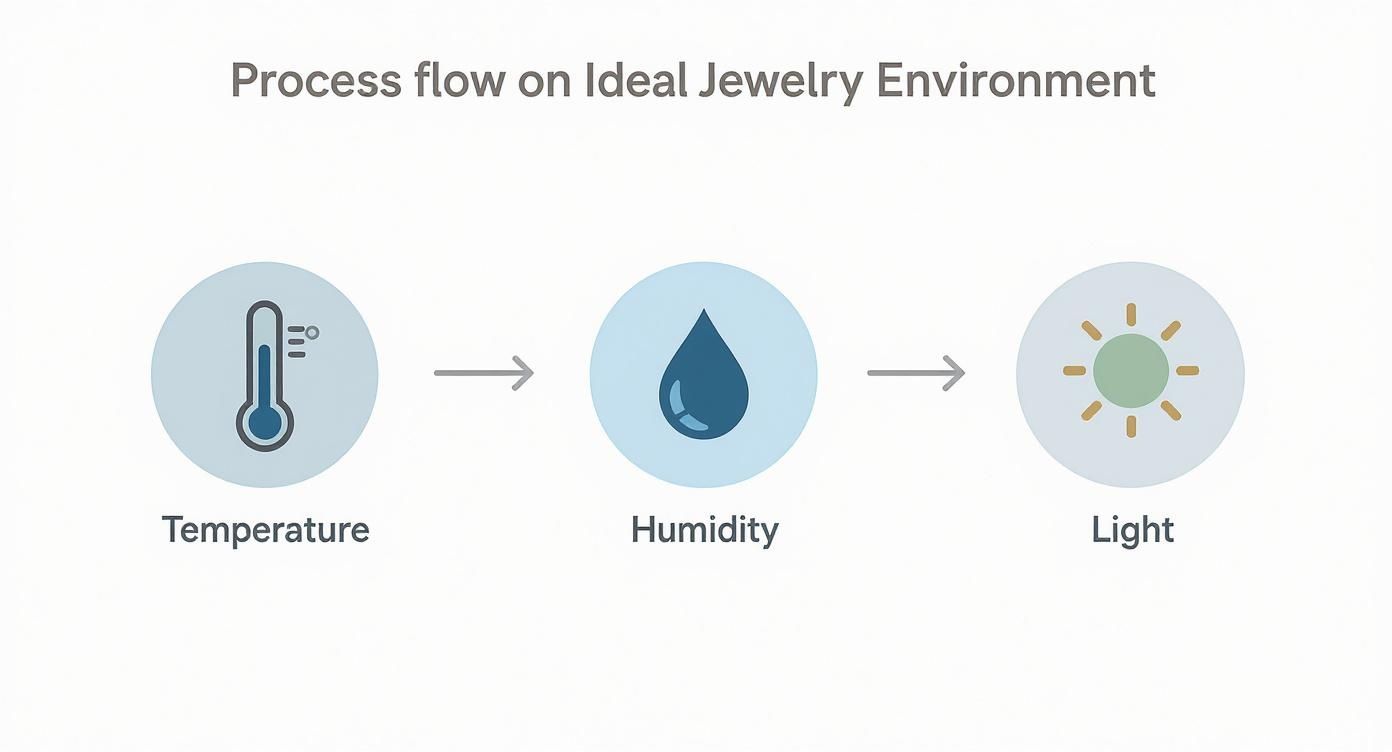
This infographic shows the ideal flow of environmental management, starting with a stable temperature, then controlled humidity, and finally, protection from damaging light.
Both stationary and mobile assets require distinct but equally rigorous security protocols. The following table breaks down the essential layers of protection for each scenario, showing how fundamental security principles are adapted for different contexts.
On-Site vs. In-Transit Security Measures
| Security Layer | On-Site Implementation (Store/Vault) | In-Transit Implementation (Travel/Shipping) |
|---|---|---|
| Access Control | Multi-factor authentication, biometric scanners, and strict key control for safes and vaults. | Personal custody ("body rule"), verified signatures for delivery, and secure hand-offs. |
| Surveillance | 24/7 high-definition cameras with off-site recording covering all critical areas. | GPS tracking on high-value shipments, team-based travel (two-person rule). |
| Physical Barriers | UL-rated safes (TL-15/TL-30), reinforced doors, window gates, and bollards. | Armored transport services, tamper-evident packaging, discreet and unmarked containers. |
| Alarm Systems | Central station monitored alarms with motion, glass-break, and panic button sensors. | Silent/panic alarms for personnel, immediate notification protocols for deviations from route. |
| Procedural Security | Daily opening/closing checklists, dual-personnel vault access, regular security audits. | Pre-planned and varied travel routes, discreet behavior, avoiding unattended vehicle scenarios. |
Ultimately, a multi-layered approach is the only way to effectively mitigate the high-stakes risks associated with jewelry, whether it’s sitting in your vault or moving across the country.
A Practical Playbook for In-Transit Security
Whether you're shipping a single ring or transporting an entire collection, every movement demands a detailed plan. Never assume something is safe just because it’s out of public view.
Real-World Scenario: A jeweler is driving to an appraisal appointment with a client’s diamond necklace in his briefcase. He stops for coffee, leaving the briefcase visible on the passenger seat. In less than two minutes, a thief smashes the window and grabs the case. Because the vehicle was unattended, his insurance claim is denied, leaving him on the hook for a six-figure loss.
To avoid this costly mistake, you need to implement strict protocols:
- Always Use Discreet Packaging: Never ship items in boxes that scream "jewelry." Use generic packaging and avoid putting words like "diamonds," "gems," or your business name on the outside.
- Choose Armored Couriers for High-Value Shipments: For your most valuable assets, standard carriers don't offer enough protection or insurance. Use a specialized armored courier that provides armed guards and secure, end-to-end transport.
- Practice the "Body Rule": If you are personally carrying jewelry, it must stay on your person at all times. Never put it in a trunk, on a seat, or in an overhead bin on an airplane.
- Vary Your Routes and Times: If you regularly transport inventory, avoid falling into a predictable routine. Change your routes and travel times to make it harder for potential thieves to track you.
To build a truly robust defense for your collection, it helps to understand security strategies from multiple angles. This ultimate guide to comprehensive security offers broader insights into fortifying assets in different environments, reinforcing the principles you need for your own business. Every layer you add reduces your risk profile and strengthens your standing with insurers like the First Class Insurance Jewelers Block Agency.
Why Smart Inventory Management Is Your Best Insurance
You can have the most secure vault on the market and perfect environmental controls, but none of it means much if you don't know exactly what's inside. A disorganized stockroom isn't just an operational headache; it's a massive liability that can complicate or even invalidate an insurance claim.
Your inventory management system is the ultimate proof of ownership and value. When something goes wrong, it becomes one of the most powerful tools in your entire loss-prevention strategy.
This system is your definitive record. In the unfortunate event of a loss, your insurer will immediately ask for detailed proof of what was stolen or damaged. A vague list or a messy spreadsheet just won't cut it. You need a bulletproof, itemized system that serves as indisputable evidence. This is a core requirement for any responsible insurance for a jewelry business.
Without it, you're essentially asking your insurer to take your word for it—and that’s a position no jeweler wants to be in when filing a claim.
Building Your Digital Fortress
Gone are the days of handwritten ledgers. For any serious jewelry business today, a digital inventory system is non-negotiable. These systems offer a level of speed, accuracy, and detail that manual methods simply can't match. More importantly, they create a verifiable, time-stamped record that is essential for insurance purposes.
Your digital system should capture several key data points for every single item you handle. This meticulous documentation is what transforms a simple stock list into a powerful asset for your Jewelers Block insurance policy.
This kind of detailed tracking is becoming the industry standard. The global jewelry organizer market was valued at around USD 28.3 billion and is expected to surge to USD 72.5 billion by 2035. It's a clear sign that organized asset protection is a growing priority at all levels. As consumers focus more on how to store their jewelry, businesses have to lead with even more sophisticated systems. You can dig into these market trends in the full report on jewelry storage solutions.
The Anatomy of an Ironclad Inventory Entry
A strong inventory entry leaves no room for ambiguity. Each item needs its own unique profile packed with specific, verifiable details. Think of each entry as a "digital passport" for your jewelry.
At a bare minimum, every entry must include:
- Unique SKU (Stock Keeping Unit): A distinct identifier to ensure no two pieces can ever be confused.
- Detailed Description: Go way beyond "gold ring." Document the metal type and karat, all gemstone types, carat weights, cuts, colors, and clarity grades.
- High-Quality Photos: Take clear, well-lit pictures from multiple angles—top, bottom, and side profiles. Make sure to capture any identifying marks, stamps, or signatures. These images are often the most compelling evidence you can provide in a claim.
- Acquisition Details: Record the date you acquired the piece, the supplier or source, and what it cost you. This paper trail is crucial for establishing its value.
This is exactly the level of detail that underwriters, like those at the prestigious Lloyd's of London, expect to see when they're assessing the value of a claim.

Your inventory system is your ultimate proof of ownership and the backbone of a successful insurance claim. Meticulous, real-time records are not just for operations—they are your primary evidence when you need it most.
Audits and Real-Time Updates Are Crucial
A great inventory system isn't something you can set and forget. It has to be a living document, updated in real time to reflect every single change in your stock. This dynamic approach is a key part of responsible jewelry store insurance compliance.
You need to document every sale, acquisition, or item sent out on memo the moment it happens. Procrastination creates gaps in your records, and those gaps can turn into major problems during an audit or a claim investigation.
You should also be conducting regular physical audits to reconcile your digital records with the actual items in your safe. A full audit can be disruptive, so many jewelers implement cycle counting—auditing small sections of your inventory on a rotating basis. This keeps your records sharp without shutting down your business. It also demonstrates a commitment to due diligence that insurers really value when you get a quote for Jewelers Block coverage.
Your Top Jewelry Storage Questions, Answered
You’ve got a plan, but the little details can still keep you up at night. Let's tackle some of the most common questions I hear from jewelers and connect the dots between your backroom procedures and your financial security.
Getting these specifics right isn't just about following a manual—it’s about building a business that can withstand a worst-case scenario. The choices you make in the vault have a direct, tangible impact on your bottom line, especially when it comes to your insurance.
How Do My Storage Choices Affect My Jewelers Block Insurance Costs?
This is the big one. Your storage and security protocols are, without a doubt, the single biggest factor that determines your Jewelers Block insurance premiums. It’s a simple equation for insurers: the more secure your inventory is, the lower your risk. And lower risk means lower insurance costs.
Think about it from their perspective. A store with a TL-30 rated safe, a centrally monitored alarm system, and crystal-clear surveillance footage is a much safer bet than one with a basic safe and a simple doorbell chime.
When you get a quote for Jewelers Block, the underwriter is going to scrutinize every single security measure you have in place. Proving you have tough, layered protection is your single best negotiation tool for getting better rates and the best possible coverage.
When you invest in best-in-class storage, you're signaling to your insurer that you're a serious, responsible partner. On the flip side, skimping on security with an unrated safe or disorganized inventory will send your premiums through the roof—or worse, could get you denied for the insurance for your jewelry business altogether.
What’s the Single Biggest Storage Mistake Jewelers Make?
I see it all the time, and it makes me cringe. The most common—and costly—storage mistake is letting hard gemstones knock up against softer materials. It often happens in a rush, when multiple pieces get tossed into the same pouch or tray. It’s a recipe for disaster.
A diamond, a solid 10 on the Mohs hardness scale, will tear through almost anything it touches. Throw a diamond ring in with a pearl necklace, an emerald bracelet, or even a soft 22-karat gold piece, and you're going to see permanent, devaluing damage. We're talking scratches, chips, and abrasions that can tank an item's value in seconds.
The fix is non-negotiable but incredibly simple: every single piece needs its own soft compartment, pouch, or fabric-lined tray. This one small habit is one of the most powerful ways to protect the value of your inventory and is a core principle of any smart jewelry store insurance and loss prevention strategy.
Are There Special Considerations for Antique Jewelry?
Absolutely. Antique and vintage pieces are a whole different ballgame. They often have incredibly delicate metalwork like filigree, older and more fragile gemstone cuts, and materials like enamel that can't handle much stress. They demand a much higher level of care.
For these pieces, a rock-solid, stable environment is non-negotiable. Any sudden swing in temperature or humidity can cause irreparable harm, stressing the old settings and causing fragile materials to crack or flake. I always recommend extra padding within their individual storage compartments to give their intricate structures more support.
And just as important is the paperwork. Your documentation for antique jewelry has to be flawless. Make sure your inventory records note any existing wear, patina, or signs of old repairs. This kind of meticulous record-keeping is absolutely critical for appraisals and becomes essential proof if you ever have to file an insurance claim.
Protecting your inventory is the cornerstone of a successful jewelry business. At First Class Insurance, we specialize in crafting insurance solutions that align with your unique storage and security protocols. Let our experts help you secure the right coverage. Get a quote today at https://firstclassins.com.