
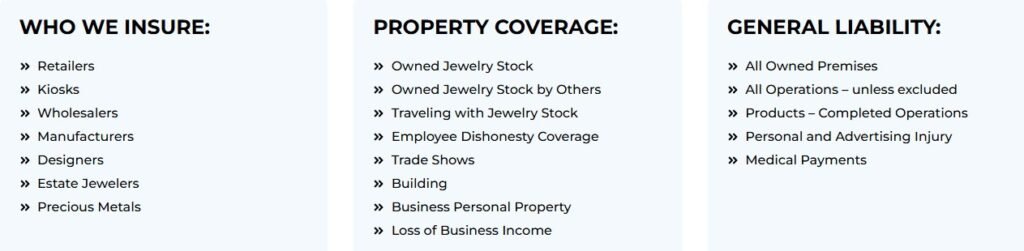
In the fine jewelry sector, expertise is currency. While the "Big Four" – diamonds, rubies, sapphires, and emeralds – form the bedrock of the market, true distinction lies in the mastery of the exceptionally rare. For jewelers, wholesalers, and collectors, understanding the world's most exclusive gems is not merely an academic exercise; it is a strategic advantage that unlocks new levels of prestige, value, and client trust. This listicle moves beyond the familiar, offering a curated look into eight of the most coveted and seldom-seen rare gemstone names on Earth.
This guide is designed for professionals who handle high-value assets. We will provide a comprehensive breakdown of each gem, focusing on the practical details that matter most: identification markers, current market valuation trends, and specific challenges in sourcing and setting. More critically, we address the non-negotiable aspect of managing such inventory: risk mitigation. The immense value and irreplaceability of stones like Painite and Musgravite make specialized insurance for a jewelry business an absolute necessity.
Properly securing these assets with a tailored Jewelers Block insurance policy is as vital as the appraisal itself. This article will equip you with the knowledge to not only identify and discuss these incredible gems but also to ensure your business is protected against the unique risks they present. For those interested in exploring even more unique specimens beyond the commonly recognized, delve into a detailed guide on Neptunite: A Collector's Guide to the Rare Gemstone. Let’s explore the gems that define the pinnacle of rarity and value.
1. Painite
Painite stands as a titan among rare gemstone names, once holding the Guinness World Records title for the rarest mineral on Earth. Discovered in Myanmar in 1956 by British mineralogist Arthur C.D. Pain, only a single crystal was known to exist for several decades. This extreme scarcity has cemented its legendary status among collectors and gemologists. While discoveries in Myanmar and later Vietnam in the early 2000s increased the known supply, gem-quality, facetable painite remains exceptionally rare and highly coveted.
Geological Properties and Rarity Indicators
Painite is a complex borate mineral containing calcium, zirconium, aluminum, boron, and oxygen, often with traces of chromium and vanadium that influence its color. Its signature hexagonal crystal structure contributes to its strong pleochroism, displaying different colors when viewed from different angles.
- Mohs Hardness: 8.0, making it durable enough for careful use in jewelry.
- Color Range: Typically ranges from brownish-red to orange-red and even pink, with the most saturated red hues being the most valuable.
- Clarity: Most painite crystals are heavily included or opaque. Eye-clean, facetable material is exceedingly scarce, which significantly drives up its value.
- Rarity Indicator: The primary indicator is its limited geographic origin. To date, gem-quality painite has only been found in specific regions of Myanmar, making its provenance a critical factor in authentication and valuation.
Market Value and Insurance Considerations
The market for painite is highly specialized, dominated by collectors and high-end investors. A faceted painite of significant size and clarity, like the 1.31-carat specimen sold at a 2005 Christie's auction, can command prices exceeding $60,000 per carat. Its value is determined by color saturation, clarity, carat weight, and provenance.
For jewelers and collectors, insuring such a rare asset is non-negotiable. Standard policies often fail to cover the true replacement cost of ultra-rare gems due to market volatility and limited availability. A specialized Jewelry store insurance policy, such as a Jewelers Block insurance plan, is essential.
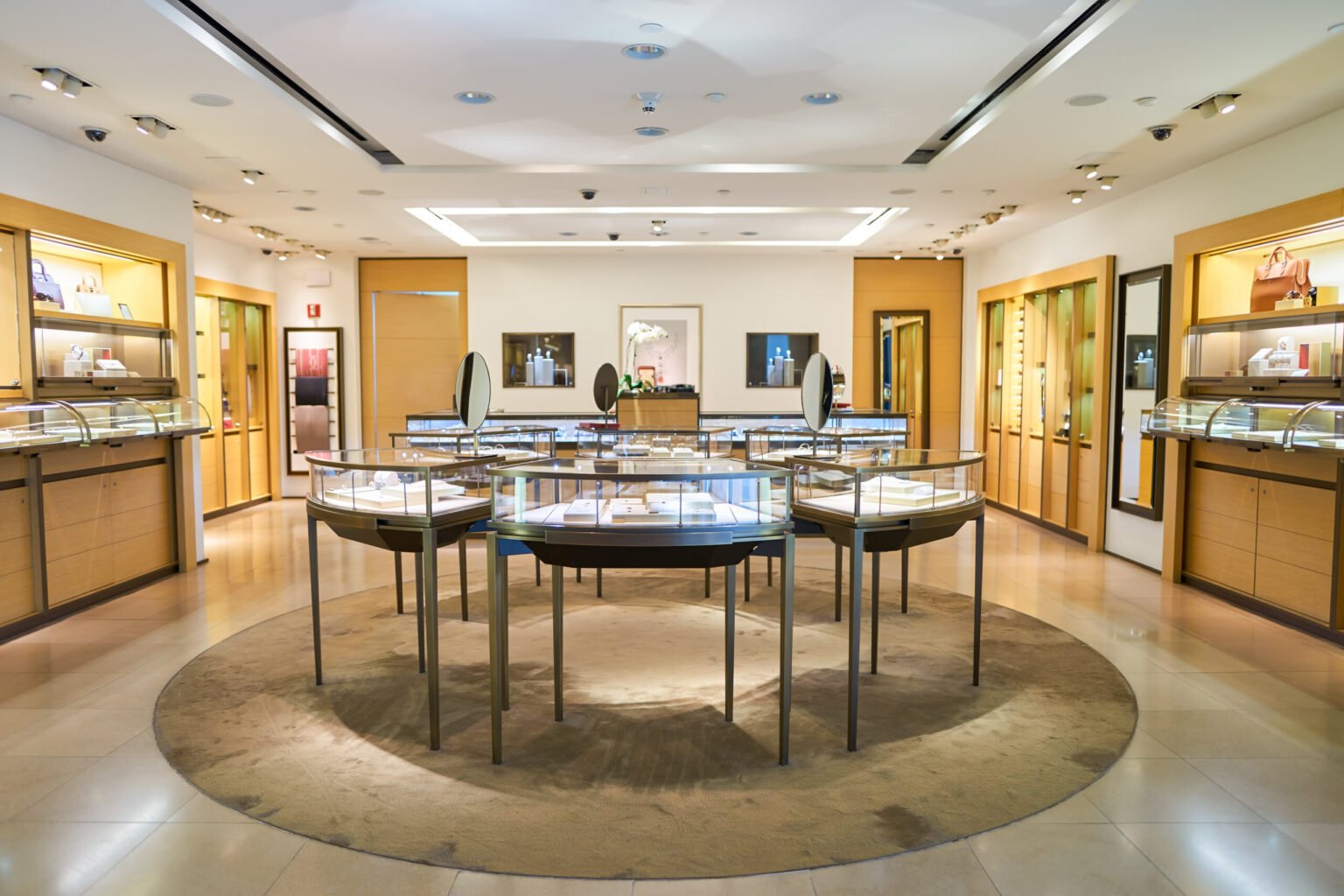
Actionable Insight: When acquiring painite for inventory or a collection, immediately obtain a gemological certificate from a reputable lab like GIA or AGL. This documentation is crucial for establishing provenance and value, which are foundational for securing adequate insurance for a jewelry business. Without it, underwriting and validating a claim for such an irreplaceable item becomes incredibly difficult.
2. Musgravite
Musgravite is a titan in the world of ultra-rare gemstone names, often vying for the top spot among the rarest faceted gems. It was first discovered in 1967 in the Musgrave Ranges of South Australia, from which it derives its name. For many years, only a handful of specimens were known, making it a near-mythical stone. While small, additional deposits have since been found in places like Greenland, Madagascar, and Tanzania, gem-quality, facetable material remains incredibly scarce, securing its place as a holy grail for elite collectors.
Geological Properties and Rarity Indicators
A member of the taaffeite group of minerals, musgravite is a beryllium aluminum oxide. Its close chemical relationship with taaffeite makes identification difficult, often requiring advanced laboratory analysis like Raman spectroscopy to differentiate between the two. This diagnostic challenge adds another layer to its rarity.
- Mohs Hardness: 8.0 to 8.5, making it exceptionally durable and suitable for all types of jewelry.
- Color Range: Typically found in shades of grayish-green to grayish-purple, but can also appear nearly colorless, deep green, or violet. The most desirable and valuable colors are deep, saturated purples and violets.
- Clarity: Like many exceptionally rare gems, most musgravite crystals are heavily included. The availability of eye-clean material over one carat is exceedingly limited, making such stones exponentially more valuable.
- Rarity Indicator: The primary indicator is its extreme scarcity combined with the difficulty of positive identification. Any gem marketed as musgravite requires certification from a top-tier gemological laboratory to confirm it is not the more common (though still rare) taaffeite.
Market Value and Insurance Considerations
The market for musgravite is exclusive, with transactions often occurring through private sales or at high-end auction houses. Fine-quality specimens can fetch staggering prices, sometimes exceeding $35,000 per carat, and even small, high-quality stones command premium values due to their rarity. The Smithsonian Institution is one of the few places to house a confirmed faceted musgravite, highlighting its museum-grade status.
For any business holding such a stone, standard insurance for a jewelry store is inadequate. The extreme rarity means replacement is often impossible, making an agreed-upon value essential for coverage. A specialized Jewelers Block insurance policy is the only way to properly protect such an asset.
Actionable Insight: When considering the acquisition of a musgravite, insist on two independent lab reports from globally recognized institutions (e.g., GIA, Gübelin) to confirm its identity and origin. This dual verification is critical for underwriting a robust Jewelers Block policy. Documenting the gem’s rarity and verified identity provides the concrete evidence needed for insurers to establish a fair and accurate agreed value for this irreplaceable asset.
3. Taaffeite
Taaffeite is one of the most intriguing rare gemstone names, known for its accidental discovery and extreme scarcity. It was first identified in 1945 by gemologist Count Edward Charles Richard Taaffe, who found the unusual stone in a parcel of what he believed were all spinels. This made Taaffeite the only gemstone to be first identified from an already faceted stone. Its remarkable rarity, estimated to be about one million times rarer than diamond, makes it a legend among collectors and a true prize for any high-end jewelry inventory.
Geological Properties and Rarity Indicators
Taaffeite is a beryllium magnesium aluminum oxide mineral. Its similarity to spinel in both appearance and chemical properties is what makes it so difficult to identify without advanced gemological testing. The primary sources for gem-quality taaffeite are alluvial deposits in Sri Lanka and Tanzania, with minor occurrences in Myanmar and China.
- Mohs Hardness: 8.0 to 8.5, making it highly durable and suitable for all types of jewelry.
- Color Range: Typically found in shades from mauve and lavender to pinkish-violet, reddish-brown, and even colorless. The most prized colors are saturated purples and reds.
- Clarity: Like many rare gems, taaffeite is often included. Finding eye-clean specimens, especially in sizes over one carat, is exceptionally uncommon.
- Rarity Indicator: Its key indicator is its double refraction, a property not found in spinel, which is singly refractive. This optical difference is the definitive test used by gemologists to distinguish it from the far more common spinel.
Market Value and Insurance Considerations
The market for taaffeite is driven almost entirely by its rarity. High-quality faceted stones can fetch prices ranging from $2,500 to over $25,000 per carat, with the final value depending heavily on color saturation, clarity, and size. Because it is so seldom seen, establishing a consistent market value can be challenging, making expert appraisal essential.
For any business holding such a scarce asset, securing the right protection is paramount. Standard insurance policies are ill-equipped to handle the valuation and replacement complexities of a gem like taaffeite. A specialized Jewelry store insurance plan, particularly a comprehensive Jewelers Block policy, provides the necessary coverage for such unique and high-value inventory.
Actionable Insight: When acquiring a potential taaffeite, always submit it to a top-tier gemological laboratory for definitive identification and a full report. This certification is non-negotiable for proving its authenticity and is a foundational requirement for obtaining adequate insurance for a jewelry business. This documentation, detailing its unique properties and provenance, is critical for underwriting and will be invaluable if a claim ever needs to be filed.
4. Red Beryl (Bixbite)
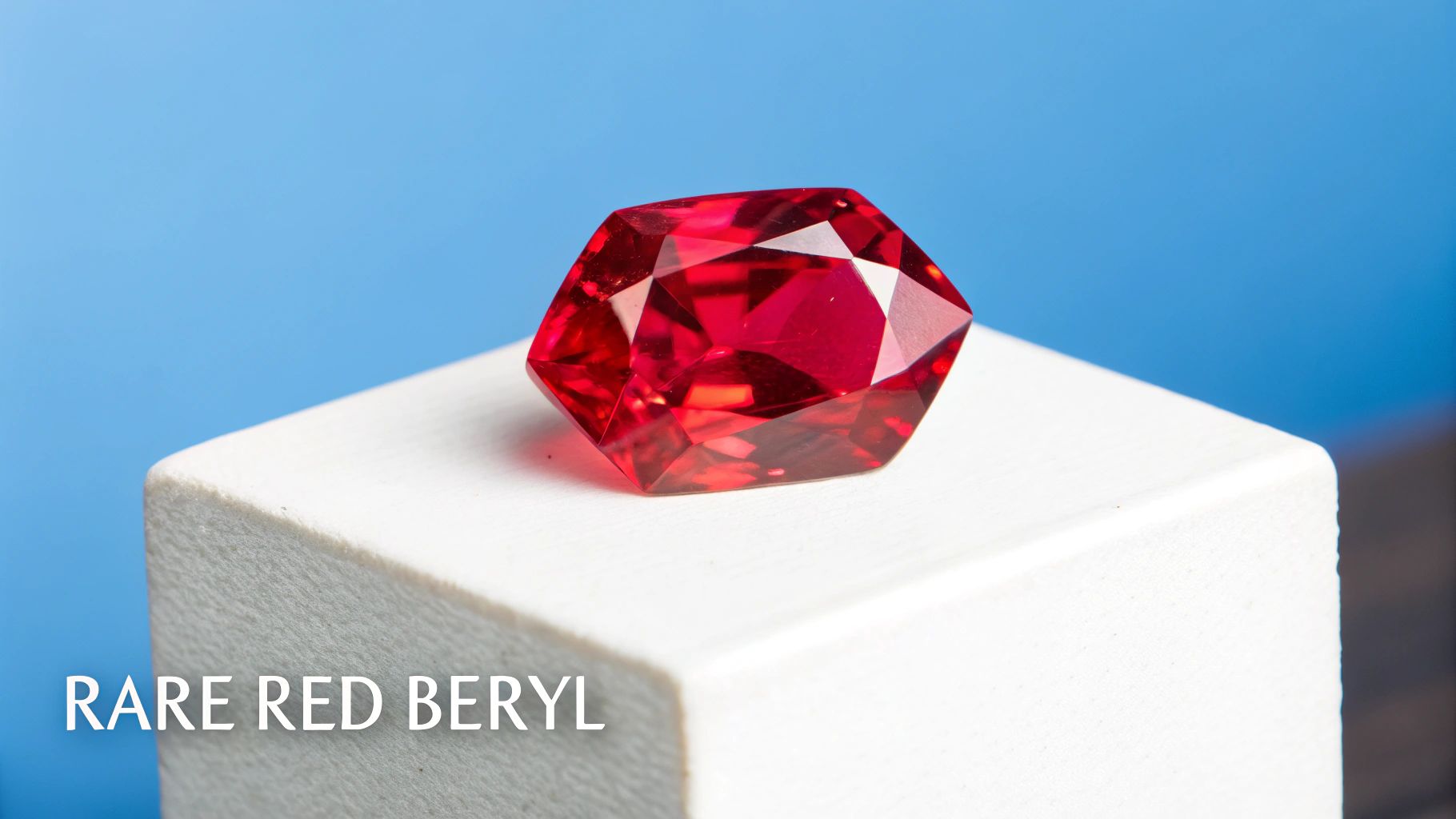
Red beryl, often marketed under the name bixbite, is one of the rarest members of the beryl family, which also includes emerald and aquamarine. Its inclusion in this list of rare gemstone names is cemented by its extreme scarcity; it is estimated that for every 150,000 gem-quality diamonds mined, only one faceted red beryl is found. Discovered in Utah's Wah Wah Mountains, this single location remains the only source of gem-quality crystals in the world, making its provenance incredibly specific and its supply exceptionally limited. The vibrant raspberry-red to purplish-pink color is caused by traces of manganese in its crystal lattice.
Geological Properties and Rarity Indicators
Red beryl is a beryllium aluminum cyclosilicate, sharing its fundamental chemistry with more common beryl varieties but distinguished by its unique coloring agent. The geological conditions required for its formation are so specific that they have occurred in only one known place on Earth, locking its supply chain to a now-closed mine.
- Mohs Hardness: 7.5 to 8.0, providing good durability for jewelry, though inclusions can affect its toughness.
- Color Range: The most desirable color is a strongly saturated, a pure red with a medium to medium-dark tone. Paler, more pinkish stones are less valuable.
- Clarity: Like emeralds, red beryl is often included. Eye-clean stones, especially those over one carat, are phenomenally rare and command premium prices.
- Rarity Indicator: The primary indicator is its exclusive Utah origin. Any red beryl presented without documented provenance from the Wah Wah Mountains should be scrutinized heavily, as its origin is the cornerstone of its value.
Market Value and Insurance Considerations
The market for red beryl is driven almost entirely by its rarity. Faceted stones over one carat are exceptionally scarce, with top-quality specimens fetching prices upwards of $10,000 to $20,000 per carat. For example, a 2.47-carat specimen featured at a 2016 gem show was valued at $38,000, underscoring its significant investment potential.
Due to its high value and irreplaceability, securing adequate insurance for a jewelry store holding red beryl is critical. A standard policy will not suffice. A specialized Jewelers Block insurance plan is designed to handle such high-value, unique assets, providing comprehensive coverage that accounts for the gem's true market replacement cost, which can fluctuate based on limited availability.
Actionable Insight: For any red beryl in your inventory, insist on a gemological report that confirms its natural origin and notes any treatments. This documentation is non-negotiable for underwriting a specialized Jewelry store insurance policy. When filing a claim, this report will be the primary evidence used to validate the gem's identity and justify its extraordinary value, making the process significantly smoother.
5. Grandidierite
Grandidierite is one of the most sought-after and elusive entries on any list of rare gemstone names, celebrated for its mesmerizing blue-green to teal hues. Discovered in southern Madagascar in 1902 and named in honor of French explorer Alfred Grandidier, this magnesium aluminum borosilicate mineral is exceptionally scarce in transparent, gem-quality form. For a century, faceted specimens were almost nonexistent, cementing its mythical status. While small deposits have since been found in Sri Lanka and Tanzania, Madagascar remains the only source of the finest, most vibrant material.
Geological Properties and Rarity Indicators
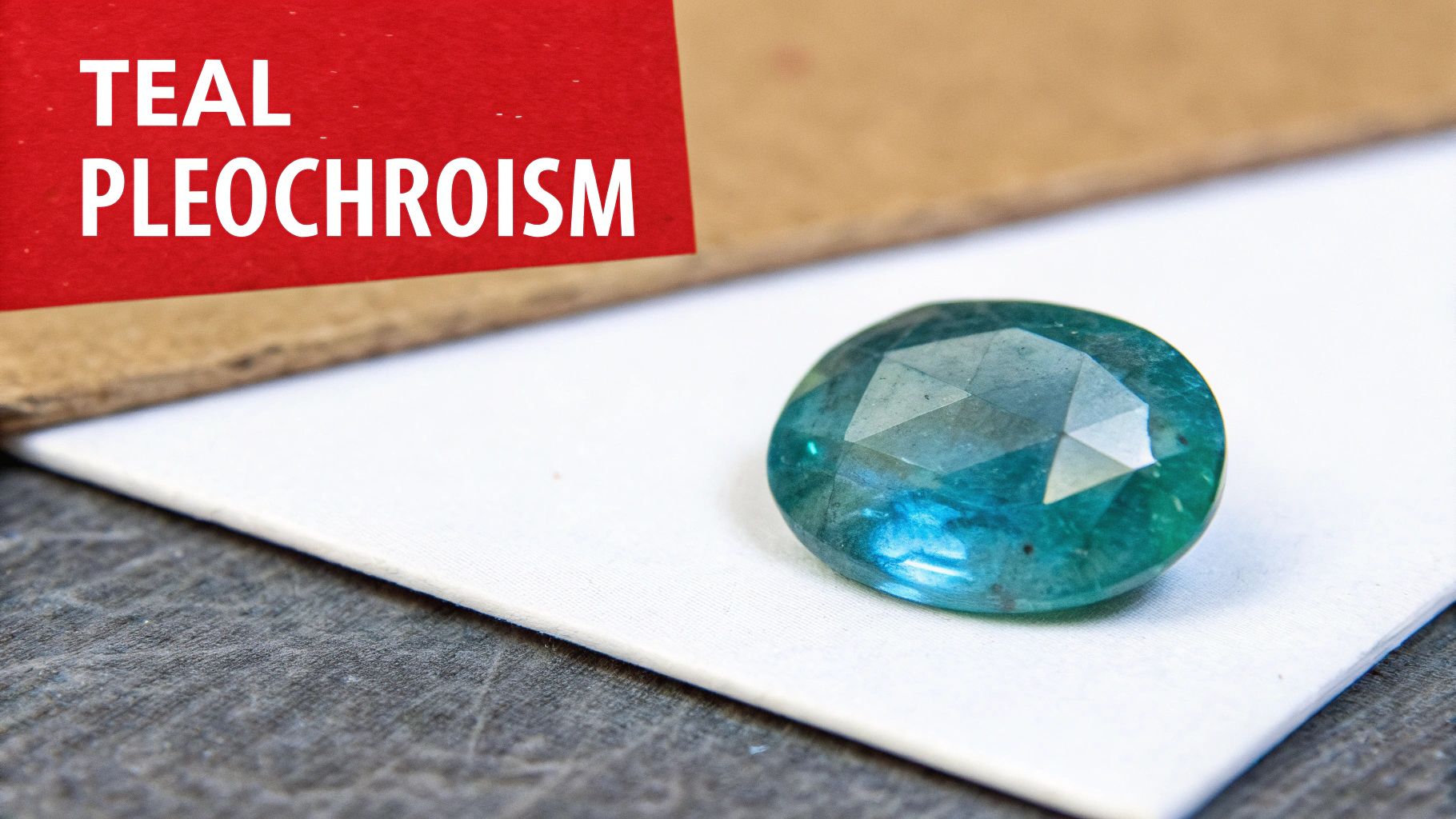
Grandidierite’s most defining feature is its strong trichroism, exhibiting dark blue-green, colorless (or very light yellow), and dark green colors from different angles. This phenomenon is a key identifier and contributes significantly to the gem's unique visual appeal. Its chemical composition and crystal structure make it difficult to form large, clean crystals.
- Mohs Hardness: 7.5, providing good durability for high-end jewelry pieces that are worn with care.
- Color Range: Varies from a light, almost ethereal sky blue to a deep, saturated teal. The most valuable specimens display a rich, neon blue-green color without any gray or brown modifiers.
- Clarity: The vast majority of grandidierite is translucent to opaque. Transparent, eye-clean material over one carat is exceedingly rare and commands a premium.
- Rarity Indicator: Its extreme pleochroism and limited geographic sourcing are primary rarity indicators. Gem-quality stones are so seldom found that the total known global supply of faceted grandidierite is estimated to be only a few hundred carats.
Market Value and Insurance Considerations
The market for grandidierite is extremely niche, appealing to connoisseurs and collectors of the world’s rarest gems. Prices for top-quality faceted stones can rival those of other ultra-rare gems, often reaching $20,000 per carat or more for exceptional examples. Value is driven almost entirely by the saturation of its blue-green color, transparency, and carat weight.
Due to its high value and scarcity, protecting a grandidierite asset requires more than a standard policy. A specialized Jewelry store insurance plan, like a Jewelers Block insurance policy from a provider like First Class Insurance Jewelers Block Agency, is critical for comprehensive coverage. Such policies are designed to handle the unique valuation and replacement challenges associated with irreplaceable gems.
Actionable Insight: For any grandidierite added to a private collection or retail inventory, insist on a gemological report that specifically notes its pleochroic properties and origin. This detailed documentation is vital for securing adequate insurance for a jewelry business. When underwriting a policy, insurers rely on this proof to accurately assess risk and establish a credible replacement value for a gem that cannot be easily sourced on the open market.
6. Alexandrite
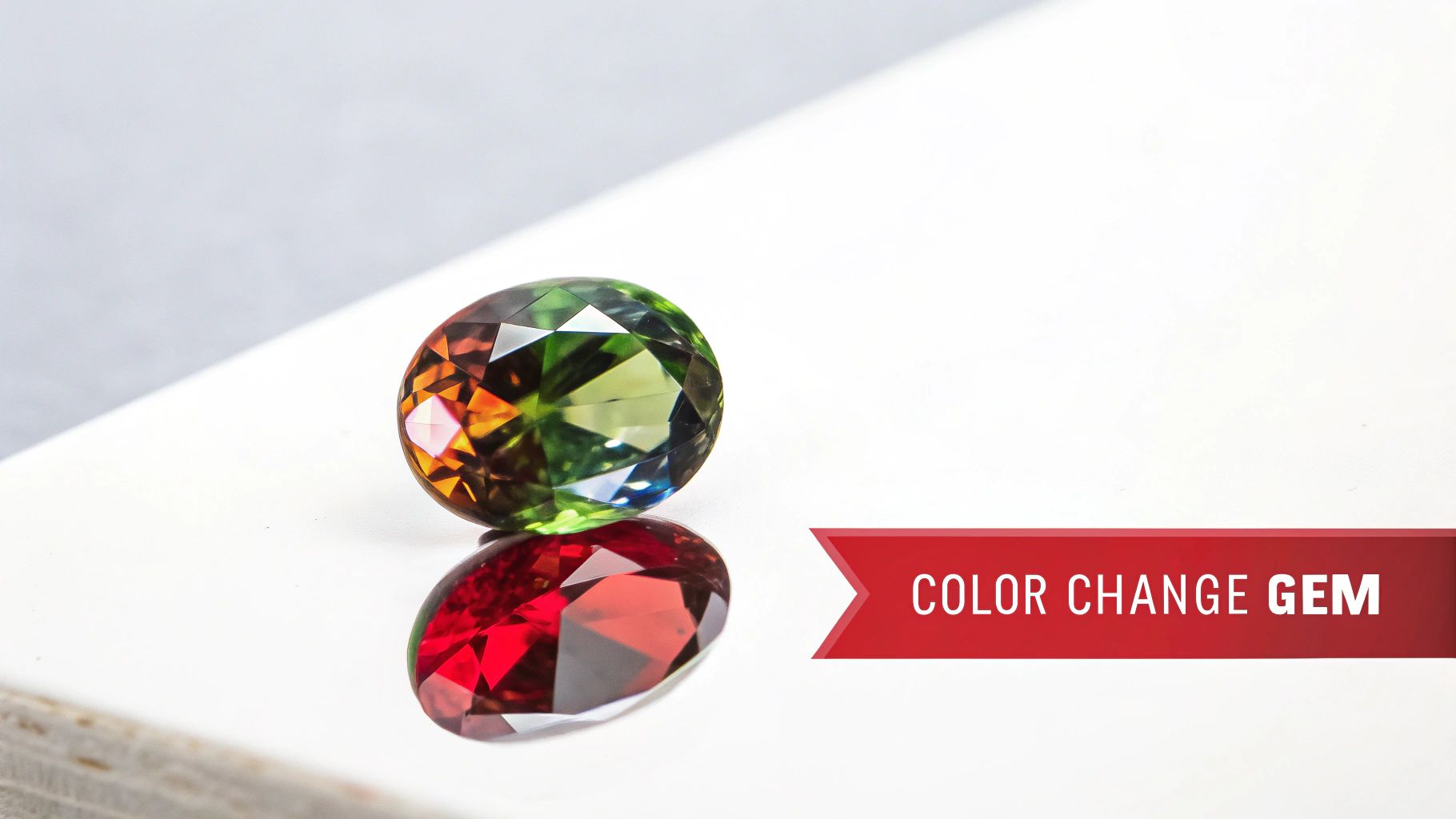
Alexandrite is a phenomenal gem among rare gemstone names, celebrated for its dramatic color-changing ability. Described as "emerald by day, ruby by night," it shifts from a vibrant bluish-green in daylight to a purplish-red under incandescent light. Discovered in Russia's Ural Mountains in 1830 and named after the future Tsar Alexander II, the original Russian specimens are legendary for their intense color change and are now virtually unobtainable, cementing their mythical status. While newer deposits have been found in Brazil, Sri Lanka, and East Africa, fine-quality alexandrite with a distinct color change remains exceptionally scarce.
Geological Properties and Rarity Indicators
Alexandrite is a rare, chromium-bearing variety of the mineral chrysoberyl. Its unique optical properties are due to the specific way chromium interacts with light, absorbing certain wavelengths and allowing others to pass through, which results in the perceived color change under different lighting conditions.
- Mohs Hardness: 8.5, making it an extremely durable and excellent choice for any type of jewelry, including daily-wear rings.
- Color Range: Green/bluish-green in daylight or fluorescent light, and red/purplish-red in incandescent light. The value is highest when the color change is 100% and the hues are strong and distinct.
- Clarity: Like most natural gemstones, alexandrite often contains inclusions. Eye-clean stones, especially those over one carat, are incredibly rare and command premium prices.
- Rarity Indicator: The strength and quality of the color change are paramount. A dramatic and complete shift between vivid green and red is the primary value driver. Provenance also plays a huge role; Russian alexandrite is the benchmark and carries a significant premium.
Market Value and Insurance Considerations
The market for high-quality natural alexandrite is robust, with prices that can rival those of fine diamonds, rubies, and emeralds. Specimens with a strong color change and good clarity can easily fetch tens of thousands of dollars per carat, with exceptional stones exceeding $70,000 per carat. Its dual identity and historical significance make it a favorite among high-end designers like Cartier and collectors worldwide.
Given its high value and rarity, protecting such an asset is crucial. Standard insurance is often inadequate, making a specialized Jewelry store insurance policy indispensable. A comprehensive Jewelers Block insurance plan provides the necessary coverage for these unique and high-value items, whether in a private collection or retail inventory.
Actionable Insight: When evaluating alexandrite, always assess the color change under multiple, controlled light sources (e.g., a daylight-equivalent lamp and a simple incandescent bulb). Documenting the percentage of change with a GIA or AGL report is essential for valuation and is a mandatory step for securing adequate insurance for a jewelry business. This certification substantiates the gem's quality and is non-negotiable for underwriting its full replacement value.
7. Jeremejevite
Among the elite class of rare gemstone names, Jeremejevite (pronounced ye-rem-ay-ev-ite) holds a special place due to its mesmerizing blue hues and extreme scarcity. First discovered in 1883 on Mt. Soktui in Siberia, Russia, and named after Russian mineralogist Pavel Jeremejev, this gemstone was for a long time known only through a few small, often pale crystals. Discoveries of gem-quality material in Namibia and later Myanmar in the 21st century introduced stunning, saturated blue specimens to the market, but the overall supply remains minuscule, making it a holy grail for serious collectors.
Geological Properties and Rarity Indicators
Jeremejevite is a complex aluminum borate mineral with variable fluoride and hydroxide content. Its prismatic, hexagonal crystals are often elongated and can be completely colorless, pale yellow, or the highly sought-after cornflower to sapphire blue. The vibrant blue color is attributed to trace amounts of iron.
- Mohs Hardness: 6.5 – 7.5, which is reasonably durable but requires a protective setting if used in jewelry.
- Color Range: Colorless, pale yellow, and light to deep sky blue. The most valuable specimens exhibit a vivid, saturated blue reminiscent of fine sapphire.
- Clarity: Finding eye-clean jeremejevite over one carat is exceptionally rare. Most crystals are small and contain inclusions, with larger, clean stones being museum-grade treasures.
- Rarity Indicator: Its extreme rarity is a function of its very limited and sporadic geological formation. Significant gem-quality deposits are virtually nonexistent, with notable finds in Namibia, Myanmar, and Tajikistan being small and quickly exhausted.
Market Value and Insurance Considerations
The market for jeremejevite is almost exclusively for collectors, with prices reflecting its profound rarity. While smaller, pale specimens can be acquired for a few hundred dollars per carat, top-quality, richly colored stones weighing over one carat can soar past $20,000 per carat. Its value is intensely sensitive to color saturation, clarity, and origin, with Namibian material often commanding the highest prices.
Given its value and irreplaceability, securing this gemstone requires specialized coverage. Standard insurance policies are inadequate for such a niche asset. A comprehensive Jewelry store insurance policy, specifically a Jewelers Block insurance plan, is essential to protect against the unique risks associated with handling and storing ultra-rare gems. This type of policy provides the necessary valuation expertise for items that have no simple market equivalent.
Actionable Insight: When adding jeremejevite to a high-value collection or store inventory, insist on a gemological report that confirms its identity and ideally its origin. This documentation is the cornerstone for securing proper insurance for a jewelry business. An underwriter will rely on this third-party verification to accurately assess the gem's value and establish a defensible replacement cost in the event of a loss.
8. Serendibite
Serendibite is an exceptionally rare and complex silicate mineral, holding a special place among rare gemstone names for its extreme scarcity and unique composition. Discovered in Sri Lanka in 1902, its name derives from "Serendip," the old Arabic name for the island. For nearly a century, only a few opaque, dark green to black specimens were known, primarily from Sri Lanka. The discovery of a new source in Myanmar's Mogok Valley in the late 1990s introduced the first known gem-quality, facetable material to the market, instantly elevating its status among elite collectors.
Geological Properties and Rarity Indicators
Serendibite is a magnesium aluminum borosilicate mineral with a complex chemical formula that contributes to its rarity. Its crystal structure is triclinic, and it exhibits strong pleochroism, often showing different shades of green, blue, and even yellow from various angles.
- Mohs Hardness: 6.5 – 7.0, making it moderately durable but best suited for jewelry pieces that are protected from impact, like pendants or earrings.
- Color Range: Typically found in shades of grayish blue-green, dark green, to nearly black. The cleaner, more vibrant blue-green specimens are the most prized.
- Clarity: Facetable serendibite is extraordinarily rare. Most crystals are heavily included, and eye-clean stones of any significant carat weight are virtually unheard of, commanding premium prices.
- Rarity Indicator: Its dual-locality scarcity is a key indicator. Gem-quality material has only been confirmed from two locations worldwide: Sri Lanka and Myanmar. A stone's origin is a critical component of its value and identity.
Market Value and Insurance Considerations
The market for serendibite is almost exclusively a collector's domain. Due to its extreme rarity, faceted stones are seldom seen outside of specialized auctions, high-end gem shows, or private collections. Prices can be astronomical, with clean, well-colored specimens easily fetching tens of thousands of dollars per carat. The limited supply means values are highly stable and often appreciate.
Insuring such a gem requires a precise and specialized approach. A standard policy is insufficient for an item with no readily available market replacement. A comprehensive Jewelry store insurance plan, like a Jewelers Block policy, is necessary to protect against the financial loss of such a unique asset.
Actionable Insight: For any serendibite specimen acquired for a collection or high-end inventory, obtaining a gemological report that confirms its identity and origin is the first critical step. This documentation is non-negotiable for securing adequate insurance for a jewelry business. When underwriting, insurers will rely heavily on this third-party validation to establish the gem’s provenance and justify its high replacement value, ensuring your investment is properly protected.
Comparison of 8 Rare Gemstones
| Gemstone | 🔄 Sourcing & Authentication | ⚡ Cost & Availability | 📊 Expected Outcomes | ⭐ Key Advantages | 💡 Tips |
|---|---|---|---|---|---|
| Painite | Extremely complex; historical scarcity, primary deposits Myanmar/Vietnam; expert lab ID required | $5,000–$15,000+/ct; extremely scarce | Very high appreciation potential; very low liquidity ⭐⭐⭐ | Extreme rarity; attractive brown-red→pink pleochroism; durable (Mohs 8) | Obtain certified report; expect small sizes; insure high-value pieces |
| Musgravite | Very challenging; few gem-quality finds (S. Australia, Madagascar); specialist verification needed | $3,000–$10,000+/ct; very limited | High collector demand; low liquidity ⭐⭐ | Unique greenish-blue/olive hues; very hard (8–8.5) | Buy certified specimens; provenance increases value |
| Taaffeite | Moderate–high complexity; often misidentified as spinel; Sri Lanka/Tanzania sources; lab testing necessary | $1,500–$5,000+/ct; few hundred specimens known | Strong prestige and appreciation; moderate liquidity ⭐⭐ | Distinct birefringence and pleochroism; hard (8–8.5) | Compare against spinel; require gemological certification |
| Red Beryl (Bixbite) | High difficulty; limited US deposits (Utah/New Mexico); expert authentication essential | $10,000–$100,000+/ct; exceptionally rare, typical sizes <1 ct | Exceptional investment/museum interest; very low liquidity ⭐⭐⭐ | Intense deep red color; high brilliance; strong collector prestige | Expect small carat sizes; demand lab reports and insurance |
| Grandidierite | Complex sourcing; primary Madagascar with minor Tanzania/Sri Lanka finds; expert cutting needed to show pleochroism | $2,000–$6,000+/ct; very scarce | Good collector appeal; niche market with moderate appreciation ⭐⭐ | Striking blue‑green/teal hues and exceptional pleochroism | Prefer well-cut stones to maximize color; check clarity carefully |
| Alexandrite | Moderate complexity; multiple sources; synthetic imitations common so certification critical | $300–$3,000+/ct (Russian up to $5k+); more available than ultra‑rares | High demand for quality color-change; relatively better liquidity ⭐⭐⭐ | Dramatic color-change (day green → incandescent red); very durable (Mohs 8.5) | Verify color-change in different lights; insist on reputable lab certificates |
| Jeremejevite | High complexity; very limited sources (Madagascar, Tajikistan, Russia); authentication essential | $1,000–$4,000+/ct; very scarce | Strong collector value; low liquidity ⭐⭐ | Beautiful sapphire-blue tones; distinctive mineralogy | Best for pendants/earrings due to lower hardness; expect inclusions |
| Serendibite | Extremely complex; virtually no commercial market (Sri Lanka primary); specialist authentication required | $500–$2,000+/ct; virtually unavailable commercially | Extreme rarity and prestige; very low liquidity ⭐⭐ | Rare pleochroic color range; true exclusivity for serious collectors | Purchase only via trusted specialists; limited market data for pricing |
Protecting Your Assets: The Critical Role of Jewelers Block Insurance
Our journey through the world of rare gemstone names has unveiled a universe of breathtaking beauty and exceptional value. From the fiery depths of Red Beryl to the elusive, color-shifting allure of Alexandrite, each gemstone represents a unique geological miracle. Understanding the properties, market value, and provenance of treasures like Painite, Musgravite, and Grandidierite is the hallmark of a distinguished jeweler and a savvy collector. However, possessing such rarity carries a proportional level of risk that cannot be ignored.
The knowledge gained from this guide is foundational, but it is incomplete without a robust strategy for asset protection. Your expertise in identifying and acquiring these magnificent stones must be matched by an equally sophisticated approach to securing them. Standard business policies are woefully inadequate for the nuanced risks associated with the high-end jewelry trade. They often contain exclusions for high-value items, mysterious disappearance, or off-premises events like trunk shows and private viewings.
Why Standard Insurance Falls Short for Rare Gemstones
The unique challenges of safeguarding an inventory that includes rare gemstone names demand a specialized solution. A typical business owner's policy simply doesn't account for the specific perils of the jewelry industry.
- Valuation Gaps: Standard policies may struggle to accurately appraise and cover the market value of a gem like Taaffeite, which can fluctuate based on new discoveries and collector demand. Jewelers Block policies are designed with this volatility in mind.
- Transit and Travel Risks: Jewelers frequently travel with high-value inventory. A specialized insurance for a jewelry business policy covers goods while in transit, at trade shows, or out on consignment, which are common gaps in general coverage.
- Mysterious Disappearance: A stone can go missing without clear evidence of theft. This scenario, known as mysterious disappearance, is a specific peril often covered by Jewelers Block insurance but is almost always excluded from standard policies.
- Employee Dishonesty: While unfortunate, internal theft is a real risk. A comprehensive jewelry store insurance plan includes provisions for employee dishonesty, protecting your business from the inside out.
Actionable Steps for Comprehensive Protection
Handling items like Jeremejevite or Serendibite means you are not just a merchant; you are a custodian of irreplaceable assets. Protecting these assets is a critical business function that requires proactive steps. It begins with acknowledging that specialized inventory requires specialized insurance.
For a business, the true value of a rare gemstone isn't just its market price; it's the confidence that comes from knowing it is fully protected against any eventuality. This is the core purpose of a tailored Jewelers Block policy.
While a robust Jewelers Block insurance policy is the commercial standard, individual collectors must also consider their personal protection needs. For consumers who own a single high-value piece, understanding personal jewelry insurance is crucial. For instance, those looking to protect a significant personal investment can find valuable insights in an engagement ring insurance UK complete guide, which outlines the principles of safeguarding individual treasured items.
Ultimately, the mastery of rare gemstone names and their characteristics is an art. Protecting the financial investment they represent is a science. By partnering with specialists who understand the unique risk landscape of the jewelry industry, you ensure that your passion and profession can thrive securely. As you continue to build your collection or inventory, make the decision to secure it with coverage that is as exceptional as the gems themselves.
Your collection of rare and valuable gemstones deserves protection from a partner who understands the intricacies of your industry. First Class Insurance specializes in comprehensive Jewelers Block insurance policies designed to safeguard your most precious assets, from inventory and raw materials to pieces in transit. Don't leave your legacy to chance; secure a policy that is as unique as your collection. Get a Quote for Jewelers Block by visiting First Class Insurance today.