
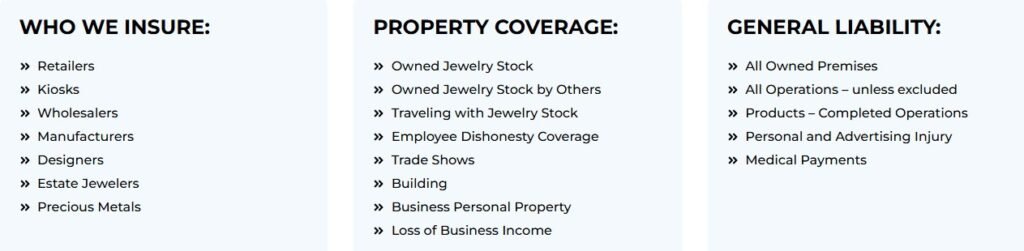
When you start comparing small business insurance, it doesn't take long to realize that standard policies just don't cut it for a jeweler. The problem is simple: a policy like a Business Owner’s Policy (BOP) is built for general risks, not for a business that handles high-value, easily portable inventory like yours. To plug those dangerous gaps, you need specialized coverage like Jewelers Block insurance.
Why Standard Business Insurance Fails Jewelers
For most small businesses, a Business Owner's Policy (BOP) is a great starting point. It conveniently bundles general liability and commercial property coverage into one package. But the unique world of a jewelry business—from handling loose stones to shipping finished pieces or setting up at trade shows—creates risks a standard BOP was never meant to handle. This is where many jewelers make a very costly mistake.
A typical commercial property policy buries low sub-limits for theft of valuable items like jewelry deep in the fine print. These often cap payouts at just a few thousand dollars—a drop in the bucket compared to the real value of your inventory. Worse, these policies are usually "named peril," which means you're only covered for disasters explicitly listed in the policy, leaving you exposed to countless other ways things can go wrong.
The Gaps in Standard Coverage You Can't Ignore
The insurance needs of a jewelry store go far beyond what a general policy offers. A BOP leaves you completely unprotected against some of the most common and financially devastating risks in this industry. A single incident in one of these blind spots could threaten the survival of your entire business.
Here are the key areas where a standard policy falls dangerously short:
- Mysterious Disappearance: This covers inventory that simply vanishes without any clear evidence of theft. It’s a frequent headache in a retail setting where pieces are constantly being handled, and it’s almost never covered by a BOP.
- Off-Premises Protection: What happens when your inventory leaves the store? A standard policy offers little to no protection for items at a trade show, with a salesperson on the road, or in transit with a shipping carrier.
- Damage to Customer Property: This covers you if a customer's piece is damaged, lost, or stolen while in your care for repair, appraisal, or on consignment.
- Employee Dishonesty: Protection against theft or fraud committed by your own staff is a common exclusion in standard property insurance, yet it remains a significant internal risk.
Relying on a standard BOP for a jewelry business is like using a simple padlock to protect a bank vault. It might deter an amateur, but it offers no real defense against the specific, sophisticated risks you face every day.
The Specialized Alternative: Jewelers Block Insurance
This is where a dedicated policy becomes non-negotiable. Jewelers Block insurance is a specialized, all-risk policy created specifically for the jewelry industry. Unlike a "named peril" policy, an "all-risk" policy covers losses from any cause that isn't explicitly excluded.
The table below breaks down the fundamental differences between these two approaches.
| Coverage Feature | Standard Business Owner's Policy (BOP) | Jewelers Block Insurance |
|---|---|---|
| Inventory Protection | Typically has low sub-limits for jewelry theft. | Covers your full inventory value, often on an "agreed value" basis. |
| Off-Premises Coverage | Generally excluded or severely limited. | Built-in coverage for transit, trade shows, and memo goods. |
| Mysterious Disappearance | Almost always excluded. | Can be included as a critical coverage feature. |
| Policy Type | "Named Peril" (covers only listed events). | "All-Risk" (covers everything unless specifically excluded). |
At the end of the day, a proper small business insurance comparison for a jeweler isn’t about finding the cheapest option. It’s about understanding that your high-value assets demand a higher level of protection that only specialized insurance for a jewelry store can provide.
Comparing Your Core Insurance Options
When you're trying to insure a jewelry business, you’re essentially standing at a fork in the road. One path leads to a standard Business Owner's Policy (BOP), maybe beefed up with separate property and liability policies. The other path leads to a specialized Jewelers Block policy, built from the ground up for the high-stakes world you operate in.
Understanding the difference isn't just about reading policy language. It’s about knowing how each policy will perform—or fail—when a real crisis hits. A BOP might seem fine on paper for a typical Main Street shop, but its cracks start to show the second you introduce high-value, portable assets into the equation.
Choosing the right path is one of the most fundamental decisions you'll make to protect your business. This graphic breaks down the two main insurance routes a jeweler can take.

As you can see, a BOP is a common place to start, but it often leaves you with serious protection gaps (the broken shield). A Jewelers Block policy, however, delivers targeted, robust security designed specifically for your high-value inventory.
Let's walk through a few real-world scenarios to see exactly how these policies stack up.
Scenario One: The Smash-and-Grab Theft
Picture this: It’s the middle of the day. Thieves shatter a display case, grab handfuls of inventory, and are gone in less than a minute. You’re left with a massive loss.
A standard BOP with commercial property coverage might respond, but you'll hit its limits almost instantly. Most of these policies have brutally low sub-limits for theft of items like jewelry, often capping the payout at just $2,500 to $5,000. That's a drop in the bucket compared to your actual loss.
A Jewelers Block policy, on the other hand, is built for this exact nightmare. It's structured to cover your entire inventory value, without those crippling sub-limits. This means you can recover the full wholesale value of what was stolen, protecting your business from a potentially devastating financial blow.
Scenario Two: The Item Lost In Transit
Now, let's try a different situation. You’ve just shipped a custom engagement ring to a client across the country. The carrier loses the package, and it’s never seen again.
Your standard BOP offers zero help here. It typically provides no coverage for your inventory once it leaves your four walls. You might get a small payout from the carrier's insurance, but good luck fighting for it—they are notoriously difficult to claim against and have very low maximums. You’d likely be eating most of that loss yourself.
In stark contrast, a Jewelers Block policy has transit coverage baked right in. It’s designed to protect your goods while they're with a shipping service, up to your policy limits. Your assets are covered whether they’re in the vault, in the display case, or on their way to a customer.
To really see the protection gaps, let's put these two policies side-by-side.
Jewelers Block Vs. BOP: A Head-to-Head Coverage Comparison
A standard BOP leaves gaping holes in coverage that a thief could drive a truck through. A Jewelers Block policy is designed to seal those gaps.
| Coverage Feature | Jewelers Block Insurance | Business Owner's Policy (BOP) |
|---|---|---|
| Inventory Theft | Covers inventory up to the full policy limit. | Severely restricted by low sub-limits (e.g., $2,500). |
| Mysterious Disappearance | Often available as an endorsement. Critical for unexplained losses. | Almost never covered. If it's not a documented theft, you're out of luck. |
| Goods in Transit | Coverage is a core feature, protecting items shipped or transported off-site. | No coverage once inventory leaves your premises. |
| Off-Premises Coverage | Protects inventory at trade shows, with sales reps, or at a polisher's. | Coverage ends at your front door. |
| Valuation Method | Typically covers items at actual cash value or agreed value, reflecting true cost. | Often uses a less favorable valuation, which may not cover your full cost. |
The takeaway is clear: while a BOP might cover the basics of running a business, it completely misses the mark on protecting the very assets that define a jewelry store.
Scenario Three: The Customer Injury
Let's shift gears from inventory to liability. A customer is in your showroom, trips over a rug, and is seriously injured. A lawsuit follows.
In this case, both a BOP and a Jewelers Block policy bundled with general liability would step in to protect you. The general liability portion of either policy is meant to cover these exact situations—third-party bodily injury claims. Both would help pay for legal defense costs and any settlement, up to your policy limit.
The lesson here is that while every business needs general liability, not every business needs the highly specialized property protection that you do. That’s why a smart insurance plan for a jeweler has to go deeper. This kind of specialized coverage has a long history, pioneered by institutions like Lloyd's of London.

A Jewelers Block policy's greatest strength is its 'all-risk' foundation. This means it covers every risk unless it is specifically excluded, whereas a standard policy only covers risks that are specifically named. For a jeweler, this difference is the gap between partial protection and true security.
The jewelry business is only getting more complex, and insurance is adapting. The global small business insurance market was valued at $17,501 million in 2021 and is projected to hit $28,673.1 million by 2033. This growth signals a bigger need for specialized policies, as smart business owners look for coverage that truly matches their risks.
Decoding Critical Coverage Details and Exclusions
The true strength of your insurance policy doesn’t show up on the sales brochure. It reveals itself when you have to make a claim. A small business insurance comparison that just skims the surface of policy names is a waste of time; the real value is buried in the fine print—the specific endorsements that protect you and the exclusions that can leave you dangerously exposed.
For a jewelry business, certain coverages are simply non-negotiable. They’re built to handle the unique, high-stakes risks you face every single day. Without them, you’re just gambling.

Why Mysterious Disappearance Is a Must-Have
One of the single most critical endorsements for any jeweler is mysterious disappearance. It’s the coverage that kicks in when an item is gone, but there's no evidence of a crime. Think about it: a diamond is missing from a mounting after a busy Saturday, or a bracelet vanishes from a display tray. With no signs of a break-in or a clear theft, a standard policy will deny that claim flat out.
Mysterious disappearance is essential because your inventory is constantly being handled by staff and customers, creating endless opportunities for things to just… vanish. A Jewelers Block policy acknowledges this reality and protects you from these maddening, hard-to-prove losses.
For a business where a single piece can be worth thousands, an unexplained loss isn't a minor hiccup—it's a financial gut punch. This coverage turns a potential disaster into a manageable event, making it absolutely indispensable.
Protecting Your Inventory on the Move
Let’s be honest, your inventory is rarely sitting still. It moves from the vault to the display case, out on memo to another retailer, or across the country to a trade show. Every one of those steps introduces a new layer of risk, and your policy has to follow your assets wherever they go.
- Goods in Transit: This protects items shipped via carriers like FedEx or UPS. Relying on the carrier’s built-in insurance is a rookie mistake; it’s notoriously inadequate and often caps payouts at a tiny fraction of an item's real value.
- Trade Show Coverage: When you take inventory on the road, your risk profile changes completely. This endorsement provides real protection against theft or loss in a less secure, high-traffic environment.
- Off-Premises and Memo Goods: This is crucial. It covers inventory that’s out of your store but still legally yours, like pieces with a traveling salesperson or goods sent to another jeweler "on memo" for a potential sale.
When you’re comparing policies, know that insurers will look closely at your physical security measures, like a high-quality lockable glass cabinet, to determine your rates and terms. And if you want to see how insurers expect high-value items to be documented, check out these professional jewelry photography techniques.
Navigating Common Exclusions and Coverage Gaps
Knowing what’s covered is only half the battle. You have to know what isn’t. Every policy has exclusions, and for a jeweler, they can be devastating. Spotting these gaps is the first step to closing them.
Two of the most common—and dangerous—exclusions you’ll find in a standard policy are:
- Employee Dishonesty: What happens if a trusted employee has been pocketing small items for months? Standard property policies almost always exclude theft by employees. This is a massive vulnerability, as internal theft is a huge source of retail loss.
- Unexplained Inventory Shortage: This is a bit different from mysterious disappearance. This exclusion applies to losses discovered during a physical inventory count where you simply can’t pinpoint the cause.
The only way to plug these holes is with a separate policy. Commercial crime insurance is specifically designed to cover losses from employee theft, forgery, and other fraud. Adding it creates a much stronger shield, protecting your business from threats both outside and inside your four walls.
How Your Operations Impact Insurance Costs
The final price tag on your jewelry store insurance isn't a number pulled out of thin air. It’s a direct reflection of how underwriters see your specific, day-to-day risks. Think of it like a puzzle where every piece—from your safe's rating to your store's location—builds the final picture of your premium.
A thorough small business insurance comparison shows that specialist carriers dig deep. They aren’t just insuring a generic "retail store"; they're insuring a high-value, high-risk jewelry business. This means every decision you make about security, inventory management, and even how you value your stock directly hits your bottom line.

Inventory Valuation and Your Bottom Line
How you value your inventory is one of the first questions an underwriter will ask, and it’s a big one. The two main approaches, Actual Cash Value (ACV) and Agreed Value, offer very different outcomes and price points.
- Actual Cash Value (ACV): This pays out the replacement cost of a lost item, minus depreciation. While it often means a lower premium, it can leave you with a serious financial gap when you need to replace a one-of-a-kind antique piece or a custom creation.
- Agreed Value: This is where you and the insurer agree on your inventory's value upfront. If a loss happens, you get that pre-determined amount without any deduction for depreciation. This ensures you can replace the item at its full, true value. For a closer look at what's at stake, you can see examples of stunning antique jewelry.
Opting for Agreed Value usually means a slightly higher premium, but the financial certainty it provides is absolutely critical for any serious jewelry store insurance plan.
The Power of Physical Security Measures
Your physical security is the most tangible factor you can control to bring down your insurance costs. Underwriters see robust security as a powerful deterrent to theft, which in turn lowers their risk. When you’re getting quotes, remember that investing in comprehensive commercial security systems is a huge factor in how insurers will assess your business.
Here are the security elements that directly impact your rates:
- UL-Rated Safes: An underwriter will want to know the specific rating of your safe (e.g., TL-15, TL-30). A higher rating signals greater resistance to an attack and will lead to much better terms.
- Central Station Alarms: A system that automatically alerts a monitoring center and the police is non-negotiable if you want favorable pricing.
- Surveillance Systems: High-definition cameras covering all entry points, display cases, and work areas are essential.
Investing in top-tier security isn't just an expense; it's a direct negotiation tool. Every layer of protection you add demonstrates to an underwriter that you are a lower-risk client, which can unlock more competitive pricing.
Location and Operational Scope
Where you are and what you do also play a massive role. A standalone store in a low-crime area will be viewed much more favorably than one in a high-traffic mall with higher crime stats.
Your business model matters, too. A wholesaler with a large inventory constantly in transit faces a completely different risk profile than a retailer with a single showroom.
This is why partnering with a specialized First Class Insurance Jewelers Block Agency is key. They give you access to multiple underwriters who actually understand these nuances. This creates competition for your business, allowing you to Get a Quote for Jewelers Block that accurately reflects your proactive risk management.
Cost management is a huge challenge, with 94% of owners reporting difficulties with insurance premiums. While U.S. small business owners cite inflation as their top headache, there are opportunities. For instance, North American insurance pricing is expected to be flat in Q4 2025, which allows specialized agencies to find competitive rates on Jewelers Block insurance and help you control your costs.
Finding the Right Insurance Partner
Let’s be honest. Comparing insurance policies is only half the battle. The single most important decision you'll make is choosing the person who will guide you through it all. In the high-stakes world of fine jewelry, your insurance partner is just as critical as your coverage.
A great partner isn't just a salesperson—they’re your advocate, risk manager, and industry insider rolled into one. They make sure your protection keeps up with your business. This is where a specialist First Class Insurance Jewelers Block Agency becomes your biggest asset, offering a level of know-how a general agent simply can’t touch.
Generalists vs. Specialists: It's Not Even Close
When you start looking for insurance, you'll run into two types of providers: generalists and specialists. A generalist can sell you a policy, sure. But a specialist understands your world from the inside out. They know the difference between a memo and a consignment, the real security requirements for a TL-30 safe, and the unique risks you face at a trade show.
That kind of deep knowledge is what turns a standard policy into a real defense strategy. A specialist doesn't just sell you Jewelers Block insurance; they build a fortress around your specific operation.
A general agent sees a jewelry store and thinks "retail." A specialist sees a complex business with unique vulnerabilities—from off-site risks with salespeople to the nightmare of mysterious disappearance—that demand a purpose-built insurance solution.
Your Checklist for Vetting an Insurance Partner
To find a true expert, you need to know what to look for. Use this checklist to cut through the noise and make sure you’re trusting your business to a pro. Any decent agency can Get a Quote for Jewelers Block, but your evaluation needs to go much deeper than that first step.
- Do they live and breathe jewelry? Ask them tough questions about employee dishonesty coverage or how they handle customer property left for repairs. Their answers will tell you everything you need to know about their experience providing insurance for a jewelry store.
- Do they have access to multiple A-rated carriers? A top-tier agency doesn’t work with just one insurer. They have relationships with several specialty carriers, forcing them to compete for your business and ensuring you get the best possible terms and price.
- Are they a bulldog when it comes to claims? This is huge. When a loss happens, you need an advocate, not a paper-pusher. Ask for real-world examples of how they’ve fought for clients during the claims process to get a fair and fast settlement.
- Do they help you prevent losses in the first place? The best partners are proactive. They should offer practical, no-nonsense advice on improving your security, tightening up inventory controls, and reducing your day-to-day operational risks.
Ultimately, you’re not just buying a policy. You're forming a strategic alliance with an expert who is dedicated to protecting your inventory, your reputation, and your future. Finding the right jewelry store insurance starts and ends with finding that trusted advisor.
Your Top Jeweler's Insurance Questions, Answered
When you're dealing with high-value assets, navigating the world of commercial insurance can feel like a minefield. A proper small business insurance comparison often just brings up more questions. Let's tackle the most common concerns we hear from jewelry store owners, wholesalers, and designers, and give you clear answers to guide your decisions.
Why Isn't My Standard Business Policy Enough for My Jewelry Store?
This is the single biggest misunderstanding jewelers have. A standard Business Owner's Policy (BOP) is built for general risks—think a slip-and-fall in a retail shop—and it almost always excludes or severely limits coverage for high-value, portable assets like jewelry.
The real problem is buried in the fine print. Critical, everyday risks for a jeweler—like mysterious disappearance, a loss while you're off-site at a trade show, or theft from a safe—are almost universally excluded from a standard BOP. These policies were simply not designed to handle the unique ways a jewelry business can suffer a loss.
A specialized Jewelers Block insurance policy, on the other hand, is built from the ground up as an "all-risk" policy. It’s specifically engineered to cover these exact scenarios, giving you real protection for your inventory, no matter where it is.
What Does "Mysterious Disappearance" Coverage Actually Cover?
Mysterious disappearance is one of the most critical add-ons for any jeweler. It covers the unexplained loss of an item when there's no clear evidence of a crime, like a forced entry or a hold-up.
Think about it: a diamond is missing from a setting after a busy Saturday, or a ring vanishes from a tray you showed to three different customers. Without a clear sign of theft, a standard policy will deny that claim flat out. Because your inventory is constantly being handled by staff and customers, this is a huge vulnerability.
A Jewelers Block policy that includes mysterious disappearance coverage is essential. It protects you from those common, hard-to-prove losses that are a daily reality in the jewelry business. Without it, you're essentially self-insuring against one of your biggest operational risks.
How Much Do Security Systems Actually Lower My Insurance Premiums?
Your security measures have a direct and significant impact on your insurance premiums. When underwriters look at an application for insurance for a jewelry business, they don't just glance at it—they meticulously analyze your safeguards to calculate your risk.
A robust security setup shows you're serious about preventing losses. This includes things like:
- UL-rated safes (like a TL-15 or TL-30) for overnight storage.
- A centrally monitored alarm system that automatically calls the police.
- High-definition surveillance cameras covering every key angle of your store.
- Secure showcases and strict protocols for who can access them.
Taking these steps translates directly into better pricing for Jewelers Block and commercial crime policies. A good agent can even tell you which security upgrades will give you the best return on your investment by lowering both your real-world risk and your insurance bill.
What Should I Look for in an Insurance Agent for My Jewelry Business?
When you need insurance for a jewelry store, you want a specialist who lives and breathes this industry—not a generalist who sells a little bit of everything. Your ideal agent or agency should represent multiple A-rated insurance carriers that focus on jewelers. This is the only way to ensure you're seeing competitive quotes for coverage that actually fits your business.
Ask them about their claims process. When a loss happens, you need a proactive advocate in your corner who will fight for you, not just file paperwork. A top-tier partner also provides ongoing risk management advice to help you stop losses before they even happen. They should be responsive and able to turn around quotes quickly.
That kind of efficiency shows they have the expertise to properly serve you. A specialist from a dedicated First Class Insurance Jewelers Block Agency will guide you through the whole process, from the first quote to ongoing support.
Ready to get the right protection for your valuable assets? The experts at First Class Insurance have over 30 years of experience building specialized insurance solutions for jewelers just like you. Get a Quote for Jewelers Block and feel the peace of mind that comes with true industry expertise.