
When you see a tiny "585" stamp on jewelry, you're looking at one of the most important clues to its composition and value. This little mark is shorthand for 14-karat gold, and it tells you the piece is made of 58.5% pure gold mixed with other metals to give it strength.
What the 585 Stamp Reveals About Your Jewelry
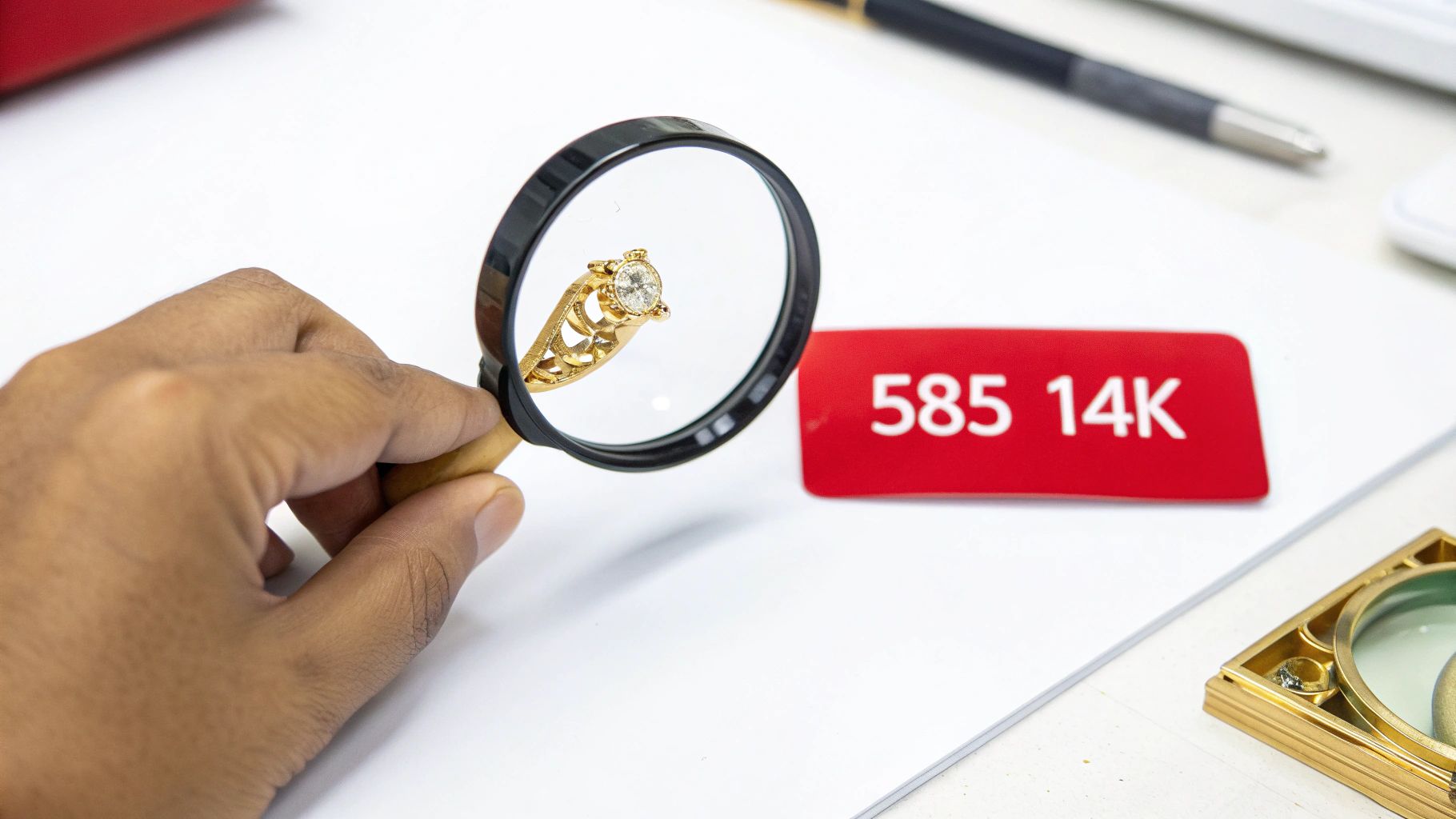
That small inscription, often tucked away on a clasp or the inner band of a ring, is more than just a number. It’s a universal language in the jewelry world—a hallmark that speaks volumes about the item’s gold content.
Think of pure, 24-karat gold as a beautiful but delicate ingredient. On its own, it’s far too soft for items like rings or bracelets that need to stand up to daily life.
To craft a piece that’s both stunning and resilient, goldsmiths mix pure gold with stronger metals like copper, silver, or palladium. This mixture is called an alloy, and the "585" stamp is the recipe. It means that out of 1,000 parts of metal, 585 are pure gold, and the remaining 415 parts are other metals. You can explore more about these popular hallmarks and what they mean from experts in the field.
You'll find these stamps used all over the world, but the specific markings can vary. Here's a quick look at some of the most common ones you'll encounter.
Common Gold Hallmarks and Their Purity Levels
| Millesimal Stamp | Karat Value | Pure Gold Percentage | Common Use Case |
|---|---|---|---|
| 999 | 24K | 99.9% | Gold bars, investment-grade coins |
| 916 | 22K | 91.6% | High-karat jewelry, common in Asia/Middle East |
| 750 | 18K | 75.0% | Fine jewelry, European standard |
| 585 | 14K | 58.5% | The U.S. standard for durable everyday jewelry |
| 417 | 10K | 41.7% | Entry-level gold jewelry, highly durable |
| 375 | 9K | 37.5% | Common in the U.K. and Australia |
This table is a great starting point, but always remember that authenticating a piece goes beyond just reading the stamp.
Why This Hallmark Matters for Jewelers
For any jewelry business, understanding this stamp is non-negotiable. It’s the very first step in accurately assessing your inventory, which directly impacts everything from pricing and customer trust to your insurance coverage. A piece marked "585" has a fundamentally different intrinsic value than one marked "750" (18K gold) or "375" (9K gold).
This simple distinction is critical for your daily operations:
- Accurate Valuation: It establishes the baseline value for appraisals and retail pricing.
- Inventory Management: Proper categorization ensures your stock records are airtight.
- Insurance Security: It provides the clear, precise documentation needed for your Jewelers Block insurance policy.
For a jewelry store, misinterpreting a hallmark is like a bank miscounting its cash. Accurate identification of marks like "585" is the foundation of a secure and profitable business, ensuring that every piece is valued and protected correctly.
Getting this simple number right prevents massive headaches down the road, from under-insuring your valuable stock to fighting claim disputes. It's a tiny detail with enormous financial implications.
The Story Behind Jewelry Hallmarks
Those tiny stamps on a piece of jewelry are far more than just a string of numbers. They're a legacy of trust, built over centuries to protect everyone from the customer to the honest merchant. A 585 stamp on jewelry, for instance, isn't some modern convention; it's the direct descendant of a system designed to guarantee quality. This is the world of hallmarking, and it started as one of the earliest forms of consumer protection.
The practice of marking precious metals goes back centuries. By the late 1200s, goldsmith guilds in Europe were already creating unique marks to certify the purity of their work. The system was formalized into law when French King Philip IV mandated guild-regulated hallmarks for all gold items way back in 1313.
From Guilds to Global Standards
At first, these marks were a simple promise from a local craftsman. The reputation of the entire guild rested on the integrity of that stamp, ensuring a piece of gold or silver was exactly what it claimed to be. It was the original anti-fraud system, creating a foundation of trust that was essential for trade.
As commerce grew, these local systems evolved. Governments stepped in, establishing official "assay offices" to independently test and verify the metal content. This crucial shift created a standardized, unbiased system that both jewelers and their customers could rely on, no matter where they were.
A hallmark is essentially the ancestor of modern-day quality certification. It transformed a piece of metal into a verified asset, assuring its value across towns, borders, and generations.
The Evolution of Marking Techniques
Just as the system evolved, so did the tools. Early hallmarks were applied with a simple punch and hammer—a method that required serious skill to avoid damaging the piece. While traditional stamping is still alive and well, modern technology has given us far more precise methods.
Understanding this progression, from old-school hand stamps to modern techniques like laser engraving metal, gives you insight into a mark's reliability. Today's methods can create incredibly crisp, detailed marks on even the most delicate items, making them much harder to counterfeit.
Take a look at the precision on this modern French hallmark on a gold item. This history isn't just trivia; it reinforces the value and authenticity you communicate to your clients, strengthening the very trust your business is built on.

How the 585 Stamp Defines Market Value
That tiny 585 stamp on a piece of jewelry is so much more than a simple quality mark. For a jeweler, it’s the foundational number that establishes a piece's intrinsic worth. It’s a direct signal that the item contains 58.5% pure gold, which gives you a clear baseline for its valuation.
We often call this baseline the "melt value"—what the raw gold is worth if you melted it down.
This melt value isn’t a fixed number. It’s a moving target, tied directly to the daily global spot price of pure, 24-karat gold. As markets ebb and flow, so does the base value of every 585-stamped piece in your showcase. This is why a precise understanding of gold content isn't just trivia; it's fundamental to smart pricing and inventory management.
From a pure market perspective, pricing 585 gold starts with a simple calculation: you multiply the current spot price of pure gold by 0.585. That gives you its base gold value. Of course, the actual consumer price is much higher, layering on costs for craftsmanship, brand prestige, and retail markup. You can learn more about how 585 gold prices are set to see the full picture.
Moving Beyond Melt Value
While the 585 stamp sets the floor for an item's price, it's just the ground floor. The true market value of a piece is a blend of its material worth and several intangible—but hugely important—factors. Any skilled jeweler knows these are the elements that turn a simple gold alloy into something truly valuable.
Here are the key factors that build value on top of the gold content:
- Craftsmanship and Design: Think about the skill and artistry involved. A handmade, intricate ring will always be worth more than a mass-produced band, even if their gold weight is identical.
- Brand Recognition and Provenance: A piece from a famous luxury house carries a premium. You’re not just buying gold; you’re buying a legacy of quality and design.
- Gemstone Quality: The moment you add stones, the game changes. The cut, color, clarity, and carat of any diamonds or gems can easily make the gold's value a minor part of the total price.
- Rarity and Condition: Is it an antique? A vintage piece from a specific era? If it’s in excellent condition, its historical significance and collectible status can send its value soaring far beyond its raw components.
The Impact on Insurance and Appraisals
Grasping this complete value picture is absolutely critical for your insurance for a jewelry business. If your policy only covers the melt value of your inventory, you are setting yourself up for a painful financial hit.
Relying solely on the gold content to value your inventory is like judging a masterpiece by the cost of its canvas and paint. The true value lies in the artistry, brand, and story—all of which must be accounted for in your business insurance.
Accurate appraisals have to document everything—not just the 585 stamp, but the craftsmanship, the brand, and every detail about the gemstones. This meticulous record-keeping is the backbone of a solid Jewelers Block insurance policy. It’s what ensures that if you suffer a loss, you can justify the full replacement value of your items, protecting your business from what could otherwise be a devastating blow.
Protecting Your Business From Counterfeits
In the world of fine jewelry, a stamp is a powerful claim. But it should never be treated as an absolute guarantee.
While a legitimate 585 stamp on jewelry signifies 14-karat gold, counterfeiters are all too willing to exploit that trust by marking inferior metals. For any serious jewelry business, moving beyond simple trust to active verification isn't just good practice—it's essential for protecting your reputation and your bottom line.
A fraudulent stamp isn't just a mark; it's a quiet liability that can poison your inventory. If you accept a counterfeit piece at face value, you risk overpaying on an acquisition, misrepresenting it to a customer, or creating major discrepancies in your records. These mistakes directly hit the accuracy of your insurance for a jewelry store, which can lead to being underinsured and fighting over claims down the road.
Visual Inspection: Your First Line of Defense
Your first move should always be a meticulous visual inspection. A genuine hallmark, whether applied by a traditional punch or a modern laser, should be crisp, clear, and evenly struck. You have to train your eye to spot the tell-tale signs of a fake.
- Fuzzy or Uneven Marks: Counterfeit stamps often look blurry, shallow, or unevenly pressed into the metal. A real stamp is confident and precise.
- Incorrect Placement: Hallmarks are typically placed in discreet but standard locations, like the inside of a ring band or near a clasp. An odd or sloppy placement is a big red flag.
- Signs of Plating Wear: Check for discoloration or flaking on edges and high-contact points. This often reveals a different base metal underneath, a dead giveaway for pieces falsely marked as solid 585 gold.
Advanced Verification Methods
When a visual check leaves you with any doubt, it's time to turn to more definitive testing.
Simple acid scratch tests can offer a quick confirmation of gold karat, but for higher-value items or pieces with questionable origins, non-destructive methods are always the better choice. You can't risk damaging a potentially valuable piece.
X-Ray Fluorescence (XRF) analysis is the gold standard for verification. An XRF gun gives you a precise breakdown of an item’s elemental composition in seconds, all without leaving a single mark. It will tell you definitively if that 58.5% gold content is genuine.
This level of certainty isn't just for your peace of mind; it's a critical part of risk management for your insurance for jewelry business. Accurate documentation built on verified data strengthens your inventory records, which are the very foundation of a solid Jewelers Block insurance policy. You can study detailed images of high-quality antique jewelry with clear hallmarks to train your eye and use them as a reference.
Comparing Gold Authenticity Verification Methods
Choosing the right test depends on the item's value, your certainty, and your tolerance for risk. Here’s a quick breakdown of the most common methods jewelers rely on.
| Test Method | Accuracy Level | Risk of Damage | Typical Use Case |
|---|---|---|---|
| Acid Scratch Test | Moderate | High | Quick, low-cost verification for scrap or low-value items. |
| Electronic Gold Tester | Moderate-High | Low | Verifying common gold karats in a retail setting; less precise than XRF. |
| X-Ray Fluorescence (XRF) | Very High | None | Appraisals, high-value acquisitions, and verifying precious metal content without damage. |
| Fire Assay | Extremely High | Complete Destruction | The definitive standard for raw gold and bullion; melts down the sample. |
Ultimately, a multi-layered approach combining a trained eye with reliable technology is the only way to operate with confidence.
This decision tree shows how value is built from the raw material all the way to the final branded product.
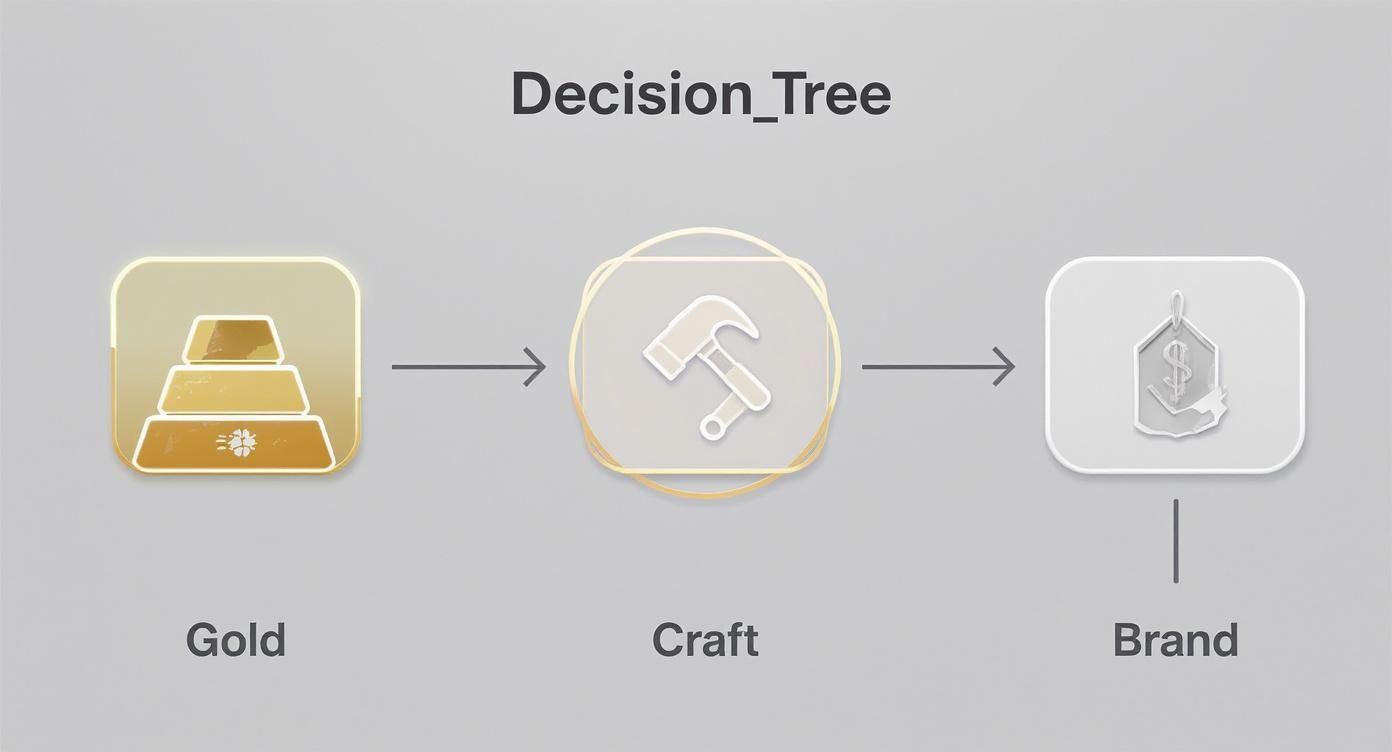
The infographic highlights that while gold content is the foundation, it's the craftsmanship and brand reputation that create the final market value—reinforcing just how crucial it is to protect the entire asset.
Why Hallmarks Are a Cornerstone of Jewelers Block Insurance
For a jewelry business, a tiny mark like the 585 stamp on jewelry is much more than a quality stamp—it’s a critical business asset. This is where your day-to-day documentation directly fuels your financial security. For providers of Jewelers Block insurance, these details aren’t just nice to have; they are absolutely essential for assessing risk, setting premiums, and, most importantly, paying claims.
Insurers need verifiable facts to understand the value of the inventory they’re protecting. A hallmark provides a clear, globally recognized standard for an item’s precious metal content. This isn't just a minor detail; it's the bedrock of a transparent, trusting relationship between your business and your insurance partner.
This level of detail allows an underwriter to build a precise risk profile for your jewelry store insurance. Think of it as the difference between insuring a vague "box of gold items" versus a detailed manifest of 150 pieces of 14K gold, 80 pieces of 18K gold, and 20 platinum items. The second scenario is a much clearer, lower-risk proposition for any insurer.
How Documentation Discrepancies Impact Claims
Let's imagine the worst-case scenario: a fire or a major theft at your store. When you file a claim with your First Class Insurance Jewelers Block Agency, the very first thing they will ask for is your inventory records. This is the moment of truth where the accuracy of your hallmark documentation gets put under a microscope.
If your records are vague, inconsistent, or missing verified details about the metal content of each piece, you've just created a huge roadblock. An adjuster's entire job is to verify your claimed loss against your documented inventory. Any discrepancies can lead to some seriously painful and costly outcomes.
Accurate inventory documentation is not a back-office chore; it is your first and most powerful line of defense in financial risk management. In the event of a loss, these records become the primary evidence that substantiates the value of your claim.
Inaccurate or incomplete records can spiral into several negative consequences, making it vital to maintain pristine documentation for your insurance for a jewelry store.
- Underinsurance: If you've undervalued your stock because of sloppy record-keeping, your policy limit might not be high enough to cover the full replacement cost of your loss.
- Claim Disputes: When your paperwork doesn't line up with the physical evidence or appraisal values, it can trigger lengthy disputes with the insurance adjuster. This means long delays in getting paid right when you need the capital most.
- Claim Denials: In the worst cases, where records seem fraudulent or are just grossly negligent, an insurer could have grounds to deny the claim entirely, leaving you to absorb the full financial blow.
Turning Documentation into a Business Advantage
Being proactive and meticulous about documenting hallmarks does more than just prepare you for a disaster. It actually strengthens your position when you go to secure insurance for a jewelry business in the first place. When you walk into a negotiation with an insurer holding airtight records, you’re sending a powerful signal of professionalism and risk awareness.
It tells underwriters that you are a responsible business owner who actively manages and protects their assets. This can translate directly into more favorable terms, better premium rates, and a much smoother underwriting process.
When you're ready to see how that commitment to detail pays off, you can Get a Quote for Jewelers Block and put your best foot forward. It's this proactive approach that ensures your business is truly protected when it matters most.
Mastering Inventory for Better Insurance Coverage
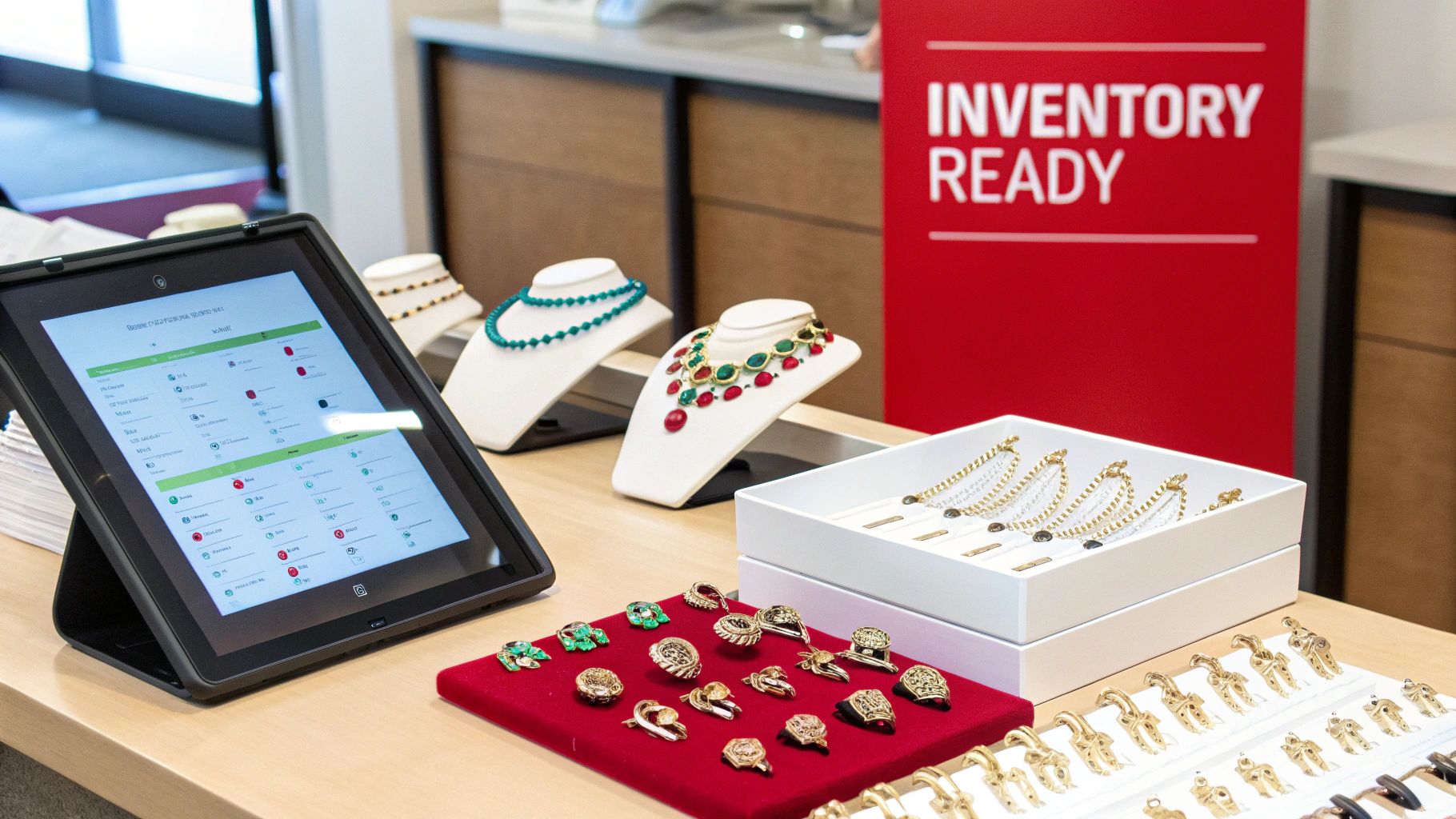
Knowing what the hallmarks mean is one thing, but putting that knowledge to work is what really protects your business. A meticulously managed inventory isn't just good for operations; it’s the absolute bedrock of a solid Jewelers Block insurance policy. When you have to file a claim, that detailed record is the playbook that proves the value of everything you've lost.
Think of your inventory list as your opening statement to an insurer. If your descriptions are vague, you’re inviting questions, delays, and friction. But precise, detailed records? That builds a case that’s credible, clear, and easy for them to process. It’s how you turn a simple list into a powerful risk management tool.
Creating an Insurer-Friendly Inventory
To get that level of clarity, your records need to be more than just a headcount of your pieces. For every item in your showcase, especially one with a 585 stamp on jewelry, the documentation has to be flawless. A strong inventory record is an indisputable reference, much like this detailed image of a diamond ring with all its facets visible.

Your documentation for each piece should include:
- High-Quality Photographs: Clear, well-lit photos from several angles are a must.
- Detailed Descriptions: Note the style, weight, dimensions, and all the specifics on gemstones (the 4Cs, of course).
- Hallmark Verification: Explicitly record the hallmark (585, 750, etc.) and note how it was verified, if you went beyond a visual check.
- Purchase Information: Keep the supplier invoices, acquisition dates, and what you paid for it.
- Appraisal Documents: For your high-value or unique pieces, attach current professional appraisals.
A detailed inventory is your financial shield. In the event of a claim, it’s not what you know you lost that matters—it's what you can prove you lost. Meticulous records are the strongest proof you can have.
This isn't just busywork. This level of detail is critical for any insurance for a jewelry business. It removes all ambiguity, helps an adjuster validate your loss quickly, and gets your claim processed faster. Learning hallmarks is step one; the next is mastering your stockroom. For more on that, it’s worth reviewing some best practices for inventory management that top jewelers swear by.
The Non-Negotiable Role of Regular Appraisals
The market for precious metals and gemstones is always moving. An appraisal from five years ago is ancient history, and it could leave you dangerously underinsured today. That’s why getting regular, professional appraisals is a non-negotiable part of the business.
For your most valuable items, you should be getting an updated appraisal every two to three years. This simple habit ensures your jewelry store insurance coverage reflects what it would actually cost to replace your stock right now, protecting you from a devastating financial hit. Turn these practices into routine, and you build a rock-solid foundation for a strong partnership with your insurer.
Answering Your Questions About 585 Gold
Let's cut right to it. Here are the quick, clear answers to the questions we hear most often from jewelers and collectors about the 585 gold stamp.
Is 585 Gold the Same as 14K Gold?
Yes, they are one and the same. The 585 stamp on jewelry is simply the European or international way of marking gold purity. It tells you the piece is 58.5% pure gold. This is the direct equivalent of the 14-karat (14K) mark used in the U.S., which means 14 out of 24 parts are pure gold.
Does 585 Gold Tarnish or Fade?
Because 585 gold is an alloy mixed with other metals, it can show signs of tarnish over time, especially if it's exposed to harsh chemicals. But the good news is that it’s far more durable and resistant to scratches and daily wear than higher-karat golds. A little regular cleaning is all it takes to bring back its original shine.
What Is the Difference Between a 585 Stamp and a G.P. Stamp?
This is a critical distinction. A "585" stamp means you're holding a piece of solid 14K gold. If you see a mark like "585 G.P." or "14K G.P.," that stands for Gold Plated. It signifies that only a razor-thin layer of 14K gold is covering a common base metal. Gold-plated items have almost no intrinsic value and are not considered fine jewelry.
Your detailed inventory records, including hallmark verification, are crucial for your insurance. Insurers use this data to accurately assess the total value at risk for your jewelry business.
How Does Hallmark Accuracy Affect Jewelers Block Insurance?
Think of it from your insurer's perspective. When you have precise, verifiable records of every hallmark, you're demonstrating excellent risk management. That kind of professionalism can lead to more favorable premiums on your insurance for a jewelry store. On the flip side, messy or inconsistent records signal a higher risk, which can mean higher premiums or even difficulty getting the right Jewelers Block insurance coverage.
Protecting your inventory starts with knowing exactly what you have and ends with having the right coverage. The team at First Class Insurance brings over 30 years of experience to the table, building custom policies just for jewelers. Get a Quote for Jewelers Block.