
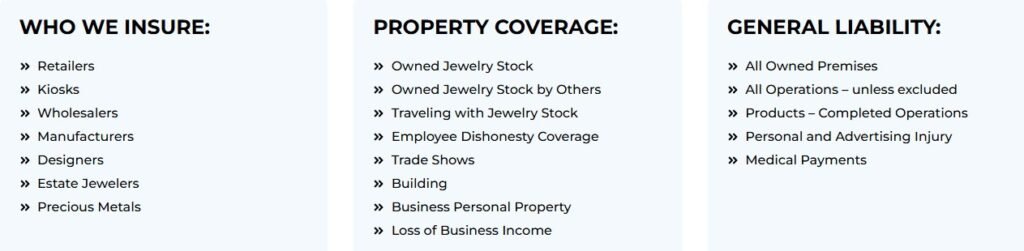
As a jeweler, you’ve done everything right to secure your inventory. You have a Jewelers Block insurance policy that protects your physical assets, but what about the threats that don't involve a shattered display case or a busted lock?
That’s where commercial crime insurance comes in. It’s the policy that guards your financial assets—your cash flow, bank accounts, and digital transactions—from hidden risks like employee theft, forgery, and cyber fraud. Think of it as the financial security system for your business operations.
Protecting Your Business Beyond the Vault

Physical security is second nature for any jeweler. You invest heavily in vaults, safes, and top-tier alarm systems to protect your tangible goods. This is where your Jewelers Block policy shines, covering the physical loss or damage to your precious inventory from disasters like a robbery or fire.
But what happens when the crime isn’t a smash-and-grab? Some of the most devastating financial hits happen quietly, often from the inside or through a deceptive email. They don’t leave a mark on your storefront, but they can drain your bank account.
The Hidden Risks in a Jewelry Business
Modern threats to a jewelry store often bypass your physical defenses entirely. These crimes attack your cash flow and financial stability, creating losses that a standard Jewelers Block policy was never designed to cover. This is exactly the gap that commercial crime insurance fills.
Just think about these all-too-common scenarios:
- Employee Dishonesty: A trusted manager has been altering sales records for months, quietly pocketing thousands in cash sales.
- Funds Transfer Fraud: A sophisticated phishing email tricks your bookkeeper into wiring a large payment for a "vendor" directly into a criminal's bank account.
- Forgery or Alteration: A client pays for a high-value watch with a flawless counterfeit certified check that your bank initially accepts, only to discover the fraud weeks later.
These incidents highlight a massive vulnerability for any business owner. It's no surprise the global commercial crime insurance market, valued at $16.25 billion, is projected to hit $63.56 billion by 2035. This explosive growth shows just how seriously businesses are taking these hidden operational risks.
Here’s the simplest way to think about it: Jewelers Block is the high-tech security system for your vault. Commercial crime insurance is the advanced firewall for your bank accounts.
While this policy provides the financial backstop, strong physical deterrents are always your first line of defense. For instance, implementing commercial security gate solutions can make your premises a much harder target.
Ultimately, these two policies work hand-in-hand to create a complete shield for your business, protecting both your stunning inventory (https://jewelersblockins.com/wp-content/uploads/2025/11/antique-jewelry-scaled-1-1536×1024.jpg) and the money you make selling it.

What Your Commercial Crime Policy Actually Covers
Think of a commercial crime policy less like a single shield and more like a specialist's toolkit. Each tool inside—what the insurance world calls an "insuring agreement"—is engineered to fix a very specific kind of financial hole that crime can punch in your business.
Let’s open that toolkit and look at the most important pieces for any jewelry business. We'll cut through the jargon and get straight to the real-world scenarios you could be up against. Understanding these individual coverages is what shows you how this policy protects your money, something your standard Jewelers Block insurance was never designed to do. This is all about defending the cash you’ve already earned.
Employee Theft Coverage
This is, without a doubt, the heart of any commercial crime policy for a retailer. Also known as employee dishonesty, this coverage pays your business back for losses of money, securities, and other property stolen by one of your own employees.
The crime isn't always a dramatic, one-time heist. More often, it’s a quiet drain that happens over months, or even years. Imagine a trusted sales associate who starts voiding cash sales after the customer leaves and simply pockets the money. This coverage is what steps in to recover those accumulated losses once the scheme finally comes to light.
The critical detail here is intent. The employee must have a clear intent to cause a loss to you and to gain a financial benefit for themselves or someone else. This is for deliberate, criminal acts—not honest mistakes or simple incompetence.
Forgery or Alteration Coverage
Forgery is one of the oldest tricks in the book, and it’s still shockingly effective. This part of the policy protects you from losses when someone forges or alters checks, drafts, promissory notes, or similar financial documents.
Picture this: a sophisticated scammer buys an expensive engagement ring with a fraudulent cashier's check that looks completely legitimate. Your bank accepts it, the ring walks out the door, and everything seems fine. But days later, the fraud is discovered, and the bank claws that money right back out of your account. That’s a direct financial hit that forgery coverage is built to absorb.
Computer and Funds Transfer Fraud
In a world where business is done online, your bank account can be emptied from a keyboard thousands of miles away. This coverage is your frontline defense against two distinct types of cyber-enabled theft.
- Computer Fraud: This covers you if a hacker breaches your computer systems to illegally transfer money. For instance, a criminal uses malware to steal your online banking credentials, logs in as you, and wires funds from your business account to their own.
- Funds Transfer Fraud: This is for when a criminal impersonates you or an authorized employee and tricks your bank into sending money. This is often a "social engineering" attack—like a meticulously crafted fake email that appears to be from you, the owner, urgently telling your bookkeeper to wire funds to a new "vendor."
These coverages are vital because the criminals behind these scams don't need to pick a lock or smash a window. They bypass all your physical security.
Money and Securities Coverage
Your Jewelers Block policy protects your inventory, but what about the cash in the register? Or the deposits on the way to the bank? This section of a crime policy protects your actual money and securities against theft, disappearance, or destruction, both on and off your premises.
It’s typically split into two key parts:
- Inside the Premises: This covers the loss of money and securities from within your store. A classic example is a burglar breaking in overnight and cracking open your safe to steal the cash inside.
- Outside the Premises: This protects your money and securities while they’re in the hands of a messenger or an armored vehicle—think of your daily bank deposit run. If your employee is robbed while walking the day's cash receipts to the bank, this is the coverage that would respond.
By putting these core pieces together, you can see how commercial crime insurance builds a financial fortress around your operations, protecting the very assets most vulnerable to deception, fraud, and theft.
Jewelers Block vs Commercial Crime Insurance
One of the most dangerous assumptions a jeweler can make is thinking Jewelers Block and commercial crime insurance are interchangeable. They aren’t. Confusing the two can leave massive, business-ending gaps in your protection, exposing your financial assets to a whole different class of criminal.
Think of it this way: these are two completely different policies built to guard against entirely different threats.
The Role of Jewelers Block Insurance
At its heart, Jewelers Block insurance is your physical fortress. Its entire job is to protect your inventory—your "stock-in-trade." That includes the loose diamonds in the vault, the gold waiting to be crafted, and the finished pieces sparkling in your showcases. It’s a highly specialized form of property insurance that responds directly to physical loss or damage.
Jewelers Block is the policy that protects what your customers can see and touch. It’s what kicks in after a tangible event, such as:
- A brazen smash-and-grab robbery during store hours.
- A sophisticated overnight burglary where thieves defeat your safe.
- A fire or flood that wipes out your inventory.
- The mysterious disappearance of a six-figure ring from your display.
- Theft of a secured package while it’s in transit.
This policy is the absolute bedrock of proper insurance for a jewelry store. It safeguards the high-value, tangible assets that are your business. But its protection ends where the physical goods do.
Where Commercial Crime Insurance Steps In
While Jewelers Block guards your inventory, commercial crime insurance guards your money. It’s designed to protect your financial assets from crimes of deception, fraud, and dishonesty—the kind of threats that slickly bypass your alarms and vaults.
This is the policy that covers losses from criminal schemes targeting your cash flow and bank accounts, not your display cases.
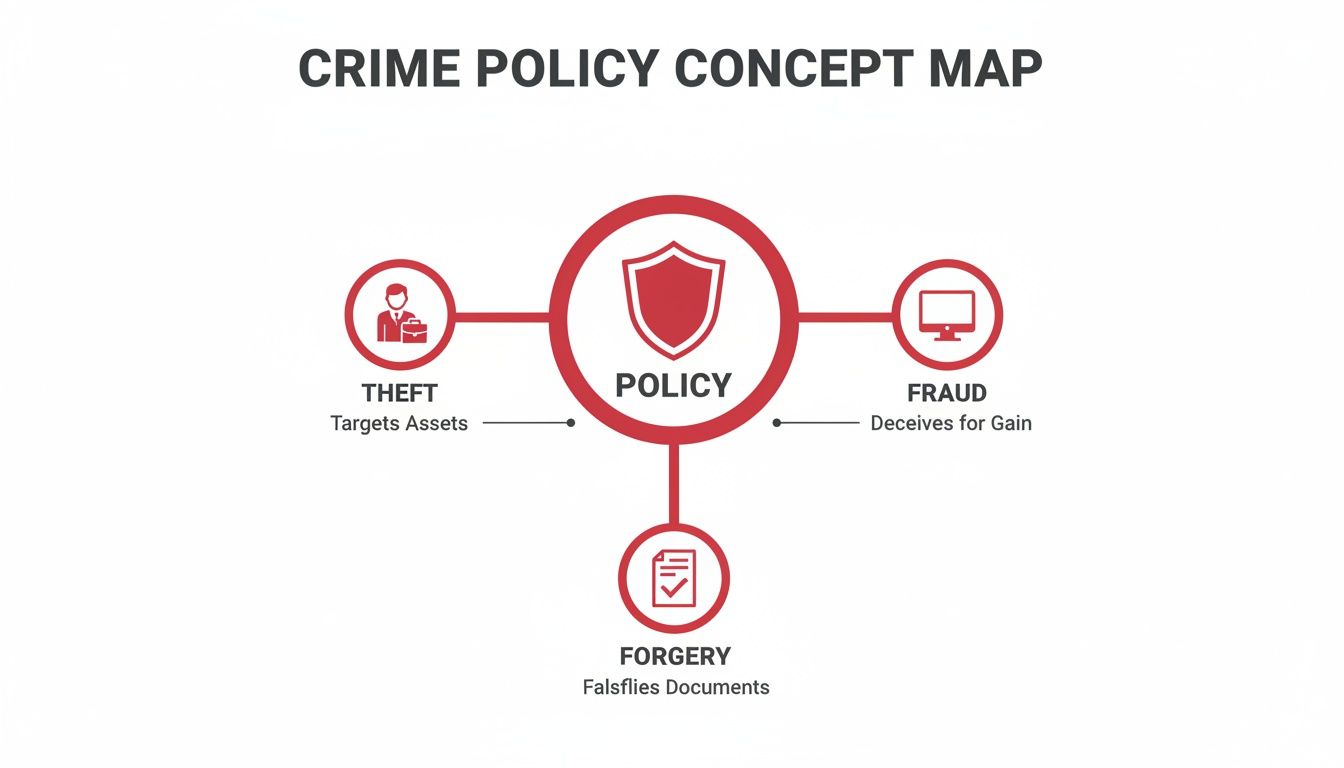
As you can see, this coverage is all about defending your business from internal embezzlement, external scams, and forgeries. These are fundamentally different risks than a physical heist.
Here’s the simplest way to remember it: Jewelers Block protects the jewelry for sale. Commercial crime insurance protects the money from the sale. One covers the product; the other covers the profit.
These two policies are partners, not competitors. A jeweler could be financially wiped out by a trusted employee siphoning funds for months or by a con artist who tricks them into a fraudulent wire transfer. A Jewelers Block policy won’t cover a penny of those losses.
We can help you see how both policies work together to protect everything from a single sparkling diamond ring to your entire bank account.

Coverage at a Glance: Commercial Crime vs. Jewelers Block
To make the distinction crystal clear, here’s a side-by-side breakdown. This table shows you exactly what each policy is built to handle.
| Coverage Aspect | Jewelers Block Insurance | Commercial Crime Insurance |
|---|---|---|
| Primary Focus | Protects physical inventory (jewelry, gems, precious metals). | Protects financial assets (money, securities, bank accounts). |
| Covered Events | Burglary, robbery, fire, transit theft, mysterious disappearance. | Employee theft, forgery, computer fraud, funds transfer fraud. |
| Example Scenario | Thieves break into your store overnight and steal from the vault. | An employee alters accounting records to hide cash theft. |
| Criminal's Method | Physical force or stealth to steal tangible goods. | Deception, impersonation, or abuse of trust to steal funds. |
Ultimately, a complete risk management plan for a jewelry store needs both. By pairing a robust Jewelers Block policy with a well-designed commercial crime plan, you create a seamless shield that protects your business from nearly every angle of criminal threat.
Real-World Crime Scenarios Jewelers Face
Policy language can be dry. To really get a feel for why commercial crime insurance is so critical, you need to step out of the theory and into the real world. Let’s walk through a few scenarios that happen every day—situations where a typical Jewelers Block insurance policy simply wouldn’t apply.
These aren't just hypotheticals; they're the kinds of devastating events that can sink a business that isn't properly protected.

Scenario One: The Trusted Insider
Imagine Sarah, your store manager for the last ten years. She’s the rock of your operation—loyal, hardworking, and someone you trust implicitly with everything from closing the register to handling bank deposits. But behind the scenes, she’s drowning in personal debt.
The scheme starts small. For months, Sarah begins voiding cash sales in your POS system after the customer has already left with their new watch or earrings. To anyone checking the daily reports, everything balances perfectly. She pockets the cash from these "voided" sales, a few hundred dollars here and there. A year and a half later, the total damage hits $45,000.
- The Financial Damage: Your business is out $45,000 in cash. Since no physical inventory was stolen, a Jewelers Block policy won’t help.
- How Crime Insurance Responds: This is a textbook case for the Employee Theft portion of a commercial crime policy. Once an audit uncovers the fraud, the policy is designed to reimburse your business for the documented financial loss from her dishonest acts.
Scenario Two: The Deceptive Email
It's a busy Tuesday morning. Your bookkeeper gets an email that looks like it's from a trusted international diamond supplier. The logo is right, the tone feels familiar, and it mentions a pending $110,000 invoice. The email urgently explains their usual payment system is down and provides new wiring instructions.
To avoid delaying a crucial shipment, your bookkeeper follows the instructions and wires the money. It’s only when the real supplier calls a few days later asking about the late payment that you realize you’ve been scammed. The money is gone, vanished into an untraceable offshore account.
This type of social engineering is exploding globally. While North America has always been a big market for crime insurance, the Asia-Pacific region is now projected to grow by 18.6% each year through 2032. It’s a direct result of digital business creating new backdoors for criminals. You can read more about this growing global crime market and see the trends for yourself.
- The Financial Damage: A straight loss of $110,000 from your bank account.
- How Crime Insurance Responds: Your Funds Transfer Fraud coverage kicks in here. It's specifically designed to cover losses that happen when a fraudulent instruction—like a sophisticated fake email—tricks an employee into sending money to a criminal.
Scenario Three: The Forged Check
A sharp-looking customer comes in on a Saturday and falls in love with a diamond necklace priced at $28,000. He pays with a certified check from a major bank. Your team gives it a good look, everything appears legitimate, and they complete the sale.
You deposit the check on Monday, and the funds even appear in your account. But a week later, the bank calls. The check was a masterful forgery. They pull the money right back out of your account, and the thief—and your necklace—are long gone.
- The Financial Damage: You’re out $28,000 in revenue and the cost of the stolen necklace.
- How Crime Insurance Responds: The Forgery or Alteration coverage is built for exactly this. It reimburses your business for the financial hit you take from unknowingly accepting a fraudulent check or other financial instrument.
Strengthening Your Defenses Against Financial Crime

While a solid commercial crime insurance policy is your financial safety net, the best claim is always the one you never have to make. Let's be honest, prevention is your first, and most powerful, line of defense.
When you put strong internal controls in place, you’re doing two crucial things. First, you make your business a much harder target for criminals. Second, you’re showing underwriters that you run a tight ship—a well-managed, lower-risk operation that often translates into better premiums.
Think of these controls as the security protocols for your cash flow, just as your vault protects your inventory. They’re the everyday habits that shut down opportunities for theft, whether from an outsider or, unfortunately, one of your own. Ultimately, smart strategies to deter crime are just good business.
Building Your Internal Security Checklist
Fortifying your jewelry store insurance plan starts with simple, smart steps. The whole idea is to create layers of accountability that make it nearly impossible for one person to exploit a weakness.
Here are the essential loss-control tactics every jewelry business should have on its checklist.
Start with Hiring and Training
Your first wall of defense is the people you hire. Before you hand over the keys to someone with financial access, you need to do your homework.
- Conduct Background Checks: This is non-negotiable for anyone handling money, inventory, or financial records. A thorough background check can flag serious risks before they ever set foot in your store.
- Train Staff on Fraud Detection: Your employees are your eyes and ears. Teach them how to spot the classic signs of social engineering, like those phony "urgent" emails from the "CEO" demanding a wire transfer. Regular training keeps everyone sharp.
Implementing Financial Safeguards
Your daily financial routines are prime targets. Tightening up these processes is one of the most effective things you can do to prevent fraud. The guiding principle here is simple: eliminate any single point of failure. No one person should have unchecked control over money.
A core strategy is dual authorization for any significant financial move. It's a simple concept that stops a huge percentage of fraud in its tracks.
No single employee should ever have the authority to approve and execute a wire transfer or payment on their own. Requiring a second, independent sign-off from a manager or owner adds a crucial layer of oversight that can stop a fraudulent transaction cold.
Finally, consistent review is key. Schedule regular, independent audits of your books to catch oddities early on. This not only discourages bad actors but helps you find weak spots in your process before they get exploited.
- Mandatory Vacations: Insist that employees in key financial roles take at least one full week of consecutive vacation time. Many fraud schemes need daily attention to stay hidden, and an uninterrupted absence can bring them right to the surface.
- Segregation of Duties: The person who handles accounts payable should never be the same person who reconciles the bank statements. This simple division of labor makes it much, much harder for someone to cook the books.
By making these loss-control measures a standard part of your insurance for jewelry business strategy, you build a resilient operation that’s ready to shut down threats before they can ever do damage.
Ready for a Quote on Your Jewelry Business Insurance?
Protecting your life’s work shouldn’t feel like navigating a maze. As specialists in the high-stakes world of insurance for a jewelry store, we know that a one-size-fits-all policy is a recipe for disaster. Your risks are unique to your business, and your coverage should be, too. We don't just sell policies; we build custom-fit protection plans.
At First Class Insurance, we specialize in weaving together Jewelers Block insurance with commercial crime insurance and any other coverage you might need. This isn't just about bundling—it's about creating a seamless shield. This approach is designed to close the dangerous gaps that can leave your physical inventory and your financial accounts exposed. Our whole process is built to be direct and efficient, getting you back to business with real peace of mind.
Our No-Nonsense Quoting Process
We’ve stripped down our process to get you a clear, competitive proposal without the usual runaround. We know your time is gold. That’s why we get straight to the point, gathering only the essentials needed to truly understand your risk profile and match you with the best markets.
Our long-standing relationships with top-tier underwriters, both here in the U.S. and overseas, unlock access to premier insurance programs built specifically for jewelers. This means we can find the right home for your business. We partner with the best in the business, including respected names like Lloyd's of London, which allows us to secure exceptional terms for our clients.

Your Quote Preparation Checklist
To kick things off and keep the process moving smoothly, it helps to have a few key details handy. A little prep work on your end allows our team at the First Class Insurance Jewelers Block Agency to build the most accurate and competitive quote right from the start.
Think of it as the first step in building a stronger defense. Having the details of your operations, security, and financials ready helps us tailor coverage that truly fits—and often leads to better terms and pricing.
Before you get a quote for Jewelers Block and commercial crime coverage, take a minute to pull together the following:
- Business Financials: Your total annual revenues and gross profits.
- Employee Information: A simple count of your total employees, including both full-time and part-time staff.
- Internal Controls: A quick rundown of your financial rules. For example, do you require two people to sign off on wire transfers? How do you handle cash deposits? Who reconciles your bank statements?
- Inventory Values: What are your maximum and average inventory values on-hand?
- Existing Security: Key details on your vault, safes, alarm systems, and surveillance cameras.
Having this information ready makes applying for your jewelry business insurance faster and more efficient. Reach out to the experts at First Class Insurance today, and let's build the protection your business deserves.
Still Have Questions? Let's Clear Things Up.
When you're trying to figure out how commercial crime insurance works alongside your Jewelers Block policy, a few key questions always come up. Let's tackle them head-on, so you know exactly where your protection starts and ends.
Doesn't My Jewelers Block Policy Already Cover Employee Theft?
In almost every case, no. Your Jewelers Block insurance is an absolute powerhouse when it comes to protecting your precious inventory from outside threats like a smash-and-grab robbery or an overnight burglary. But it's specifically designed to exclude theft committed by your own team.
That’s not a flaw in the policy; it’s by design. This is precisely the gap that commercial crime insurance was built to fill. It steps in to protect your business's money and securities from internal threats, which Jewelers Block simply isn't meant to cover.
I Run a Small Jewelry Store. Is Commercial Crime Insurance Going to Be Expensive?
Not necessarily. The cost isn't a flat rate; it's based on your specific situation. Insurers will look at factors like your annual revenue, how many people you employ, the coverage limits you need, and—importantly—the strength of your internal financial controls.
For a smaller shop, a solid crime policy can be surprisingly affordable. When you weigh that manageable premium against the devastating cost of a single major fraud or theft incident, it's one of the smartest investments you can make. We specialize in finding the right balance for your jewelry business insurance needs.
Trust is the bedrock of a great team, but it isn't an insurance policy. Real protection means having a financial backstop for things that have nothing to do with trust, like sophisticated check forgery or a computer fraud scheme originating from halfway across the world.
What's the Real Difference Between a Commercial Crime Policy and a Fidelity Bond?
It's a common point of confusion, but the difference is pretty simple: scope.
- A Fidelity Bond is a very specific tool. It focuses almost entirely on one risk: protecting your business from financial losses caused by employee dishonesty.
- A Commercial Crime Policy is much broader. It usually wraps employee dishonesty coverage into a more comprehensive package that also protects you from a host of other criminal acts, like forgery, computer fraud, and the theft of money right off your premises by an outsider.
Think of a fidelity bond as a targeted tool and a crime policy as the complete toolkit. For most jewelers, the comprehensive policy is the far better choice.
I Trust My Employees. Do I Really Need This?
It’s a question that comes from a good place, but trust can't prevent every bad situation. The tough reality is that a huge percentage of business theft is committed by trusted, long-term employees who find themselves under unexpected financial pressure. Good people can make disastrous choices.
This coverage isn't about a lack of trust. It’s a smart business decision to safeguard the company you've poured your life into from the unpredictable moments you can't see coming.
Ready to build a protection plan that guards your business from every angle, both physical and financial? The specialists at First Class Insurance are here to design a strategy that leaves no gaps. Get a Quote for Jewelers Block and commercial crime coverage today.