
When you ship a five-figure diamond ring, the last thing you want to do is tick the box for the carrier's default insurance. Let’s be clear: specialized marine insurance cargo coverage, often baked into a proper Jewelers Block policy, is the only real way to protect high-value assets once they leave your hands.
Relying on anything less is a massive, unnecessary gamble for your jewelry business.
Why Standard Shipping Insurance Fails Jewelers
Trusting a standard carrier's "declared value" option to protect a precious piece is like sending cash in the mail and just hoping it gets there. It’s a bet against the house, because those basic plans were never built to handle the unique risks of the jewelry trade. The gap in coverage they leave behind can be financially catastrophic.
The biggest problem? The laughably low value limits.
Most carriers cap their liability for jewelry at a tiny fraction of its real worth—sometimes as low as $1,000. If your $15,000 diamond bracelet vanishes in transit, you might get back just enough to cover the shipping label. Your business is left eating the rest of that devastating loss.
The Pitfalls of Carrier-Provided Plans
It gets worse. Beyond the low limits, the fine print is a minefield of exclusions aimed squarely at items like yours. A great primer on the basics can be found in this Shipping Insurance Guide: Coverage And Costs, but jewelers face even bigger hurdles.
Here’s a quick look at how these plans let you down:
- Mysterious Disappearance: A package arrives, seals intact, but the box is empty. It’s a classic inside job. A standard policy will almost certainly deny that claim, leaving you with no recourse.
- No "All-Risk" Coverage: Carrier insurance usually covers only "named perils" like a truck fire or a plane crash. It does nothing for the far more likely scenarios of sophisticated theft, internal pilfering, or simple loss.
- Impossible Proof Requirements: The burden of proof they demand is often insane. They may ask for evidence that’s impossible to produce, especially in a professional theft where thieves cover their tracks.
Before we go any further, let's put these two options side-by-side. The difference is night and day.
Standard Shipper Insurance vs Specialized Marine Cargo Insurance
| Coverage Aspect | Standard Shipper Insurance | Specialized Marine Cargo Insurance (via Jewelers Block) |
|---|---|---|
| Coverage Type | Named Peril (fire, crash, etc.) | All-Risk (covers everything unless specifically excluded) |
| Value Limits | Very low, often capped at $500-$1,000 for jewelry. | Covers the full agreed value of the item. |
| Mysterious Disappearance | Almost always excluded. | Typically covered. A critical protection for jewelers. |
| Geographic Scope | Limited to specific carrier routes. | "Warehouse-to-warehouse" global coverage. |
| Claims Process | Often adversarial, high burden of proof on the shipper. | Handled by experts who understand the jewelry trade. |
| Deductible | Can be high relative to the low coverage limit. | Tailored to your business's risk tolerance. |
The table makes it obvious. One is a token gesture; the other is real, professional-grade protection.
Specialized marine insurance cargo coverage is the industry standard for a reason. It closes these dangerous gaps, providing comprehensive, "warehouse-to-warehouse" protection that follows your assets from the moment they leave your vault until they are safely signed for at their destination.
This is where a true Jewelers Block insurance policy proves its worth. It isn't just a policy with a shipping add-on; it has marine cargo coverage built into its DNA, designed for the realities of moving gems and precious metals.

It’s an essential shield for the lifeblood of your jewelry business. Ensuring every single piece is properly covered isn't just good practice—it's a non-negotiable part of managing your risk in today's world.
Understanding the Three Tiers of Cargo Coverage
Diving into the world of marine insurance cargo can feel like you’re learning a new language. But for a jeweler, it really just boils down to three levels of protection, known as the Institute Cargo Clauses (ICC). These are the global standard for anything in transit, and you can think of them as different security clearances for your goods.
Making the right choice isn't just a small detail; it's a critical business decision. Get this wrong, and you could leave your most valuable inventory dangerously exposed. The difference between these tiers is the difference between getting a check for a full loss and facing a financial nightmare.
This diagram cuts right to the chase, showing the clear path for a jewelry business.
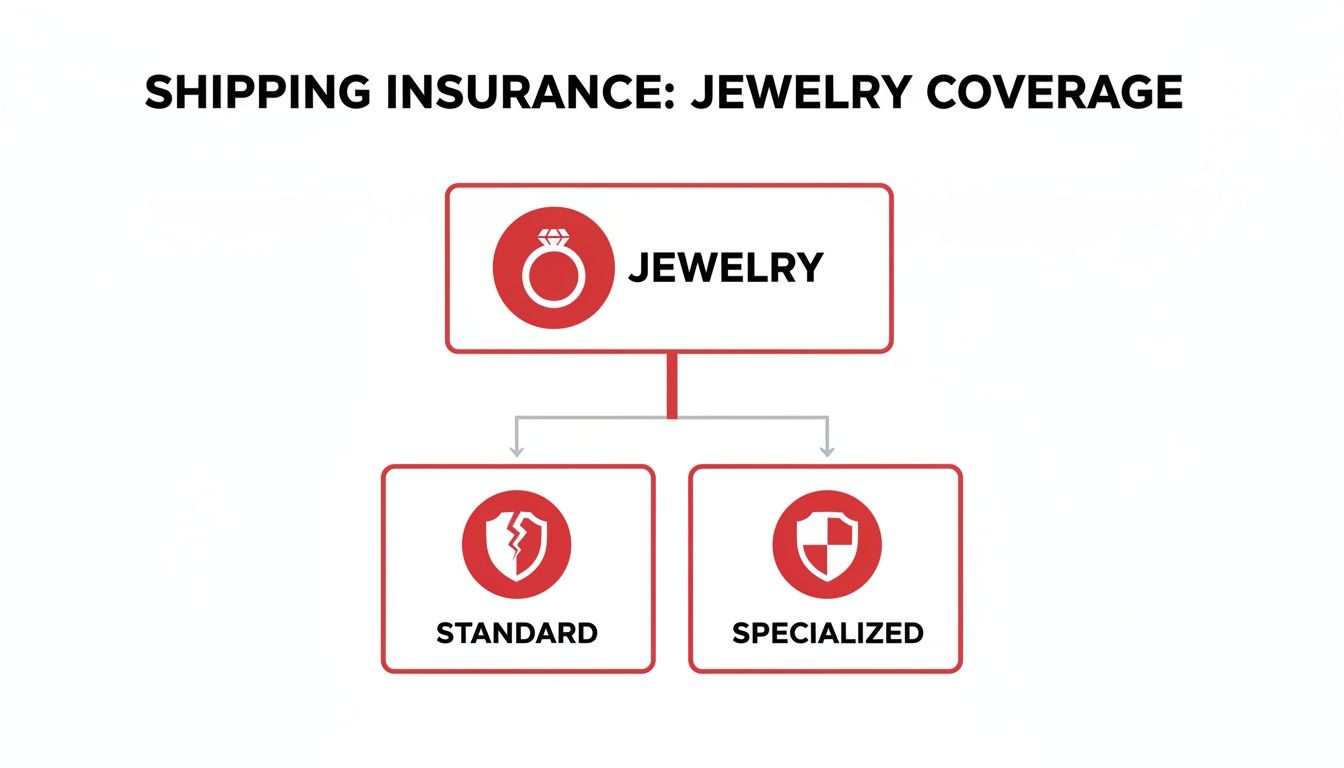
As you can see, when you're dealing with high-value assets like jewelry, standard options just don't cut it. You have to go with specialized coverage that’s built for the job.
ICC C: The Most Basic Coverage
Let's start at the bottom with ICC 'C'. This is the absolute bare-bones option, the most restrictive coverage you can buy. Imagine it as a simple locked door on your bank vault—it only protects against a handful of major, catastrophic events.
ICC 'C' is what’s called a "named perils" policy. That means it only covers losses from a very specific, short list of events. This list includes things like:
- Fire or explosion on the ship.
- The vessel stranding, sinking, or capsizing.
- General average sacrifice (when cargo is deliberately thrown overboard to save the ship).
- A collision involving the vessel.
Notice what’s missing? Theft, mysterious disappearance, damage from rough handling, or water damage from a leaky container. For a jeweler, this level of insurance for a jewelry store is totally inadequate. It creates a false sense of security while leaving your business wide open to the most common and likely risks.
ICC B: A Small Step Up
Next up is ICC 'B', which gives you slightly more protection but is still a "named perils" policy. Think of this as adding a basic alarm to your locked vault door. It covers everything under Clause 'C' and adds a few more specific events to the list.
These extra covered perils include:
- Earthquake, volcanic eruption, or lightning.
- Water from a sea, lake, or river getting into the vessel or container.
- Total loss of a package if it’s lost overboard or dropped while loading or unloading.
While it’s a bit better than 'C', ICC 'B' still doesn't address the real threats a jewelry business faces. A thief could steal an entire shipment from a port warehouse, or a dishonest employee could slice open a package and empty it, and you'd have zero coverage. That makes it another completely unsuitable choice for protecting high-value goods.
The fatal flaw in both ICC 'B' and 'C' is their structure. If the cause of your loss isn't explicitly named in the policy, it isn't covered. This leaves massive gaps that professional thieves and fraudsters are experts at exploiting.
ICC A: The Gold Standard for Jewelers
Finally, we get to ICC 'A', the highest level of protection you can get and the only real option for any insurance for jewelry business. This isn't a "named perils" policy; it’s "all-risk" coverage. Now, imagine your bank vault has that locked door, an advanced alarm, pressure plates, laser grids, and armed guards.
"All-risk" flips the script completely. It means your policy covers any and all physical loss or damage from any external cause, unless it is specifically excluded. The burden of proof shifts. With ICC 'B' or 'C', you have to prove your loss was caused by one of the named perils. With ICC 'A', the insurance company has to prove the loss was caused by an excluded peril (like willful misconduct or packing your goods improperly).
This comprehensive approach is essential. The marine cargo insurance market is softening, with experts forecasting 7.5-10% rate decreases for transit coverage. Global capacity has soared past USD1.5 billion, which is crucial for insuring large jewelry shipments, especially with cargo thefts now averaging over $200,000 per incident. You can learn more about the current state of the marine insurance market and how it affects high-value shippers.
For any business shipping diamonds, precious metals, or finished jewelry, ICC 'A' is non-negotiable. It's the only clause that truly protects against the real-world risks of theft, pilferage, and mysterious disappearance—the very risks that "named perils" policies ignore. This is the exact level of protection you'll find built into a high-quality Jewelers Block insurance policy.
How to Insure Your Shipments for Their True Value
Underinsuring a high-value shipment is one of the easiest and most painful financial mistakes a jeweler can make. It’s a gamble that risks far more than just the cost of the lost goods—it can seriously wound your business. The goal is to insure every shipment for its true replacement value, and that figure goes way beyond the number on the invoice.
This isn't just about picking a number out of thin air. It's about building a financial safety net. A successful claim should do one thing: make your business whole again. And that means your valuation strategy has to account for every single cost connected to that shipment.

Agreed Value vs. Invoice Value: The Critical Difference
When you get a policy, you’ll run into two main ways to value your goods. The most basic is Invoice Value—simply the price the buyer paid. It’s straightforward, sure, but for a jewelry business, it almost always leaves money on the table.
A much smarter approach is Agreed Value. This is a figure you and your insurer agree on before the package ever leaves your hands. For jewelers, this number absolutely must include the full replacement cost, not just your wholesale cost. If you lose a one-of-a-kind piece, you need enough cash to actually source or create a similar one, not just recoup what you paid for it.
Why You Must Add a "Plus Percentage"
Just insuring for the invoice value is a recipe for a financial shortfall. A solid marine insurance cargo valuation has to cover the "soft costs" tied to every shipment. That’s where the “plus percentage” comes in—it's a crucial buffer that protects you from all the other money you lose when a package goes missing.
This extra percentage, usually 10% to 20%, gets tacked on top of the invoice value. It’s designed to reimburse you for real expenses that vanish along with the cargo, like:
- Freight and Shipping Charges: You paid to ship it, and that money is gone if the package disappears.
- Insurance Premiums: The cost of the premium itself is a loss you need to recover.
- Duties and Taxes: For international shipments, these prepaid costs can be huge and are non-refundable if the goods are lost.
- Lost Profit: The markup you would have earned is a real financial hit to your bottom line.
Without this buffer, even a fully paid claim for the item's cost leaves you footing the bill for all these other expenses.
A policy's valuation clause is where you see its real muscle. Insuring for "Invoice + Freight + 10%" is the industry standard for a reason. It's the bare minimum needed to make sure a loss doesn't spiral into an even bigger financial headache for your jewelry store.
The Danger of Underinsurance: The Principle of Average
In the world of marine insurance, underinsuring doesn't just mean you get a smaller check—it means you effectively become a co-insurer on your own loss. This is because of a harsh policy condition known as the Principle of Average.
Here’s how it works: If you insure an item for only a fraction of its true value, the insurer will only pay that same fraction of your claim.
Let’s say you insure a $100,000 shipment for only $70,000 (that's 70% of its real value). If you suffer a $50,000 partial loss, the insurer won’t pay the full $50,000. They’ll only pay 70% of the claim, which is $35,000. You’re left to eat the remaining $15,000 loss yourself.
Putting It All Together: A Real-World Example
Let's make this tangible. Imagine you're shipping a collection of luxury watches from Geneva to your jewelry store in Los Angeles.
- Invoice Value of Watches: $150,000
- Air Freight Costs: $2,500
- U.S. Customs Duties & Fees: $8,000
A rookie might insure this parcel for just the $150,000 invoice. Someone a little more experienced might add the freight, insuring it for $152,500. Both are making a costly mistake.
Here’s how to do it right:
- Start with the Invoice Value: $150,000
- Add All Transit Costs: Add the freight ($2,500) and duties ($8,000) for a subtotal of $160,500.
- Apply the Plus Percentage: Add a 15% buffer to cover lost profit and other expenses: $160,500 x 1.15 = $184,575.
The correct insured value for this shipment is $184,575. Insuring for anything less opens you up to the Principle of Average and guarantees you’ll lose money, even on an approved claim. Getting this number right is the foundation of smart risk management.
Navigating the Claims Process When a Shipment is Lost
An insurance policy is just a piece of paper—a promise—until the moment you actually need it. For a jeweler, discovering that a high-value shipment has simply vanished is more than a problem; it's a crisis. A cool, methodical response isn’t just for your own sanity. It’s absolutely critical to making sure your marine insurance cargo policy does its job and turns a potential disaster into a manageable financial recovery.

The first few moments after you realize something is wrong are everything. The steps you take—and how fast you take them—will directly impact the outcome of your claim. This is no time to panic. It’s time to execute a precise, step-by-step plan.
Immediate Steps to Take After a Loss
As soon as you even suspect a shipment is lost, damaged, or has been tampered with, the clock is officially ticking. Your top priority is to immediately preserve your rights against every party involved and get your insurer in the loop. Acting fast shows diligence and lays the groundwork for a successful claim.
Your immediate, non-negotiable to-do list should look like this:
- Notify the Carrier in Writing Immediately: Your very first call is to the shipping company (FedEx, UPS, Brinks, etc.). But a call isn't enough. You must immediately follow it up with a formal written notice that holds them legally responsible for the loss. This is a crucial step your insurance company will require to preserve their right to recover from the carrier.
- Contact Your Insurance Broker: Next, call the expert who placed your Jewelers Block insurance. Tell them what happened and ask for clear instructions on what your specific policy requires next. They are your single best advocate and will help you navigate the entire process.
- Secure All Original Documents: Grab every single piece of paper related to that shipment. Don't even think about throwing anything away, especially damaged packaging. Meticulous documentation is the foundation of a solid claim.
A common, and costly, mistake is waiting too long to act. Hesitation can absolutely kill your claim. Carriers have very strict time limits for reporting a loss, and if you miss that window, it can give your insurer grounds to deny coverage. You have to move with urgency.
Assembling Your Essential Claims Documentation
When you officially file your claim, your insurer is going to need a complete, organized file to verify the loss and cut you a check. Think of it like you're building a legal case—the clearer and more compelling your evidence, the smoother and faster the whole thing goes. Missing paperwork is the number one reason claims get delayed.
Start pulling together the following key documents right away:
- Original Bill of Lading or Air Waybill: This is your contract with the carrier. It's the single most important document you have, proving the shipment existed and was in their hands.
- Commercial Invoice: This document establishes the value of the goods and the terms of the sale, which is absolutely essential for verifying the amount you insured it for.
- Packing List: This details exactly what was supposed to be in the box, providing concrete proof of the contents of the lost package.
- Written Correspondence: Make copies of the formal notice you sent to the carrier holding them responsible.
- Survey Report (if applicable): If the items are damaged instead of completely lost, an independent surveyor’s report will be needed to professionally assess the extent of the damage.
Keeping meticulous records isn't just good business practice; it's a core part of risk management for any jewelry business. When you have these documents ready to go, you show your insurance partner that you're professional and prepared, allowing them to work quickly on your behalf. This proactive approach can take a chaotic, high-stress event and turn it into a structured, manageable process, dramatically improving your chances of a fast and full settlement from your insurance for a jewelry store.
Essential Policy Details Most Jewelers Overlook
A solid marine insurance cargo policy is more than its headline coverage; the real protection is found in the fine print. For any jewelry business, a standard, off-the-shelf policy is just a starting point. Without the right add-ons and a sharp eye on the exclusions, you could be paying for a policy that looks great on paper but evaporates the moment you file a real-world claim.
This is where coverage gets real. Overlooking a key endorsement or a seemingly small exclusion can create a coverage gap big enough to drive a Brinks truck through. It's the difference between having a generic policy and a tailored shield built for the specific dangers of the jewelry trade.
Critical Endorsements Your Policy Must Have
Endorsements, sometimes called riders, are specific modifications that patch the holes in a base policy. They’re designed to close the very loopholes that sophisticated criminals know how to exploit. For a jeweler, a few of these are simply non-negotiable.
One of the most important is Mysterious Disappearance. Picture this all-too-common nightmare: a sealed, tamper-evident package arrives at its destination, but the box is empty. With no sign of forced entry, a standard policy would almost certainly deny the claim. This endorsement is built specifically for these unexplained losses, which are often the work of professional thieves operating inside the shipping networks.
Another must-have is an Exhibition Floater. The moment you ship pieces to a trade show, your risk profile changes completely. This endorsement extends your coverage to protect your inventory while it's on display, being handled by show staff, or locked away in a temporary safe. It provides a seamless blanket of protection that goes far beyond simple transit.
Think of these endorsements as essential, not optional. They address the high-stakes, real-world scenarios that jewelers face every single day. A policy without them isn't just incomplete—it's a gamble.
Common Exclusions That Can Sink Your Claim
Knowing what isn't covered is just as critical as knowing what is. Exclusions are the specific situations where your insurer can, and will, refuse to pay. Ignoring this section of your policy is a recipe for disaster.
Here are a few common exclusions every jeweler needs to have on their radar:
- Improper or Insufficient Packing: If your goods are damaged because the packaging couldn't stand up to the normal bumps and jostles of transit, your claim will be denied. Insurers expect professional, secure packaging designed for high-value items.
- Inherent Vice: This industry term describes a loss caused by the nature of the goods themselves. For example, a fragile gemstone cracking due to temperature fluctuations without any outside force would fall under this exclusion.
- Loss Due to Delay: A shipment of sensitive materials that spoils because it got held up in customs is a perfect example. Unless you have a specific endorsement covering it, losses caused purely by a delay are almost always excluded.
Even as the cargo insurance market sees record premiums, the industry is facing new threats. A recent surge in cargo theft, with average losses per incident now topping $202,000, is a brutal reminder of just how fragile supply chains are. This makes digging into your policy's fine print more crucial than ever. You can see the full breakdown of these evolving risks in the latest global marine and cargo insurance trends report.
To get straight to the point, here are the endorsements you absolutely need to discuss with your broker.
Key Endorsements for Jewelers' Cargo Policies
| Endorsement Name | What It Covers | Why a Jeweler Needs It |
|---|---|---|
| Mysterious Disappearance | Loss of items from a sealed package where there is no physical evidence of tampering or forced entry. | Covers sophisticated internal theft within shipping carriers, a major risk for high-value, small-item shipments. |
| Exhibition & Trade Show Floater | Extends coverage to goods while they are on display, in transit to/from, or stored at an exhibition or trade show. | Standard transit insurance often ends upon delivery. This protects your most valuable pieces when they are most exposed. |
| War, Strikes, Riots & Civil Commotions (SR&CC) | Protects against loss or damage due to acts of war, terrorism, strikes, riots, or other civil unrest. | This is almost always excluded from standard policies but is critical for international shippers facing geopolitical instability. |
| Unattended Vehicle | Covers theft of goods from a locked vehicle that has been left unattended, often with specific security requirements. | Essential for salespeople or couriers who transport jewelry by car and must make stops. Standard policies exclude this. |
These riders aren't just "nice-to-haves." They are fundamental protections that transform a generic cargo policy into a real asset for a jewelry business.
The Special Case of Geopolitical Risks
One of the most misunderstood and dangerously overlooked areas of marine insurance cargo is the "War, Strikes, Riots, and Civil Commotions" (SR&CC) clause. Many business owners are stunned to learn that this is almost always excluded from a standard "all-risk" policy.
In a world of unpredictable global events—from piracy in major shipping lanes to sudden civil unrest that shuts down a port—this is a massive blind spot. SR&CC coverage has to be bought back into the policy with a separate endorsement. Without it, any loss or damage to your cargo from war, terrorism, strikes, or riots simply isn't covered. For any jeweler shipping internationally, this is a vital shield against the chaos of geopolitics. Our gallery shows examples of the kind of precious antique jewelry that demands this level of detailed protection during transit.

Having a direct, informed conversation with your broker about these specific endorsements and exclusions is the only way to be sure your business is truly protected.
Finding the Right Insurance Partner for Your Business
Trying to secure the right marine insurance cargo protection on your own is like navigating a maze blindfolded. For a jeweler, the stakes are just too high. The complexities of shipping high-value goods demand a guide who speaks the language of both jewelry and insurance.
This is where a specialist insurance broker becomes your most valuable asset.
Don’t make the mistake of going with a generalist broker. You need an expert who lives and breathes the jewelry business and understands the critical differences between a standard policy and a truly comprehensive Jewelers Block insurance program. They’re your advocate, making sure your coverage is built for how you actually operate.
Questions to Ask Any Potential Broker
Finding the right partner starts with asking the right questions. Before you sign anything, you need to vet their experience, market access, and how they handle claims when things go wrong. A great broker will welcome this scrutiny and have clear, confident answers.
Use this checklist to interview any potential insurance partner:
- How many jewelry businesses do you currently insure? You want someone with a deep bench of clients in your industry, not an agent who only dabbles in jewelry policies once or twice a year.
- Which underwriters do you work with? Top brokers have direct lines to reputable, A-rated markets and specialized syndicates. Knowing the landscape of available insurance partners is a crucial step toward getting the best protection.
- Walk me through your process for a transit claim. Their answer should outline a clear, proactive plan that puts you first, from immediate carrier notification all the way to a final settlement.
- Can you explain how shipping is covered under your Jewelers Block policy? A specialist will confirm that robust transit coverage is seamlessly woven in, not just tacked on as an afterthought.
The Power of an Integrated Jewelers Block Policy
The real goal here is to eliminate any gaps in your protection. A well-crafted Jewelry store insurance policy is designed to do exactly that. A comprehensive Jewelers Block policy from an expert agency like First Class Insurance provides seamless, "warehouse-to-warehouse" coverage.
What does that mean? It means your inventory is protected from the moment it leaves your supplier until it’s safely in your vault or in your customer’s hands. You won't have to juggle separate policies for on-premise stock and goods in transit. For a better sense of the strong markets brokers work with, you can learn about key underwriters like

that are central to the industry.
Your insurance broker should be more than a salesperson; they should be a risk management partner. Their expertise ensures your policy is not just a document but a shield that protects the lifeblood of your business.
Don't leave your most valuable assets exposed. It’s time to get a professional review of your transit risks. Partner with an agency that specializes in insurance for jewelry business to get a quote and build the protection you truly need.
Your Top Questions, Answered
Let's cut through the jargon. When it comes to shipping high-value jewelry, a lot of questions pop up. Here are straight answers to the ones we hear most often from jewelers just like you.
"Isn't My Jewelry Covered by FedEx or UPS?"
Almost never. And even if it is, it's nowhere near enough. Carriers like FedEx, UPS, and the postal service place extremely low limits on what they'll cover for jewelry—often capping it at a mere $1,000, sometimes less.
Worse yet, their policies are riddled with fine print and exclusions specifically designed to avoid paying out on high-value goods. Relying on basic shipper's insurance is one of the biggest financial risks a jeweler can take. A proper marine cargo policy, ideally built into your Jewelers Block insurance, covers the full agreed value and closes this dangerous gap.
What’s the Difference Between Marine Cargo and Jewelers Block?
Think of it this way: marine insurance cargo is the bodyguard that protects your inventory while it's traveling. A Jewelers Block policy is the entire fortress that protects your business 24/7.
A Jewelers Block policy is the all-in-one security blanket for a jewelry business. It's a specialized package covering everything—inventory in your safe, pieces out on memo, and, crucially, goods in transit. For most jewelers, an integrated Jewelers Block policy from a specialist like First Class Insurance Jewelers Block Agency is the smartest move. It automatically includes worldwide shipping coverage, so you never have to worry about gaps.
The bottom line is this: a standalone marine policy only covers transit. A Jewelers Block policy protects your assets everywhere—in your store, in your safe, and on the move.
How Does "Mysterious Disappearance" Work for Shipments?
Mysterious Disappearance is a coverage you absolutely need. It’s designed for a very specific, and unnerving, scenario: a package arrives at its destination, the seals look perfectly intact, but the jewelry inside is gone. There's no sign of a break-in or tampering.
This situation points to an inside job somewhere along the supply chain. Standard insurance policies almost always exclude this type of loss. But because high-value jewelry is a prime target for internal theft within shipping networks, having this clause in your insurance for jewelry business is non-negotiable. It protects you from those baffling, otherwise unprovable losses.
Do I Need Different Policies for Air, Land, and Sea?
No, and if your broker says you do, find a new one. The term "marine insurance" is a bit of a historical holdover; it can be misleading. A modern, well-written cargo policy provides seamless "warehouse-to-warehouse" protection.
This means your goods are fully covered from the moment they leave your hands to the moment they are safely delivered, regardless of whether they travel by plane, truck, or ship. It ensures there are absolutely no gaps as your shipment moves between different carriers on its journey.
Your inventory is simply too valuable to leave exposed during transit. First Class Insurance specializes in building the comprehensive Jewelers Block policies that protect your assets everywhere they go. Get a Quote for Jewelers Block and secure your business today.