
Every piece of gold jewelry tells a story, and for a jeweler, that story is written in a series of tiny, stamped symbols. These gold jewelry markings are the universal language of value, quality, and origin. Think of them less as simple stamps and more as the DNA of your inventory—the hard proof you need to protect your assets with the right insurance for your jewelry store.
The Hidden Language of Gold Jewelry Markings
For anyone in the jewelry business, being able to read the small inscriptions on a gold ring or necklace isn't just a neat trick—it's a fundamental skill. These marks are far more than decorative engravings; they’re a built-in certificate of authenticity that directly impacts your buying decisions, appraisal accuracy, and ability to secure proper insurance for a jewelry business.
This guide is all about decoding that language. We’re going to turn those confusing stamps into critical business intelligence. You’ll learn to identify the essential marks that confirm an item's value and history, making sure every single piece in your inventory is accurately identified and protected. For anyone serious about running a jewelry business, mastering this system is non-negotiable.
Why Markings Matter for Your Business
Knowing how to properly identify gold jewelry markings gives your store a serious edge. It lets you confidently assess new acquisitions, price your inventory accurately, and build rock-solid trust with customers by being transparent. But more importantly, it’s the bedrock of a smart risk management strategy.
When you can prove the value of your inventory through documented markings, you're set up to:
- Secure Accurate Appraisals: Appraisers depend on these marks to verify purity and origin.
- Obtain Proper Coverage: Detailed records are absolutely essential for getting the right Jewelers Block insurance.
- Streamline Claims: In the event of a loss, having clear documentation of hallmarks can make the claims process move much faster.
- Prevent Fraud: Recognizing legitimate marks is your first line of defense against fakes and forgeries.
These markings, often called hallmarks, have a long history as one of the earliest forms of consumer protection. The system actually dates back to 14th-century Europe, with London's Goldsmiths' Company stamping gold in 1300 to certify its purity and protect buyers from getting ripped off. You can learn more about the gold jewelry market by exploring global market data from Dataintelo.
Ultimately, these tiny symbols are the gatekeepers of your inventory’s value. They provide the irrefutable proof you need to protect your assets—from the moment a piece enters your shop to the day it's sold or appraised. That makes them a cornerstone of any successful insurance plan for a jewelry store.
Decoding Karats, Hallmarks, and Maker's Marks
Think of the tiny stamps on a piece of gold jewelry like its birth certificate. Each symbol tells a crucial part of its story—where it came from, what it's made of, and who created it. For anyone running a jewelry business, reading this language isn't just a neat trick; it’s a core skill for managing your assets and getting the right Jewelers Block insurance.
These four key markings work together to build a complete profile of every item in your inventory. Once you understand them, you can assess value with confidence, spot fakes, and keep the kind of detailed records your insurer demands.
Karat Stamps: The Measure of Purity
The first and most common marking you'll see is the Karat stamp—usually a number followed by "K" or "KT." This stamp answers the most basic question: "How much pure gold is actually in this piece?"
Pure 24K gold is beautiful but far too soft for most jewelry. To make it strong enough to wear, it’s mixed with other metals, known as alloys. The Karat mark tells you the exact ratio of pure gold to these alloys, based on a scale of 24 parts. An 18K ring, for example, is 18 parts pure gold and 6 parts alloy. In the U.S., a piece must be at least 10K to be legally sold as "gold."
Here’s a quick rundown of what you’ll see:
- 24K: This is 99.9% pure gold. It’s incredibly rich in color but too soft for daily wear, so you won't see it often outside of investment-grade bullion.
- 18K: Made of 75% pure gold, this alloy hits the sweet spot between purity and strength, making it a favorite for high-end jewelry.
- 14K: At 58.3% pure gold, this is the workhorse of the U.S. jewelry market. It offers an excellent mix of durability and affordability.
- 10K: With 41.7% pure gold, this is a tough, budget-friendly option perfect for pieces that will see a lot of action.
Knowing the Karat is the starting point for any appraisal. It's non-negotiable information for your insurance for a jewelry store because without it, you can't accurately value what you own.
Fineness Numbers: The Global Standard
While Americans are used to the Karat system, much of the world—especially Europe—uses a fineness mark. This is simply a three-digit number representing gold purity in parts per thousand. It’s a more universal language, like the metric system for precious metals.
A piece stamped "750" means it's made of 750 parts pure gold out of 1,000. That translates to 75% pure gold, which is the same as 18K.
This global system is what makes international trade and appraisal possible. A "585" stamp means 14K gold whether the piece was crafted in Florence or Miami, ensuring everyone is on the same page.
Here’s how the numbers line up:
| Karat Purity | Fineness Mark | Percentage of Pure Gold |
|---|---|---|
| 10K | 417 | 41.7% |
| 14K | 585 (or 583) | 58.5% (or 58.3%) |
| 18K | 750 | 75.0% |
| 22K | 916 (or 917) | 91.6% |
Logging both the Karat and the fineness number in your inventory creates a rock-solid record, which is exactly what you need for a potential insurance for a jewelry business claim.
Maker's Marks: The Artist's Signature
The Maker's Mark is the signature of the jeweler, company, or workshop that made the piece. It can be anything from simple initials to an intricate logo. Like an artist’s signature on a painting, this mark establishes who made it and can dramatically change its value.
A plain gold band might be worth its weight in gold and little more. But if that same band has the maker’s mark of a legendary house like Cartier or Tiffany & Co., its value skyrockets. It's no longer just a piece of metal; it’s a collectible.
Identifying these marks is a critical skill that lets you:
- Attribute a piece to a specific designer, brand, or time period.
- Uncover high-value items that might otherwise be overlooked.
- Trace the history of estate jewelry.
- Build a stronger case for value during appraisals and for insurance.
The Maker's Mark is what separates a mere commodity from a work of art with a story.
Hallmarks: The Official Guarantee of Quality
Finally, there’s the Hallmark. This isn’t just another stamp; it’s an official seal of approval from an independent, government-run assay office. This mark certifies that the piece has been professionally tested and its purity is exactly what the stamp claims.
The United States doesn't have a national hallmarking system, but it’s a legal requirement in many other countries, particularly in the UK and Europe. A full, traditional hallmark is like a complete passport for a piece of jewelry, often including:
- The purity mark (the fineness number).
- The assay office mark (a symbol showing where it was tested).
- A date letter to identify the year it was hallmarked.
- The Maker's Mark.
This powerful combination provides an ironclad guarantee of quality and origin. For a jeweler, recognizing these official hallmarks is essential—they offer a level of verification a simple Karat stamp can't touch. And that verified data is exactly what your Jewelers Block insurance provider wants to see.
A Global Guide to International Hallmarks
For any jeweler dealing with a global supply chain or appraising estate pieces, recognizing international gold jewelry markings is a non-negotiable skill. While the U.S. system leans heavily on Karat and Maker’s Marks, many other countries have long-established, government-regulated hallmarking systems that offer a much deeper story.
Think of these international hallmarks as a passport for your jewelry. They don’t just tell you the gold’s purity—they tell you where it was certified, who made it, and often, the exact year it was stamped. This level of detail is invaluable for establishing provenance and protecting your business from fakes or misidentified items.
The flowchart below breaks down the core types of marks you'll come across, showing how they build from basic purity stamps to official, government-backed guarantees.
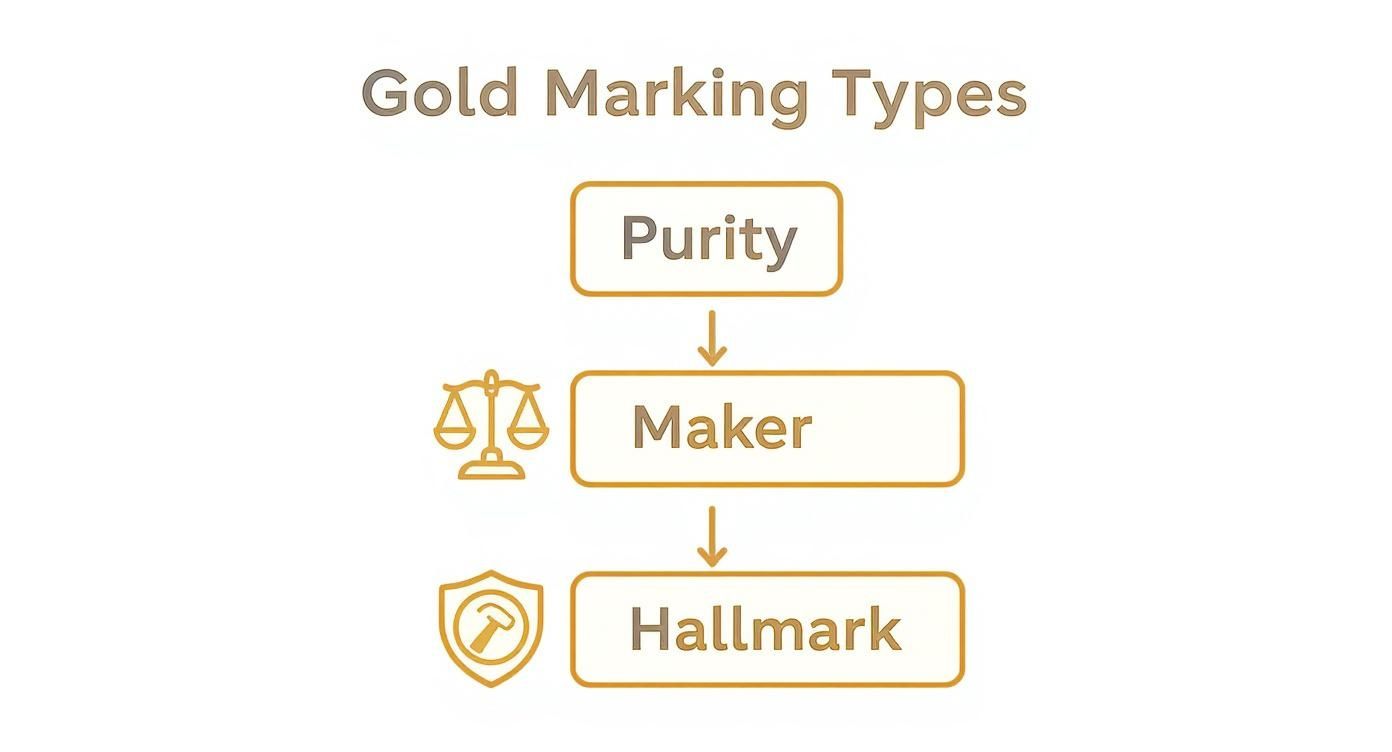
As you can see, the official hallmark represents the highest level of verification you can find, giving you and your insurer absolute confidence in the piece.
The United Kingdom: A Tradition of Precision
The UK has one of the oldest and most trusted hallmarking systems on the planet, with a history stretching back over 700 years. A traditional British hallmark tells a complete story in just a few tiny symbols.
- Assay Office Mark: This symbol pinpoints the city where the item was tested. A leopard's head means London, an anchor is for Birmingham, a castle signifies Edinburgh, and a rose points to Sheffield.
- Purity Mark: You’ll typically see the fineness number (like 750 for 18K gold) stamped inside a specific shape that also identifies the metal.
- Date Letter: A specific letter of the alphabet, often in a unique font and shield, corresponds to the exact year the piece was hallmarked. These charts are easy to find and allow for incredibly precise dating.
- Maker’s Mark: These are the initials of the jeweler or workshop that submitted the piece for testing.
These four marks work together to provide an ironclad guarantee of an item's quality, origin, and age, making UK-hallmarked pieces incredibly straightforward to document for insurance.
French Hallmarks: Iconic and Distinctive
France uses beautiful, iconic pictorial marks that are instantly recognizable once you know what to look for. The go-to mark for 18K gold made for domestic sale or export is the eagle's head.
This classic symbol has been in use since 1838 and acts as a government guarantee of 75% gold purity (750 fineness). You can find some fantastic examples of these historic French markings online to help train your eye.

Other Notable European Systems
Many other European nations have their own unique systems that a jeweler might encounter when handling international or vintage pieces. Here are a couple of key ones to know.
Switzerland: Known for its precision in watchmaking, Switzerland applies that same rigor to its jewelry. The hallmark for 18K gold is the head of a St. Bernard dog—a symbol of Swiss quality you can trust.
Italy: Italian law requires a unique system that traces a piece right back to its source. The mark includes a star, a number, and a two-letter abbreviation for the province of origin. The number is the maker’s unique ID. For instance, a stamp reading
☆ 24 ARtells you it came from the 24th registered jeweler in the province of Arezzo.
Common International Gold Hallmarks at a Glance
Navigating the world of hallmarks can feel like learning a new language. This table offers a quick reference to help you identify some of the most common symbols you'll encounter on pieces from around the globe.
| Country | Purity Mark Example | Assay Office/Unique Symbol | Key Identifiers |
|---|---|---|---|
| United Kingdom | 750 (18K) in an octagon | Leopard's Head (London), Anchor (Birmingham) | Combination of purity, assay office, date letter, and maker's mark. |
| France | Eagle's Head (18K+) | Not applicable (symbol denotes purity) | Pictorial marks are key. Different animals/symbols for different purities. |
| Switzerland | St. Bernard Dog Head (18K+) | Not applicable (symbol denotes purity) | Look for the iconic dog head for gold, or a duck for silver. |
| Italy | ☆ 24 AR |
Province abbreviation (AR for Arezzo) | The star, registration number, and two-letter province code are always present. |
| Austria | Head of a Toucan (22K) | Not applicable (symbol denotes purity) | Pictorial marks of animal heads indicating different gold purities. |
This is just a starting point, of course, but familiarizing yourself with these key players will give you a massive advantage when sourcing or appraising international jewelry.
How to Identify Fakes and Forgeries
Knowing what legitimate gold jewelry markings look like is only half the battle. The real skill is applying that knowledge to spot a counterfeit before it ever makes it into your showcase.
Fraudulent stamps are far more common than many seasoned jewelers want to admit. Letting even one fake piece slip through can poison your reputation and hit you with a serious financial loss. Honing this skill isn't just good practice—it's essential for protecting your assets and ensuring your Jewelers Block insurance covers what you think it does.
Your first line of defense is always a meticulous visual inspection with a quality jeweler's loupe. Counterfeiters almost always cut corners somewhere, and a trained eye can usually spot the evidence. A genuine mark, whether stamped or engraved, is clean. It has precision, with sharp, uniform edges that show it was applied professionally.
A fake mark, on the other hand, just looks wrong. It might be blurry, uneven, or have a soft, "cast-in" appearance, as if it were part of the mold instead of being struck into the metal. That lack of crispness is a massive red flag.
Distinguishing Solid Gold from Deceptive Look-Alikes
One of the oldest tricks in the book is using markings that imply gold content without actually lying. These stamps are designed to look official but really just tell you the piece is plated. For anyone managing a jewelry store inventory, being able to spot these instantly is non-negotiable.
Get familiar with the usual suspects for plated items:
- GP (Gold Plated): A microscopic layer of gold over a base metal.
- HGE (Heavy Gold Electroplate): A slightly thicker layer of gold, but still just a plating.
- RGP (Rolled Gold Plate): A thin sheet of gold mechanically bonded to a base metal. It’s often more durable, but it’s absolutely not solid gold.
A crucial detail to remember is that markings for plated items often accompany a Karat stamp, such as "14K HGE." This can be deceiving, as the "14K" only refers to the purity of the thin gold layer, not the entire piece.
Illogical combinations are another dead giveaway. If you see a piece stamped with a modern maker’s mark right next to a historical date letter, you’re looking at an obvious fake. The same goes for a hallmark from a country that doesn't match the piece's style or maker. To train your eye, it helps to study visuals of genuine antique jewelry markings and get a feel for what’s authentic.
A Professional Checklist for Examining Acquisitions
The best way to protect your jewelry business is to develop a systematic approach for every new piece that comes across your desk. This checklist pushes you beyond just glancing at the stamp and forces a more complete assessment.
- Examine the Mark's Quality: Get out your 10x loupe and look for those crisp, sharp edges. Are the letters and numbers evenly spaced and properly aligned? A sloppy stamp is the number one indicator of a fake.
- Verify the Logic: Do the different marks actually make sense together? Cross-reference the maker's mark, country of origin, and any date letters with reliable guides to confirm they are historically and geographically consistent.
- Check for Plating Indicators: Be on the lookout for "GP," "HGE," or "RGP." Just as important, inspect high-wear areas like clasps, bails, and edges for any sign of base metal showing through.
- Feel the Weight: Gold is incredibly dense. A piece that feels too light for its size is a classic red flag for plating or a cheap alloy. This "hand-feel" test becomes second nature with experience.
- Perform a Magnet Test: Solid gold isn't magnetic. If a strong magnet grabs the item, you’ve confirmed it contains iron or another magnetic base metal under the plating. Just remember to test the main body of the piece—clasps often contain tiny steel springs that will react.
Documenting Markings for Appraisals and Insurance

This is where your ability to read gold jewelry markings moves beyond a neat skill and becomes a serious business asset. Meticulous documentation is the absolute foundation for accurate appraisals and a rock-solid Jewelers Block insurance policy. Without it, you’re basically just guessing at the value of your inventory—and that's a risk no professional can afford.
Think of your detailed log as ironclad proof of what your inventory is worth. It’s the evidence you’ll need to make any potential insurance claim straightforward. Strong documentation takes the headache out of the claims process after a theft or loss and ensures your insurance for a jewelry business actually reflects the true value of what you need to protect.
Creating an Ironclad Inventory Record
A proper inventory log isn't just a list. It’s a detailed dossier on every single piece you hold. The system has to be methodical, consistent, and thorough. You should treat each entry like a legal document you're preparing in advance to prove ownership and value.
The goal here is to create a record so clear that an appraiser or insurance adjuster could understand an item's full story without ever laying eyes on it. It’s this proactive mindset that’s essential for securing the right protection from a specialized provider like First Class Insurance Jewelers Block Agency.
The Step-by-Step Documentation Process
Building a bulletproof inventory system takes discipline. You need to follow this process for every piece that comes through your door to create a record you can truly rely on.
- Assign a Unique Identifier: Every item gets its own stock-keeping unit (SKU) or inventory number. This is the critical link between the physical piece and its digital record.
- Take High-Resolution Photographs: Get multiple shots of each item from different angles. Most importantly, take a crystal-clear, close-up photo of every single marking. This visual proof is priceless.
- Log All Markings Meticulously: In your inventory system, create specific fields to record every detail you can pull from the stamps.
- Describe the Piece in Detail: Note the type of item (ring, necklace, etc.), its weight, dimensions, and any gemstones—including their cut, color, clarity, and carat weight.
Accurately documenting intricate gold jewelry markings for appraisals and insurance requires high-resolution images. To capture the necessary detail, it's worth exploring guides on choosing the best camera for detailed product photography.
This is the level of detail that validates your appraisal values. It gives your insurance provider the hard data they need to underwrite your policy correctly.
What to Record for Each Marking
Your inventory log needs to break down the markings into specific, searchable fields. For every piece, make sure you're documenting this critical information.
- Purity Marks: Record both the Karat stamp (e.g., "18K") and the fineness number (e.g., "750"). Getting both covers your bases for U.S. and international standards.
- Maker's Mark: Note the initials, name, or symbol of the manufacturer. If you know the maker, add their full name to make searching easier down the line.
- Hallmarks and Assay Marks: Document any official symbols, like a country's mark (e.g., the French eagle head) or an assay office stamp (e.g., the London leopard's head).
- Date Letters: If you see one, record the date letter and find its corresponding year. This is absolutely vital for establishing the age and value of antique pieces.
Precise data like this is exactly what’s needed for proper jewelry store insurance. When every single piece is accounted for with this level of detail, you can confidently Get a Quote for Jewelers Block knowing your coverage is based on fact, not guesswork.
Protecting Your Assets with Jewelers Block Insurance
All your expertise in reading gold jewelry markings really boils down to one thing: protecting the value of your business. When you have a deep, documented understanding of your inventory, you can secure the right insurance for your jewelry business. You're essentially turning knowledge into a powerful financial shield.
This is where a specialized policy like Jewelers Block insurance comes into play. It's not your average business policy. It’s a very specific type of coverage built for the unique risks jewelers handle every single day, from a smash-and-grab theft to a mysterious disappearance.
Why Your Documentation Matters to Insurers
When you sit down with an insurance agency to talk about jewelry store insurance, the underwriter’s primary job is to size up your risk. They are relying almost entirely on your records—including all that detailed hallmark data, maker’s marks, and purity stamps—to accurately value your inventory and calculate your premium.
Without that solid proof, you're starting on the back foot. Vague or incomplete records can create two huge problems:
- Overpaying for Coverage: If your inventory isn't clearly valued, insurers might assume a higher risk profile and hit you with inflated premiums.
- Being Underinsured: In the case of a catastrophic loss, a lack of detailed proof could mean a claim payout that doesn't even come close to your inventory’s true worth.
Armed with a meticulously documented inventory, you can confidently discuss your specific coverage needs. This professional approach demonstrates that you are a well-managed risk, which is a key factor for any insurer.
Your detailed log of gold jewelry markings is the hard evidence that bridges the gap between what your inventory is actually worth and what an insurer will agree to cover. This is especially critical for your high-value items, where getting the valuation right is everything. You can see examples of stunningly documented high-value pieces to get a feel for the level of detail that makes a difference.

With this solid foundation, you’re in the best possible position to secure a policy that truly protects your assets. When you’re ready to safeguard your valuable, well-documented inventory, you can confidently Get a Quote for Jewelers Block and ensure your peace of mind.
A Few Final Questions on Gold Markings
To wrap things up, let's tackle a few common questions that come up in the day-to-day work of a jeweler. Think of this as the practical advice you need to handle those tricky situations with confidence.
What if a Gold Piece Has No Markings at All?
The first instinct might be to assume it's fake, but hold on. An absence of marks doesn't automatically mean you're dealing with a counterfeit. Extremely old pieces, especially those made before hallmarking was standardized, often have no stamps at all. The same goes for custom-made jewelry or pieces from countries without strict marking laws.
That said, an unmarked item always warrants a closer look. You absolutely must have it professionally tested to confirm its gold content before it ever gets added to your inventory or assigned a value for your jewelry store insurance.
Can Markings Wear Off Over Time?
Absolutely. It’s actually quite common. Think about a ring that's been worn for fifty years—the constant friction can easily wear down a stamp on the inside of the shank, leaving it faint or even completely unreadable. While this is a perfectly normal sign of a well-loved vintage piece, it does create a documentation headache.
When you come across worn markings, professional assaying is non-negotiable. You’ll need to log the results of that test in your inventory system to create a solid, verifiable record for your insurance for a jewelry store.
Do All Countries Require Gold Hallmarks?
No, and this is a critical detail for any jeweler to remember. The United States, for instance, has no federal law that mandates hallmarking. The only legal requirement in the U.S. is that if a piece is stamped with its Karat, it must also bear a registered maker's mark.
Contrast that with countries like the UK, France, and Switzerland, which have incredibly strict, government-enforced hallmarking systems. Knowing these global differences is essential for accurately appraising and documenting pieces for your insurance for jewelry business. Always do your homework on a piece's origin so you know what markings you should—or shouldn't—expect to see.
Once your inventory is accurately documented, the final step is making sure it's protected. For a specialized policy built from the ground up for jewelers, trust First Class Insurance. Get a Quote for Jewelers Block insurance.