
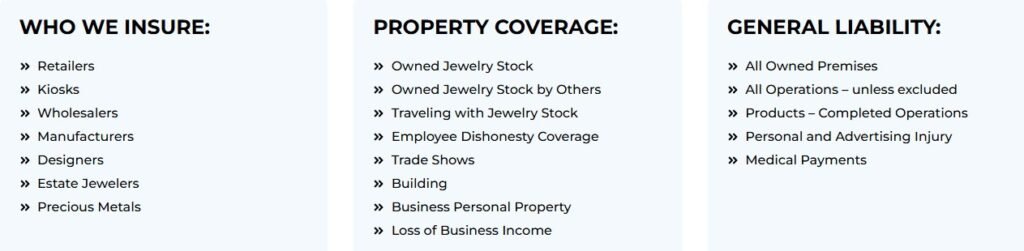
If you own a small jewelry business, you know that standard business insurance just won't cut it. Your inventory is high-value, portable, and a constant target for risks that other retailers never have to think about. That's where a specialized Jewelers Block insurance policy comes in—it’s the only real way to properly protect your assets from theft, damage, and even mysterious disappearance. Think of it as a comprehensive shield for your jewelry, whether it’s sitting in your store, being shipped to a customer, or on display at a trade show.
Why Your Jewelry Business Needs More Than Standard Insurance
It’s a tempting mistake to think a standard business owner's policy (BOP) is enough to cover your sparkling inventory. Unfortunately, this is one of the most expensive assumptions a jeweler can make. General policies are built for typical retail shops, like a bookstore or a clothing boutique, not for a business where a single display case could hold a small fortune.
A standard policy might cover your building and general liability, but it almost always has severe limitations on what it will pay for stolen jewelry. These limits are often laughably low—maybe just a few thousand dollars. Relying on that is like trying to guard a bank vault with a simple padlock. It’s the wrong tool for the job.
The Unique Risks Facing Jewelers
The right insurance for a jewelry business has to tackle risks that other retailers just don't encounter. Your inventory isn't just valuable; it's incredibly portable, which makes you a prime target for sophisticated criminals. The threats you face are distinct and require a specialized defense.
Let's look at a few key vulnerabilities:
- Smash-and-Grab Robberies: These are fast, violent, and can wipe out a display case in seconds, leading to a catastrophic loss of inventory.
- Mysterious Disappearance: An item is just… gone. There’s no sign of a break-in, no clear evidence of theft, but a high-value piece has vanished. It's a common headache in a busy showroom.
- Employee Dishonesty: Internal theft is a quiet but persistent threat that can drain a business from the inside out.
- Damage in Transit: Every time you ship a valuable piece to a client or receive an order from a supplier, you're taking a significant risk.
These scenarios make it crystal clear why a generic insurance policy for a jewelry store falls dangerously short. It simply doesn't have the specific provisions to cover your stock, your customers' property left in your care, or your goods while they're traveling.
"A standard policy protects a typical shop, but you're guarding a treasure chest. The right insurance for a small jewelry business is less of an expense and more of a fortress built to protect your most valuable assets from specialized threats."
The Financial Reality of Inadequate Coverage
The stakes couldn't be higher. In this industry, specialized protection like Jewelers Block insurance isn't a luxury; it's a necessity. Just look at the numbers. North America accounts for 38% of the global jewelry insurance market, and the U.S. sector alone is on track to hit USD 2.991 billion by 2025.
What’s driving this? The stark reality of claims. Globally, theft accounts for 36% of all incidents, with damage at 44% and simple loss at 20%. For a small jeweler, these aren't just statistics—they're a warning. A single major theft could wipe out years of hard work if you're not properly covered. That’s why finding an agent who truly understands these unique risks is one of the most important business decisions you’ll make.
Understanding Jewelers Block: The Core of Your Protection
So, what exactly is Jewelers Block insurance? Forget standard, off-the-shelf business policies. Think of Jewelers Block as a custom-built vault for your entire operation, designed by people who understand the unique risks of this industry. It's not just another policy; it's a specialized bundle of protections wrapped into one powerful package.
A general business owner's policy just doesn't cut it. It sees a diamond ring and a desk chair as the same type of asset, which couldn't be further from the truth. Jewelers Block insurance is different. It’s built from the ground up to protect your most valuable and vulnerable items, moving and adapting as they travel from your safe to your showroom and beyond.
The All-in-One Shield for Your Inventory
The real power of Jewelers Block lies in its "all-risk" foundation. In simple terms, this means your inventory is covered against almost everything unless a specific peril is clearly excluded in the policy language. This approach is absolutely critical for a business where your most valuable assets are small, portable, and highly desirable.
It's designed to protect your stock no matter where it is: locked securely in your vault, sitting pretty in a display case, or even on its way to a trade show.
The numbers don't lie. The global jewelry insurance market is expected to hit USD 7.13 billion by 2031, a testament to the high-stakes nature of the trade. Here in the U.S., theft alone accounts for 36% of all claims, with another 20% coming from mysterious disappearance or simple loss. As detailed in market analysis from Business Research Insights, these aren't distant threats—they are daily realities for jewelers.
A proper policy has to follow your inventory everywhere. Key components include:
- On-Premises Coverage: This is your home base protection, covering everything inside your store—in the safe, the vault, or your display windows.
- In-Transit Coverage: This keeps your pieces safe while they're on the move, whether you're shipping an engagement ring to a client or carrying inventory to a craft fair.
- Off-Premises Coverage: This is for those times your jewelry leaves the shop but is still in your possession, like during a private showing at a client's home or office.
Protecting More Than Just Your Finished Pieces
One of the biggest mistakes jewelers make is assuming this policy only covers the finished goods in their display case. The reality is, a well-structured Jewelers Block insurance policy protects the entire life cycle of your inventory and your service obligations.
For instance, a solid policy should absolutely cover:
- Raw Materials: Those loose gemstones and gold settings are just as valuable as a finished necklace.
- Customer Property: This is huge. When a customer trusts you with their watch for repair or an heirloom for appraisal, you are responsible for it. This coverage protects their property while it’s in your hands.
- Work in Progress: Pieces on your bench are also covered, protecting your investment in labor and materials before the item is even complete.
To give you a clearer picture, let's break down how these coverages work in practice.
Jewelers Block Coverage At a Glance
This table maps out the core protections you'll find in a typical Jewelers Block insurance policy, showing you exactly what’s covered and where.
| Coverage Area | What It Protects | Example Scenario |
|---|---|---|
| Stock on Premises | Finished jewelry, loose stones, and raw materials stored at your primary business location. | A thief smashes your display case overnight and steals several diamond necklaces. |
| Stock in Transit | Inventory being shipped via common carrier (like FedEx or UPS) or armored transport. | A package containing a custom-ordered bracelet is lost or stolen while on its way to the customer. |
| Stock Off-Premises | Items temporarily away from your store for business purposes (e.g., trade shows, private viewings). | You are at a jewelry trade show, and several pieces are stolen from your booth. |
| Customer Property | Items owned by your clients that are in your care, custody, and control for repair, appraisal, etc. | A fire in your workshop damages a customer's antique ring that was left for resizing. |
As you can see, this is far more than simple property insurance. It’s a comprehensive shield designed for the specific, day-to-day operations of a jeweler.
Think of it this way: a standard policy is like a simple alarm on the front door. A Jewelers Block policy is a fortress with motion sensors, reinforced walls, and guards protecting every single valuable asset inside.
Ultimately, getting the right coverage is the bedrock of your risk management strategy. When you get a quote from a specialist like the First Class Insurance Jewelers Block Agency, you're not just buying a piece of paper. You're investing in the resilience to ensure that one bad day—a smash-and-grab, a shipping error, or an employee theft—doesn't end the business you’ve poured your heart into.
Securing Your Entire Operation Beyond Inventory
Your Jewelers Block insurance policy is the centerpiece of your protection, no question. It guards your most valuable asset: your inventory. But it can't do the whole job on its own. To build a truly secure business, you need other coverages working alongside it to protect against risks that have nothing to do with a missing diamond or a stolen watch.
Think of it this way: if Jewelers Block protects the "crown jewels," these other policies are here to secure the "castle"—your physical shop, your finances, and your reputation. Without them, you’re leaving gaping holes in your defense. A smart insurance for jewelry business strategy looks well beyond the display case.
Protecting Your Physical Space with Commercial Property Insurance
Your store is so much more than just four walls. It’s where you’ve invested in custom display cases, specialized benches and tools, high-end lighting, and crucial security systems. Commercial Property Insurance is what steps in to protect these vital physical assets.
Let’s say a fire starts next door and spreads to your shop. Your inventory might be safe and sound inside a high-grade vault, but the fire could easily destroy your showcases, your point-of-sale system, and the building structure itself. Jewelers Block won't touch those things. Commercial Property insurance is what pays to rebuild your space and replace your equipment so you can actually open your doors again.
Shielding Your Business from Accidents with General Liability
Every single person who walks through your door, from a browsing customer to a delivery driver, represents a potential liability risk. A client could slip on a freshly polished floor, or a poorly secured display could fall and injure someone. These simple, everyday accidents can spiral into massive medical bills and lawsuits that would sink most small businesses.
This is why Commercial General Liability (CGL) insurance is absolutely non-negotiable. It’s built to handle claims for:
- Bodily Injury: Covers medical bills and legal costs if a customer or other visitor gets hurt on your premises.
- Property Damage: Pays to repair or replace someone else's property if you or an employee accidentally damage it.
- Personal and Advertising Injury: Protects you from claims like slander, libel, or copyright issues in your marketing.
Without CGL, you're on the hook personally for legal fees and settlements. That’s a financial hit very few jewelers can afford to take, making it a cornerstone of any jewelry store insurance plan.
A comprehensive insurance plan acts as a financial shock absorber. It ensures that a single unfortunate event—whether it's a slip-and-fall accident or a fire—doesn't escalate into a business-ending catastrophe.
Ensuring Financial Survival with Business Interruption Coverage
Picture this: that fire forces you to shut down for three months, right in the middle of the holiday rush. The sales revenue stops cold, but your bills don't. Rent, payroll, utilities, and loan payments keep coming due. This is the exact nightmare scenario that Business Interruption Insurance was created for.
Usually added onto a Commercial Property policy, this coverage is a financial lifeline. It’s designed to replace your lost income and cover your ongoing operating costs while your business is closed because of a covered disaster. It gives you the cash flow you need to survive the downtime, pay your bills, and get back on your feet without digging yourself into a massive financial hole.
Of course, the less risk you have, the better. Implementing effective retail loss prevention strategies not only helps prevent losses but also makes your business more attractive to insurers. When you can show you're proactive about security, you'll often find more favorable terms when you get a quote for Jewelers Block and your other essential policies.
How to Accurately Value Your Inventory for Insurance
One of the most critical decisions you'll make for your business is setting the right coverage limit for your Jewelers Block insurance. It’s a fine line to walk. Go too low, and you're underinsured, facing a huge financial hole after a major loss. Aim too high, and you're just throwing money away on premiums for coverage you can't use.
Getting this number right is the bedrock of a solid insurance strategy. It’s what ensures that if the worst happens, your policy pays out like you expect it to, letting you get back on your feet without wiping out your savings. This isn't a time for guesswork; it requires a disciplined, methodical approach.
This process flow shows how layered protection for a jewelry business begins with inventory, expands to the business itself, and finally covers operational risks.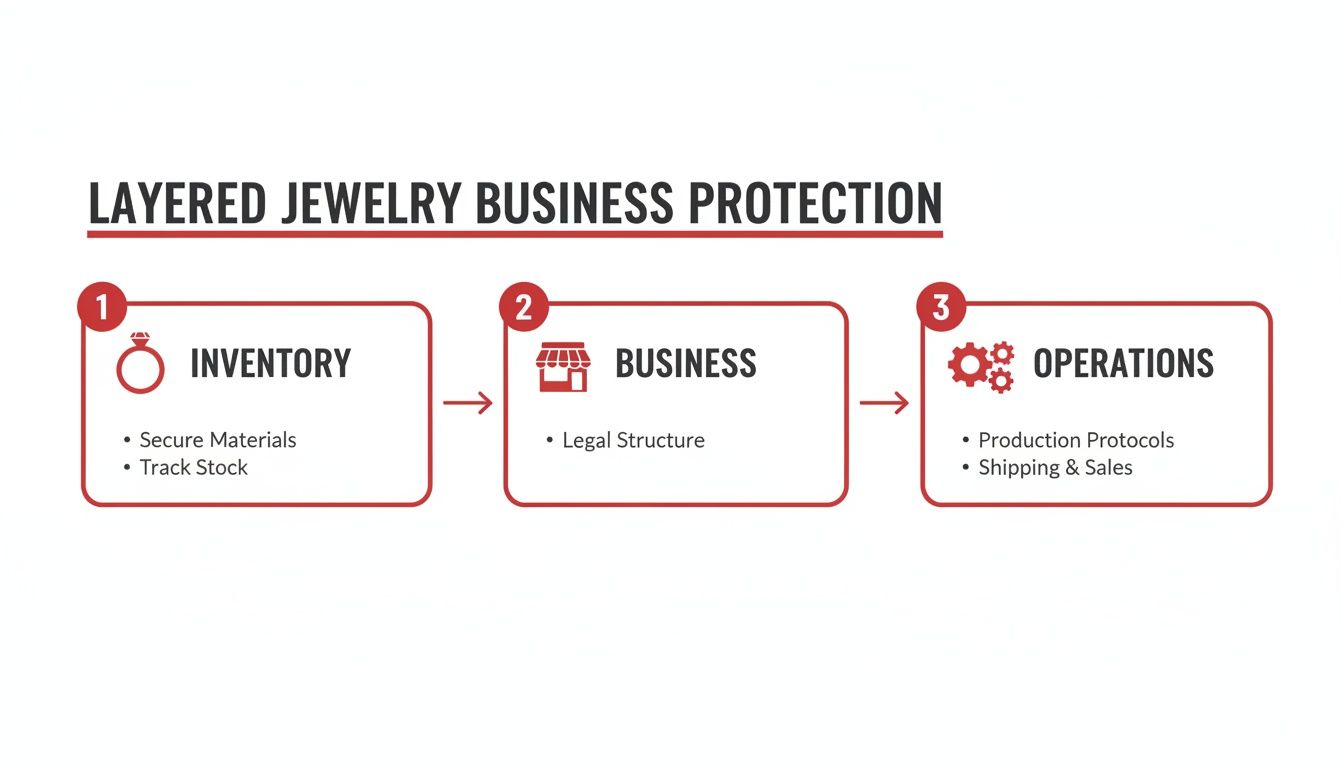
As the visual makes clear, locking down your inventory coverage is the essential first step before you can protect your wider business assets and keep your doors open.
Start with a Detailed Physical Inventory
First things first: you can’t insure what you can’t prove you have. That means conducting a complete, wall-to-wall physical inventory. This is more than just a quick count; it’s about documenting every single piece with meticulous detail.
Your inventory list needs to be a comprehensive record. For each item, you should log:
- A detailed description (e.g., "14k white gold engagement ring with a 1.5-carat princess-cut diamond, GIA certified").
- The stock number or SKU.
- Your wholesale cost for the item.
- Clear, high-quality photos of every significant piece.
Think of this document as your proof of existence and value. If you ever have to file a claim, your insurer will demand this list to process your payment. Keeping it updated—at least annually—is absolutely non-negotiable.
Replacement Cost vs. Actual Cash Value
When you're looking at jewelry store insurance, you'll come across two main ways of valuing your property: Replacement Cost Value (RCV) and Actual Cash Value (ACV). The difference between them is massive, and it directly affects how much you get paid after a loss.
Replacement Cost (RCV): This is the gold standard. RCV pays you the full amount needed to replace a stolen or damaged item with a brand-new piece of similar kind and quality. There’s no deduction for depreciation. For a jeweler dealing with fluctuating metal and gem prices, this is almost always the right choice. It gives you the actual cash needed to restock at today's market rates.
Actual Cash Value (ACV): This method pays you the replacement cost minus depreciation. Sure, it comes with a lower premium, but it can leave you dangerously short-funded when you need it most. Imagine trying to replace a five-year-old showcase piece with the depreciated value you're paid—it just doesn't work. For a jeweler's primary stock, ACV is rarely a good idea.
Comparing Valuation Methods for Jewelry Inventory
Choosing the right valuation method is crucial for ensuring your policy responds effectively after a loss. This table breaks down the two primary options to help you see how they impact your coverage and potential claim payout.
| Valuation Method | How It Works | Best For | Claim Payout Impact |
|---|---|---|---|
| Replacement Cost (RCV) | Pays the cost to replace an item with a new one of similar kind and quality, with no deduction for depreciation. | Virtually all jewelry inventory, including precious metals, gemstones, and finished pieces. | You receive enough funds to fully restock your inventory at current market prices, making your business whole. |
| Actual Cash Value (ACV) | Pays the replacement cost minus a deduction for depreciation due to age, wear, and tear. | Older, non-inventory assets like office furniture or basic equipment where a new replacement isn't essential. | You receive a lower payout that may not be enough to buy a brand-new replacement, creating a financial gap. |
For a business whose assets are commodities with volatile market prices, Replacement Cost coverage isn't a luxury—it's a necessity. It’s the only way to ensure you can truly rebuild your business after a significant loss.
The Role of Professional Appraisals
While your own records are the foundation, professional appraisals provide objective, third-party proof of your inventory's value. For your most unique, high-value, or custom-made pieces, an appraisal from a certified gemologist is worth its weight in gold. It creates an undisputed record that insurers trust.
Appraisals are especially vital for antique or one-of-a-kind items where a simple cost breakdown just won't cut it. These documents become a cornerstone when you get a quote for Jewelers Block, helping underwriters accurately assess your risk and set the right coverage limits. For a better sense of what these high-value pieces look like, you can see professional shots on our resource page.

When you combine a meticulously detailed inventory with professional appraisals, you build a bulletproof valuation that stands up to scrutiny and fully protects your business.
Reading Between the Lines: Policy Exclusions and Custom Endorsements
Knowing what your insurance covers is only half the story. The real secret to being truly protected lies in understanding what your policy doesn't cover. Every Jewelers Block insurance policy has exclusions—very specific scenarios and losses the insurer simply won't pay for. Skimming over this fine print can leave you dangerously exposed right when you need your coverage the most.
Think of exclusions as the policy's ground rules. They aren't there to catch you out; they exist to clearly outline the risks the insurance company has agreed to shoulder. A smart insurance for jewelry business strategy means finding these gaps and deliberately closing them.
Common Exclusions That Catch Jewelers By Surprise
While every policy is different, some exclusions are so common they're practically standard in insurance for a jewelry store. Getting familiar with these potential blind spots is your first step toward building a truly watertight plan. A good agent will point these out to you right away.
Here are some of the most critical ones to look for:
- Unattended Vehicles: This is a big one. Leave inventory in an unlocked car—or even a locked one overnight—and any theft claim will almost certainly be denied. Insurers have very strict protocols for securing inventory on the move.
- Employee Dishonesty: Your standard Jewelers Block insurance policy probably won’t cover theft by your own staff. Since internal theft is a major risk in this industry, you’ll need a separate crime or fidelity policy to cover that exposure.
- Mysterious Disappearance: This is a tricky one. It describes a loss where there's no evidence of what happened. A diamond ring is just… gone from a display case, with no signs of a break-in or foul play. Some policies exclude this completely, while others might offer a small amount of coverage.
- Unexplained Inventory Shortage: If you do a physical count and come up short without being able to pinpoint a specific event (like a documented robbery), your policy won't cover that gap. This is how insurers protect themselves from having to pay for losses that might just be down to poor bookkeeping.
Closing the Gaps with Endorsements and Riders
Here’s the good news: you don't just have to live with these gaps. You can add endorsements, sometimes called riders, to your policy. These are specific add-ons that patch the holes in your base coverage, protecting you from risks that would otherwise be excluded. This is how you customize your jewelry store insurance to match the reality of how you do business.
Think of your main policy as a high-quality, off-the-rack suit. It’s a great start, but endorsements are the custom tailoring that makes it a perfect, bespoke fit for your unique business.
Working with an agent who knows the jewelry trade means you can add the right endorsements to create a policy that truly has your back. You can learn more about how specialized markets like those at Lloyd's of London approach this by reviewing some of our insurance resources.

A few of the most popular endorsements for jewelers include:
- Mysterious Disappearance Coverage: If your base policy excludes it, this is probably the most important rider to add, especially if you handle a high volume of smaller pieces.
- Trade Show Coverage: This boosts your limits for inventory while it's off-site, giving you full peace of mind when you're exhibiting at a show.
- Appraisal Liability (Errors & Omissions): This protects you if a customer sues, claiming your appraisal was inaccurate and cost them money.
- Cyber Liability and Crime Coverage: As business increasingly happens online, this rider is essential for protection against data breaches, fraudulent wire transfers, and other digital-age crimes.
By strategically adding endorsements, you can turn a standard policy into a custom-built shield. It’s exactly why you should get a quote for Jewelers Block from a specialist who knows what questions to ask and which riders you actually need. A provider like the First Class Insurance Jewelers Block Agency will dig into your operations to build a policy that covers your real-world risks, not just the generic ones.
Your Guide to Getting an Insurance Quote
You've done the homework—you know which coverages are critical, you’ve put a real value on your inventory, and you understand the importance of reading the fine print. Now, it's time to put that knowledge into action and get the right insurance for your small jewelry business. It might feel like a big step, but if you’re prepared, it’s smoother than you think.
Getting a Jewelers Block insurance quote isn't like buying car insurance online in five minutes. Underwriters need a crystal-clear picture of how you run your business to gauge your risk and offer a policy that truly fits. The more organized you are upfront, the faster and more painless the process will be.
What You'll Need for Your Application
Before you even pick up the phone, pull together the essential details about your business. A good insurance specialist will walk you through everything, but having this information ready makes a huge difference. Think of it as building a professional profile of your business for the insurance carrier.
Here’s a quick checklist to get you started:
- A Detailed Inventory List: This is the big one. You’ll need a complete breakdown of your stock with wholesale costs and clear descriptions, just like we covered earlier.
- Business Basics: Have your legal business name, how long you've been in business, and your annual sales figures handy.
- Security Rundown: Document every single security measure. We're talking make, model, and rating of your safes; who monitors your alarm system; and the specifics of your surveillance setup.
- Day-to-Day Operations: Be ready to share your business hours and, crucially, what percentage of your inventory stays in the safe versus what you leave in display cases overnight.
The more thorough and organized you are, the better. Strong security and meticulous records don't just look good—they can directly translate into better premiums because they show an underwriter you're serious about risk.
Why a Specialist Agency Matters
When you’re ready to get a quote for Jewelers Block, who you choose to work with is the most important decision you'll make. A general insurance agent just won't cut it; they don't live and breathe the unique risks of the jewelry world. You need someone who speaks your language and understands what keeps you up at night.
This is where a dedicated partner like the First Class Insurance Jewelers Block Agency makes all the difference. They already have relationships with the right underwriters and know precisely what information will present your business in the best possible light. Their expertise not only helps you find competitive pricing but ensures your final jewelry store insurance policy is built right, without any dangerous gaps.
With your documents in order and a specialist by your side, you can confidently turn what you've learned into real-world protection for the business you’ve poured your heart into.
Common Questions Jewelers Ask About Insurance
When you're in the business of selling beautiful, high-value items, insurance can feel complicated. Let's clear up some of the most common questions jewelers have when trying to get the right protection in place.
How Much Will My Jewelry Business Insurance Cost?
This is always the first question, and the honest answer is: it really depends. There's no flat rate for jewelry store insurance because every business has a different risk profile. Think of it like a custom-made suit; the final price comes down to the specific materials and measurements.
Underwriters look at a few key things to determine your premium:
- Total Inventory Value: This is the big one. The more value you have on hand, the higher the potential risk, and the more your coverage will cost.
- Business Location: A shop in a busy downtown area with a high crime rate will be priced differently than a boutique in a secure, quiet shopping center.
- Security Measures: This is where you have some control. Top-notch safes, UL-certified alarm systems, and high-def surveillance cameras can significantly lower your premium. Insurers reward proactive protection.
- Claims History: Just like with car insurance, a clean record helps. A history of losses will signal a higher risk to the insurance company.
For a small artisan jeweler, a policy might start at a few thousand dollars a year. For a larger retailer with a vault full of diamonds, it will be substantially more. The only way to know for sure is to get a quote for Jewelers Block from an agent who can dig into the specifics of your operation.
Is Mysterious Disappearance Actually Covered?
Ah, the classic "it was here, and now it's not" scenario. Mysterious disappearance is when an item vanishes without any evidence of theft—no broken locks, no security footage, nothing. It's just gone.
Standard insurance policies often shy away from this because it's so hard to prove a loss event occurred. But for a jeweler, this kind of protection is critical. Fortunately, you can almost always add coverage for mysterious disappearance through an endorsement to your Jewelers Block insurance policy. Given how easily a small earring or a loose stone can vanish, this is one add-on you really can't afford to skip.
What About Shipping Jewelry to Customers?
This is a huge blind spot for many jewelers. Don't ever assume the "insurance" offered by carriers like FedEx or UPS is sufficient. Their declared value limits are often capped at levels far below the true worth of fine jewelry, and their fine print is filled with exclusions.
A proper Jewelers Block insurance policy should have dedicated "transit coverage." This protects your pieces from the moment they leave your hands until they are safely delivered.
It's crucial to follow your insurer's specific shipping protocols—such as using registered mail or specific overnight services—to ensure your coverage remains valid. If you don't, you could be taking a massive financial risk with every single package.
Does My Policy Cover My Personal Jewelry?
That's a great question, and the answer is almost always no. A commercial insurance for a jewelry store policy is built to protect business assets—the inventory you sell and the items your customers leave with you for repair.
It doesn’t cover your personal watch or the necklace you inherited from your grandmother, even if you wear them to the shop. To protect those, you need a separate personal jewelry policy, often as a rider on your homeowner's insurance. Keeping business and personal coverage separate is the only way to avoid any dangerous gaps in protection.
Ready to secure the right protection for your life's work? At First Class Insurance, we specialize in building insurance solutions that fit the unique needs of your jewelry business. Our experts at the First Class Insurance Jewelers Block Agency understand your risks and can provide a clear, competitive quote to give you peace of mind.
Protect your assets today by visiting our website.