
Here’s the single most important thing to know if you use a bank vault: the contents of your safe deposit box are not automatically insured by the bank or the FDIC. It's a common, and frankly dangerous, assumption that leaves your most valuable assets completely exposed to disaster.
The Million-Dollar Misconception About Bank Vaults
For any jeweler, wholesaler, or serious collector, a safe deposit box feels like the ultimate fortress. You see the reinforced steel door, use the dual-key system, and feel that sense of absolute security. But that feeling is an illusion, one that masks a massive financial risk many only discover after it's too late.
The whole problem comes down to confusing the physical security of the space with financial protection for what's inside it.
Think of it like renting a high-security storage unit. The facility gives you walls and a lock, but they aren't responsible if your belongings get damaged in a fire. A bank is no different. They provide a secure box in a vault, but their responsibility ends there. I can almost guarantee your rental agreement explicitly states the bank is not liable for the contents.
The FDIC Fallacy
Another trap people fall into is thinking about FDIC insurance. The Federal Deposit Insurance Corporation (FDIC) is fantastic for protecting cash deposits in your bank accounts—your checking, savings, and money market funds are covered up to $250,000. That coverage is all about keeping the banking system stable.
But it has absolutely nothing to do with the physical items you store in a safe deposit box. FDIC coverage provides zero protection for:
- Gold, silver, or platinum bars
- Loose diamonds and gemstones
- Finished jewelry pieces and high-end watches
- Crucial documents like GIA certificates or appraisals
This creates a huge, uninsured gap. Your standard jewelers policy might even have strict limits for inventory stored off-premises, leaving your most valuable stock completely unprotected right where you think it's safest.
This gap between perceived security and actual financial protection is where specialized safe deposit box insurance coverage becomes essential. Without it, you are self-insuring against potentially millions of dollars in losses.
Why You Urgently Need Specialized Coverage
For any jewelry business, this isn't some minor risk you can afford to ignore—it’s a critical flaw in your operation. A burst pipe, a fire, or a sophisticated burglary at the bank could wipe out a huge chunk of your inventory overnight, and you’d have zero recourse from the bank.
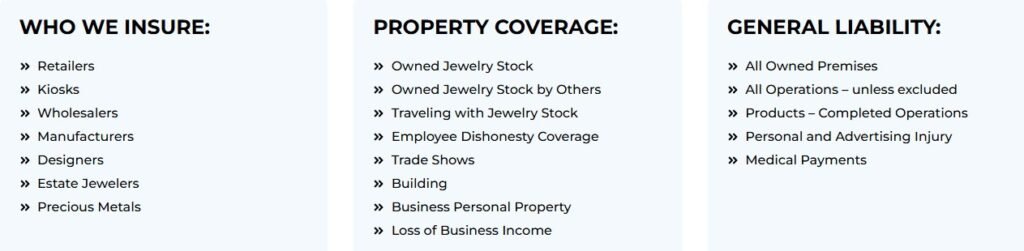
The only real solution is a dedicated insurance policy designed for these exact risks. A comprehensive Jewelers Block insurance policy from an expert like First Class Insurance is built to protect your inventory wherever it is—in your store, in transit, or locked away in a bank vault.
Don't let a simple misunderstanding threaten the business you've built. Get a Quote for Jewelers Block and close this dangerous gap for good.
What Banks Actually Cover—And What They Don’t
It’s one of the most dangerous myths in asset protection: the idea that if something goes wrong at your bank, its insurance will make you whole. People assume the vault is an extension of the bank’s protection. It’s not.
The hard truth is that banks have almost zero liability for the contents of your safe deposit box. Their insurance is there to protect their property—the building, the vault door, their cash—not the precious metals or irreplaceable jewelry you’ve stored inside. This is exactly why specialized safe deposit box insurance coverage isn't just a good idea; it's absolutely essential.
When A Bank Might Be on the Hook
There are only a handful of extreme situations where a bank could be held responsible for your loss, and they all fall under a legal concept called proven gross negligence. This isn't about simple mistakes; it’s a very high bar to clear.
You would have to legally prove that the bank failed to provide a "reasonable standard of care" and that this specific failure directly caused your loss. Think of scenarios like:
- Employees handing your box key over to an unauthorized person.
- Management knowing about a major security flaw in the vault and doing nothing to fix it.
- A documented screw-up, like the bank drilling your box by mistake and losing the contents.
Even if one of these rare events happens, you’re in for an expensive, uphill legal fight. You’d need airtight proof of the bank's negligence and indisputable proof of exactly what was in the box and its value. Good luck with that.
The Real Risks Your Bank Won't Cover
The vast majority of threats that could wipe out your inventory are simply not the bank's problem. Dig into your rental agreement, and you’ll find clauses that legally absolve them from responsibility for events far beyond their control.
Let’s be blunt: If a fire, flood, hurricane, or any other natural disaster takes out the bank branch, the contents of your safe deposit box are your loss. Full stop. The bank is under no obligation to pay you a dime.
The same goes for sophisticated theft. If a skilled crew bypasses the bank's security systems and cleans out the vault, the bank is generally not liable unless you can prove their security was negligently weak. Other risks, like "mysterious disappearance"—where an item is just gone with no clear explanation—are also your burden to bear.
For a jeweler storing five-figure inventory pieces in that box, these coverage gaps aren't just risks; they’re a massive financial vulnerability. This is precisely the scenario that policies like insurance for a jewelry store, specifically a Jewelers Block policy, are designed to solve.
Bank Liability vs. Your Responsibility
To really understand the gap, you need to see where the bank’s responsibility ends and yours begins. Relying on the bank’s safety net is a recipe for disaster because it was never designed for you in the first place.
Here’s a clear breakdown of what’s covered by whom:
| Coverage Type | What It Protects | Covered Perils | What It Excludes |
|---|---|---|---|
| FDIC Insurance | Your cash deposits in accounts like checking and savings (up to $250,000). | Bank failure. | Physical assets. This means your jewelry, gold, gemstones, important papers, or anything else in a safe deposit box. |
| Bank's Building Insurance | The bank’s own physical property (the building, vault, equipment). | Fire, structural damage, liability for slip-and-falls on their property. | The contents of your safe deposit box. Your property is explicitly not their property. |
| Jewelers Block Insurance | Your entire inventory, whether it's in your store, in transit, or in a safe deposit box. | Theft, fire, flood, natural disasters, mysterious disappearance, accidental damage. | Varies by policy, but it’s designed from the ground up to protect high-value, portable inventory. |
The takeaway here is crystal clear: the only reliable financial shield for the assets you store in a safe deposit box is the insurance you buy yourself.
Whether you need a comprehensive jewelry store insurance policy or specific coverage for a private collection, relying on the bank is not a viable risk management strategy. For a confidential review of your needs and to get a quote, contact the experts at First Class Insurance Jewelers Block Agency.
Why Your Standard Insurance Policies Fall Short
Relying on a standard insurance policy for the high-value assets in your safe deposit box is a huge mistake. It’s like trying to haul a ton of bricks in a family minivan—it simply wasn’t built for that kind of load. Your homeowners, renters, or even a general business liability policy offers a false sense of security, packed with limitations that leave your most valuable inventory dangerously exposed.
The problem is that these standard policies are designed for everyday risks, not the concentrated value a jeweler deals with. Think about it: the average homeowners policy often slaps a strict sub-limit on jewelry theft, frequently capping coverage at just $1,500. For a jewelry professional storing even a single high-end piece in a bank vault, that's essentially zero coverage.
These policies also get very picky about where a loss happens. Many have an "off-premises" clause that severely limits or completely excludes coverage for property stored away from your main insured location. A bank vault is the textbook definition of an off-premises location, creating a massive blind spot in your protection.
The Mysterious Disappearance Dilemma
One of the biggest anxieties for any jeweler is the risk of mysterious disappearance. This is the gut-wrenching moment you realize an item is gone, but there’s no clear evidence of what happened. No broken locks, no security footage—it just vanished. Maybe an employee misplaced a ring, or a diamond disappeared somewhere between your shop and the bank.
Standard insurance policies almost never cover mysterious disappearance. They are written to cover "named perils"—specific, provable events like a fire, an explosion, or a forced-entry burglary. Without solid proof of a covered event, your claim will be denied, and you’ll be left to eat the entire loss. For a business built on small, high-value, portable items, this single exclusion is a catastrophic risk.
This chart really breaks down where the responsibility lies when it comes to the contents of your safe deposit box.
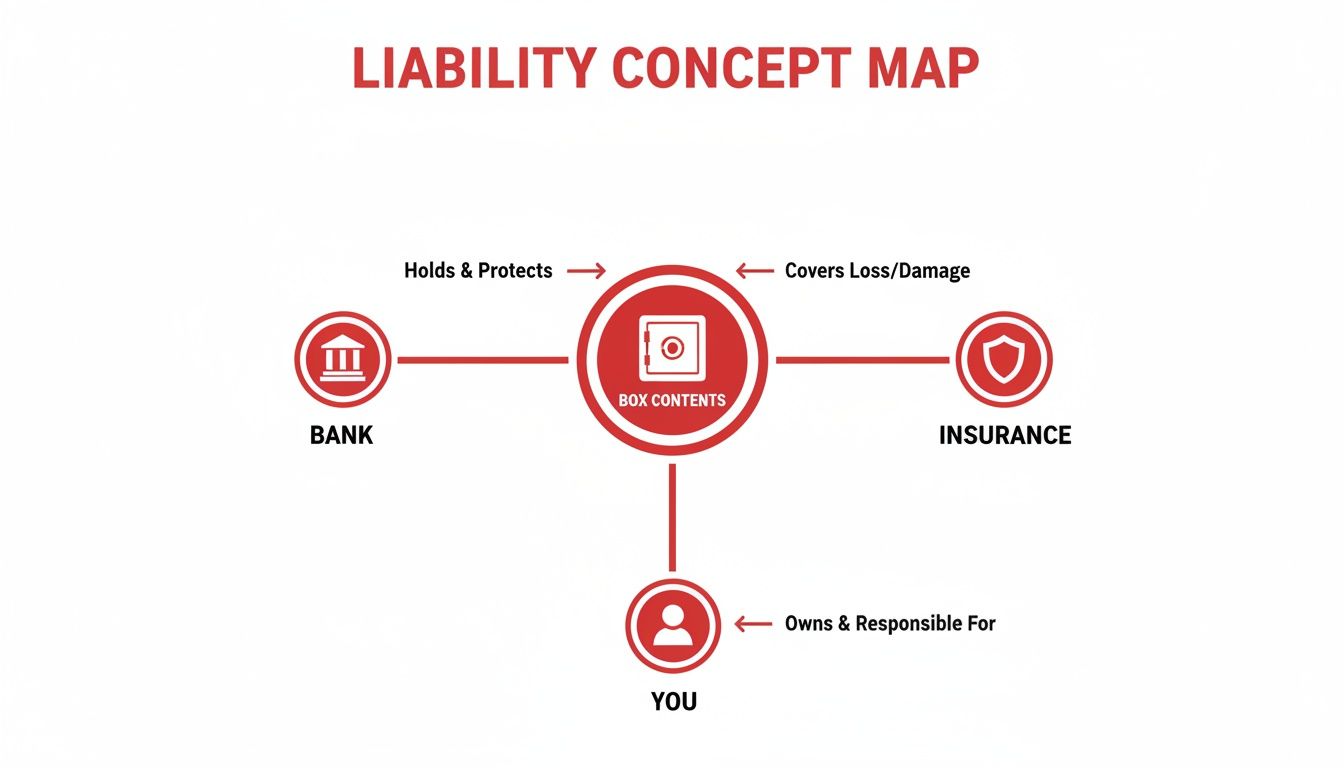
As you can see, while you and the bank share the physical space, the financial responsibility for what's inside falls squarely on you and your insurer.
The Right Tool for The Job
The shortcomings of standard policies make it crystal clear why specialized insurance for a jewelry business isn’t a luxury—it’s an absolute necessity. A dedicated Jewelers Block insurance policy is built from the ground up to handle these exact risks. It’s designed to provide "wall-to-wall" coverage for your inventory, no matter where it is: in your showcase, in transit, or locked away in a bank vault. You might also want to read our detailed guide on protecting valuable antique jewelry.

A standard policy protects a home full of varied, lower-value items. A Jewelers Block policy protects a concentrated inventory of unique, high-value assets against industry-specific risks like mysterious disappearance. The difference is fundamental.
Trying to protect your business with a generic policy is like betting against the very risks most likely to hit your industry. To get real peace of mind, you need a policy engineered for the unique world of the jewelry trade. At First Class Insurance Jewelers Block Agency, that's exactly what we do. We make sure your insurance for a jewelry store has no dangerous gaps.
Specialized Insurance Solutions For Jewelers and Collectors
Once you realize the huge gaps left by both bank liability and your standard insurance policies, the need for a real solution becomes crystal clear. For professionals in the jewelry trade or serious private collectors, protecting high-value assets in a safe deposit box demands a policy built for their world. This is exactly where Jewelers Block insurance comes in.
Unlike a generic policy riddled with exclusions and tiny limits, a Jewelers Block policy is designed from the ground up to cover your entire inventory. It's like a protective bubble that follows your assets wherever they go. This “wall-to-wall” or “all-risk” coverage is its most powerful feature, giving you seamless financial protection whether a piece is in your showcase, on its way to a client, or locked away in a bank vault. This kind of comprehensive insurance for a jewelry store is the gold standard, period.
The Power of Jewelers Block Insurance
A properly structured Jewelers Block policy directly confronts the risks that keep jewelers up at night. It’s built to cover perils like theft, fire, natural disasters, and even that frustrating threat of mysterious disappearance—all things that standard policies and bank agreements won't even consider.
This specialized approach means your safe deposit box insurance coverage isn't just a footnote; it's a core part of your risk management strategy. It understands that storing items off-site is a normal part of doing business. Because of this, a Jewelers Block policy extends its robust protection to those assets without the usual off-premises handcuffs. Here at First Class Insurance Jewelers Block Agency, we make sure that coverage is ironclad.
For a jeweler, inventory is the lifeblood of the business. Jewelers Block insurance acts as the ultimate safeguard, ensuring that a catastrophe at a third-party location like a bank does not become a catastrophic business failure.
This type of dedicated insurance for jewelry business owners delivers genuine peace of mind. It turns a bank vault from a potential liability black hole back into the secure, strategic asset it’s supposed to be.
Navigating a Shifting Security Landscape
The need for solid, independent insurance is getting more urgent every day. While the global safe deposit box market is expected to grow from USD 9.08 billion in 2025 to USD 11.82 billion by 2030, a strange thing is happening on the ground. Many major banks across North America and Europe are actually getting out of the safe deposit box business, creating a real scarcity of secure options. You can read the full research on the safe deposit box market to get a handle on this shift. This trend makes having your own dedicated insurance more critical than ever.
Options For High-Net-Worth Collectors
Private collectors also need specialized protection. While they don't need a full commercial jewelry store insurance policy, a standard homeowners policy is just as useless for their needs. The best options for individuals are a bit different:
- Scheduled Personal Property Floaters: This is an add-on to your homeowners or renters policy. It lets you list, or "schedule," individual high-value items—like an engagement ring, a luxury watch, or a rare gem—insuring them for their full appraised value against a wide range of risks.
- Valuable Articles Policies: For bigger collections, a standalone valuable articles policy offers even broader, dedicated coverage. These are made specifically for assets like fine art, antiques, and, of course, jewelry collections.
For high-net-worth individuals, protecting one-of-a-kind assets is everything. It all starts with knowing what you have, whether it’s fine jewelry or even understanding the world's rarest rocks. This is the level of expert coverage provided by trusted underwriters like those at 
Whether you're a business owner or a private collector, the message is the same: you cannot outsource the financial protection of your most valuable assets. You need a dedicated insurance partner to build a policy that closes every single gap. Don't wait for a disaster to show you where you're vulnerable. Get a Quote for Jewelers Block insurance today and secure your assets with the specialized coverage they truly demand.
How To Document Your Assets For Proper Coverage
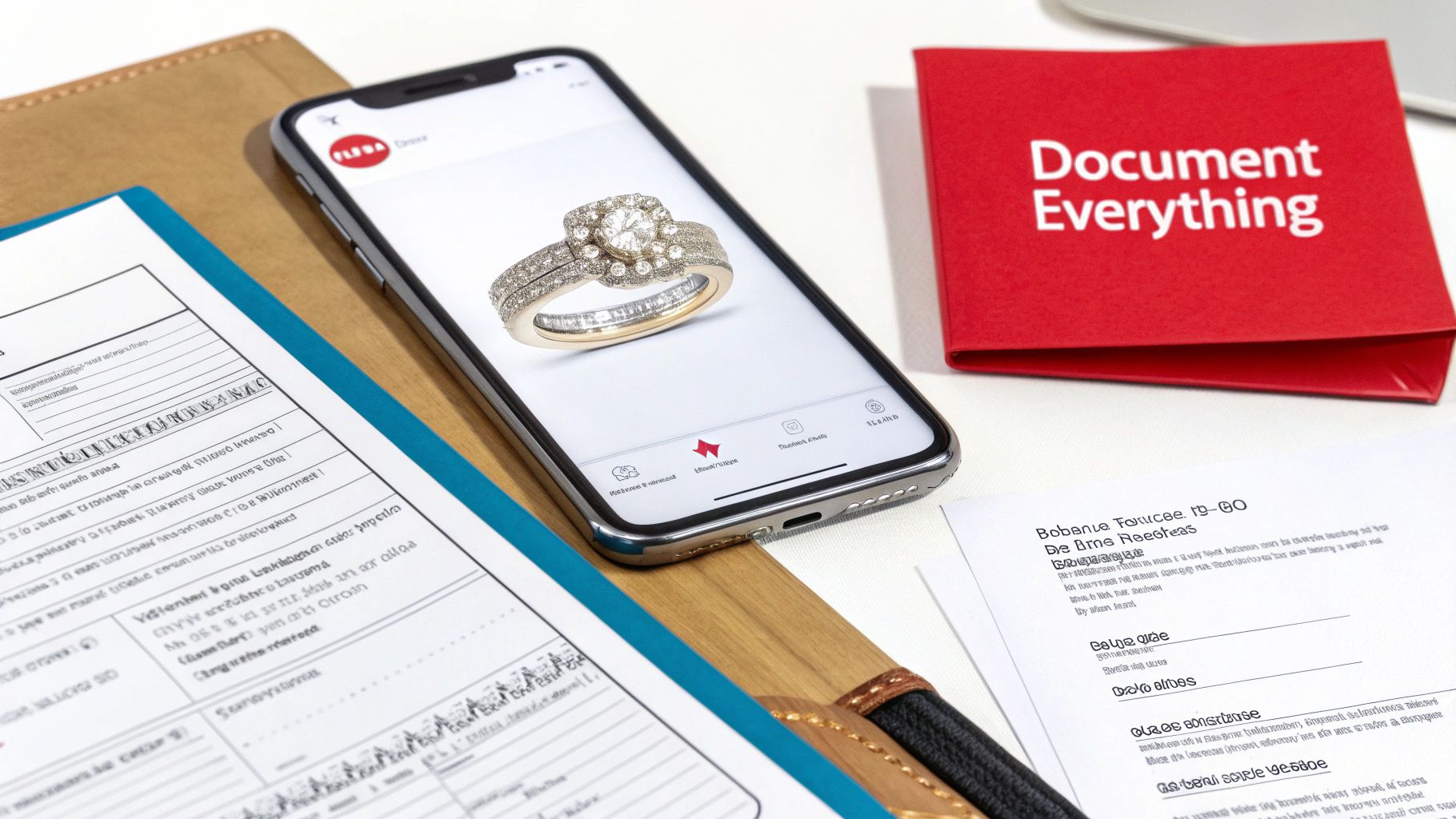
Getting the right safe deposit box insurance coverage is a great first step, but it’s only half the battle. If you ever have to make a claim, your success will ride entirely on the quality of your documentation. Without it, you’re left trying to prove the value of things that are already gone—an uphill climb, to say the least.
In the insurance world, we live by a simple rule: “proof of ownership and existence.” It’s not complicated, but it’s non-negotiable. You have to prove two things: first, that you legally owned the item, and second, that it was actually in the box when the loss occurred. Just your word isn't enough; you need a rock-solid paper trail.
Think of your records as the evidence you’d present in court. The more organized and detailed they are, the faster and smoother the claims process will be. For any jewelry business, this isn't just a "best practice." It's a fundamental part of staying in business.
Building Your Documentation Arsenal
Your best defense is meticulous, almost obsessive, record-keeping. The goal is to build a complete history for every single high-value piece you store off-site, leaving zero room for questions or doubt.
Your file for each item should include a mix of these essentials:
Recent Appraisals: This is your MVP. A current appraisal from a certified professional establishes an item’s replacement value, which is what your insurance coverage is based on. To get this right, especially for older pieces, you'll need a professional vintage jewelry appraisal.
Original Purchase Receipts: Invoices are undeniable proof of ownership. They show exactly when and where you got the piece and what you paid for it.
High-Resolution Photos and Videos: A picture is worth a thousand words, and in a claim, it might be worth thousands of dollars. Take crystal-clear photos from multiple angles, making sure to capture any identifying marks, stamps, or unique features. A short video clip can be even more powerful.
Certificates of Authenticity: For gemstones, this means GIA, AGS, or other lab reports. For high-end watches, it's the original box and papers. To see what a well-documented piece looks like, check out our guide on documenting diamond rings for insurance.

Maintaining a Living Inventory
Here’s the thing: documentation isn't a one-and-done chore you can check off a list. It needs to be a living, breathing system that you update constantly. A master inventory list is the backbone of this whole process.
An outdated inventory is nearly as dangerous as having no inventory at all. An appraisal from five years ago might undervalue an item by 30% or more, leaving you critically underinsured and facing a huge financial gap if you file a claim.
Use a simple spreadsheet or dedicated inventory software to track every item that goes into your safe deposit box. Each entry needs a description, serial number, appraisal value, and the date it was placed in or taken out of the box. This creates a clear, clean timeline that proves an item's existence when it matters most.
When you treat your documentation with this level of seriousness, your insurance policy transforms from a piece of paper into a powerful recovery tool. This proactive mindset is the hallmark of a smart jewelry store insurance program and is absolutely essential for protecting your assets—and your peace of mind.
Navigating The Claims Process After A Loss
That sinking feeling when you realize something is missing from your safe deposit box is a tough moment for anyone. It's stressful, chaotic, and easy to feel overwhelmed. But if you have the right safe deposit box insurance coverage, you're not facing it alone. The key is to follow a clear, methodical plan to get the financial recovery process started with confidence.
Your first two calls are the most important, and they need to happen right away. First, get the bank manager on the phone and report the loss. Immediately after, contact local law enforcement to file an official police report. That report is a non-negotiable piece of the puzzle—it creates the official record of the incident that your insurance claim will be built upon.
Taking The First Steps With Your Insurer
With a police report number in hand, your next call is to your insurance provider, like First Class Insurance Jewelers Block Agency. Don't wait. The faster you get the ball rolling, the better. Your insurer will connect you with a claims adjuster, who becomes your primary contact and will walk you through everything you need to do.
This is the moment where all that meticulous record-keeping we talked about earlier really pays off. It becomes your most powerful tool. The adjuster is going to ask for your complete file, including:
- The detailed inventory list of what was in the box.
- Recent appraisals and original purchase receipts.
- High-resolution photos and any videos of the items.
- Copies of GIA certificates or other proofs of authenticity.
Handing over a complete, organized package right from the start sends a clear signal that your claim is legitimate and seriously speeds up the entire review process.
The Investigation and Resolution Phase
The claims adjuster’s job is to dig into the details of the loss and verify the value of your missing items against your policy. They’ll review the police report, go through all your documentation, and cross-reference it with the bank’s version of events. You can expect them to ask follow-up questions to make sure every detail is buttoned up.
A well-documented claim is a strong claim. Your goal is to leave no room for doubt about what you owned and what was lost. This transforms a chaotic event into a clear, manageable process. Your insurer is your partner in this, working to validate your loss and get you the settlement you're entitled to under your policy.
Stay in touch with your adjuster throughout this period and be ready to respond quickly to any requests. Think of it as a partnership—the more you work together, the faster you’ll move toward a fair and efficient resolution.
For a business like a jewelry store, insurance isn't just a policy; it's a lifeline in a crisis. Having a specialist in insurance for a jewelry business means you have an expert in your corner, guiding you through the storm so you can recover the loss and get back to business.
Frequently Asked Questions
When it comes to safe deposit box insurance coverage, a lot of questions pop up, especially for those of us in the jewelry business. Getting straight answers is the only way to know your high-value assets are actually protected. Here’s a rundown of what jewelry professionals ask us most often.
Does Jewelers Block Insurance Cover Items In A Safe Deposit Box?
Yes, almost always. A solid Jewelers Block insurance policy is built to provide "all-risk" protection for your inventory, no matter where it is. That means your assets should be covered whether they're in your showcase, in transit, or locked away in a bank vault.
But you can't just assume it's covered. You have to read the fine print of your specific policy. Some carriers might set lower limits for off-site locations or require you to declare the vault's address and the total value you're storing there. At First Class Insurance Jewelers Block Agency, we make it a point to walk through your entire operation—including your use of safe deposit boxes—to make sure there are absolutely no gaps in your coverage.
How Much Does This Insurance Coverage Cost?
This isn’t a separate policy you buy on its own; it’s a built-in feature of your broader insurance for a jewelry store. The final premium for your Jewelers Block policy depends on a handful of key factors.
We're looking at things like:
- The total value of your insured inventory.
- The security systems at the bank you're using.
- Your business's claim history over the years.
- The deductible you're comfortable with.
For any jeweler, this cost is simply part of the premium for their insurance for jewelry business policy. When you weigh that cost against the risk of losing everything in a single event, it becomes a minor and essential expense. The only way to know the real cost for your business is to get a quote based on your specific situation.
The investment in proper insurance is minimal compared to the devastating financial impact of an uninsured loss. It shifts the risk from your balance sheet to the insurer's, providing critical stability for your business.
What If The Bank Is Destroyed By A Natural Disaster?
This is exactly why you need your own insurance. A bank's policy is there to protect the bank's property—the building itself, its computers, its cash in the teller drawers—not what you’ve stored in your private box.
Dig out your rental agreement, and you’ll almost certainly find a clause that releases the bank from liability for "Acts of God" like floods, fires, hurricanes, or earthquakes. If a disaster strikes, you would be looking at a total, unrecoverable loss without your own policy. A specialized jewelry store insurance policy, however, is designed specifically to cover these kinds of catastrophic events, protecting your inventory no matter what happens to the building it's in.
Do I Get A Discount For Using A Safe Deposit Box?
Years ago, underwriters would almost always give you a premium credit for stashing high-value inventory in a bank vault. It was seen as the gold standard for risk management. But as more and more banks have scaled back or even eliminated these services, the insurance market has had to adapt.
While using a vault is still seen as a major security positive, underwriters today often give just as much, if not more, weight to the security you have at your own business location. They’re looking at your UL-rated safes, your alarm and camera systems, and your day-to-day procedures. The best way to make sure you’re getting every credit you deserve is to have an in-depth conversation with your agent about your entire security setup.
Protecting your inventory is the foundation of your business. Don't leave its security to chance or rely on the false promises of a bank's liability. The experts at First Class Insurance can build a policy that closes every gap and provides true peace of mind. Get a Quote for Jewelers Block today to secure your assets with the specialized coverage they demand.